NEP 2020 PDF: Your Complete Guide to India's National Education Policy
The National Education Policy 2020 is the most transformative education reform India has seen in nearly three decades. Whether you're a student, parent, teacher, or school administrator, understanding the policy is essential — and it all starts with reading the official NEP 2020 PDF.
In this comprehensive guide, we'll share the direct link to download the NEP 2020 PDF, break down its most important highlights, explain what NEP 2020 implementation in schools actually looks like, and show you how platforms like SPYRAL are making it easy for schools to go NEP-ready.
Where to Download the Official NEP 2020 PDF
The full text of the National Education Policy 2020 was approved by the Union Cabinet on 29 July 2020. The official PDF document is available for free from the Ministry of Education, Government of India.
- Official Source: Download NEP 2020 PDF from education.gov.in
- Document Length: Approximately 66 pages
- Languages Available: English, Hindi, and several regional languages
We strongly recommend downloading the NEP 2020 PDF directly from the government website to ensure you have the authentic, unaltered version of the policy document.
Key Highlights of the National Education Policy 2020
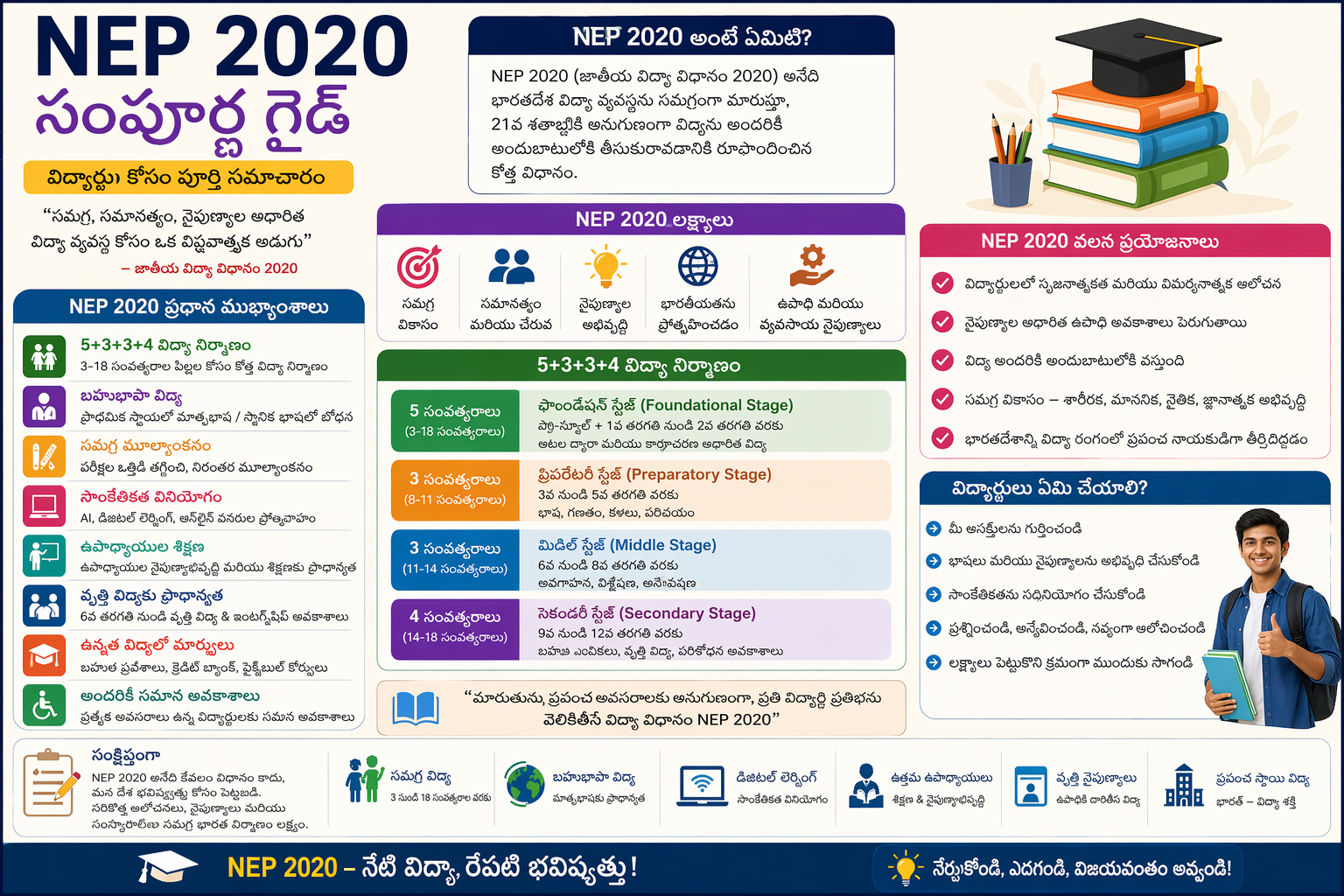
The NEP 2020 replaces the 34-year-old National Policy on Education (1986) and introduces sweeping changes across every stage of education. Here are the most important reforms outlined in the document:
1. New 5+3+3+4 School Structure
The policy replaces the traditional 10+2 system with a 5+3+3+4 curricular structure covering ages 3 to 18. This includes a Foundational Stage (ages 3–8), Preparatory Stage (ages 8–11), Middle Stage (ages 11–14), and Secondary Stage (ages 14–18). This restructuring is a core theme of NEP 2020 implementation in schools.
2. Competency-Based Learning
One of the biggest shifts in NEP 2020 is the move away from rote memorization toward competency-based, experiential, and multidisciplinary learning. Students will be assessed on what they can do, not just what they can recall.
3. Multidisciplinary & Flexible Curriculum
The rigid separation between arts, science, and commerce streams is eliminated. Students in Classes 9–12 can choose subjects across disciplines — for example, combining physics with music or mathematics with political science.
4. Technology & AI Integration
The NEP 2020 PDF dedicates an entire section to technology in education, recommending the use of AI, machine learning, and digital tools to personalize learning, improve assessment quality, and bridge access gaps. This is where platforms like SPYRAL play a crucial role. Explore SPYRAL's AI & Coding Workbench for CBSE students to see NEP-aligned technology in action.
5. Reformed Assessment Framework
Board exams will be restructured to test core competencies rather than encourage coaching-driven rote learning. Continuous and comprehensive evaluation, portfolio-based assessments, and formative testing are key recommendations in the policy.
6. Coding & Experiential Learning from Class 6
The policy recommends introducing coding, computational thinking, and hands-on experiential learning from Class 6 onwards. Schools are expected to create lab-based environments where students learn by doing — building projects, solving real-world problems, and developing 21st-century skills.
What Does NEP 2020 Implementation in Schools Actually Look Like?
Reading the NEP 2020 PDF is one thing; putting it into practice is another. Many schools across India are struggling with the practical aspects of implementation. Here's what effective NEP 2020 implementation involves:
- Curriculum redesign to support multidisciplinary, competency-based learning outcomes
- Teacher training for new pedagogical approaches and technology integration
- Digital infrastructure including AI-powered learning platforms and assessment tools
- Lab setups for coding, robotics, drone technology, and experiential learning
- Continuous assessment systems that go beyond traditional pen-and-paper exams
This is precisely where a purpose-built NEP school platform becomes essential. Rather than stitching together multiple disconnected tools, schools need an integrated solution designed from the ground up for NEP compliance.
SPYRAL: The NEP Lab for Schools
SPYRAL is an AI-powered education platform built specifically for Indian schools and students. It functions as a comprehensive NEP lab for schools, providing everything educators need to bring the National Education Policy 2020 to life in their classrooms.
How SPYRAL Aligns with NEP 2020
- AI-Powered Personalized Learning: SPYRAL uses artificial intelligence to adapt content and assessments to each student's learning level and pace — exactly as the NEP 2020 envisions. Access the student dashboard to experience personalized learning pathways.
- Competency-Based Assessments: Move beyond rote testing with SPYRAL's NEP-aligned evaluation tools that measure understanding, application, and critical thinking.
- Coding, Robotics & Drone Workbench: SPYRAL provides hands-on digital labs for coding and robotics — fulfilling the NEP's mandate for experiential learning from Class 6 onwards.
- UPSC & Higher-Order Thinking: For senior students and UPSC aspirants, SPYRAL's UPSC Answer Writing Lab develops analytical writing and structured thinking skills aligned with NEP's emphasis on higher-order competencies.
- School Integration via API: Schools can integrate SPYRAL into their existing systems using the developer API, making adoption seamless and scalable.
Explore SPYRAL's full NEP 2020 Learning Platform to see how your school can become fully NEP-ready.
Why Every Educator Should Read the NEP 2020 PDF
The NEP 2020 PDF is not just a policy document — it's a roadmap for the future of Indian education. Whether you're a principal planning curriculum changes, a teacher adapting your pedagogy, or a parent trying to understand what's changing for your child, reading the original document gives you clarity that no summary can replace.
Here's what we recommend:
- Step 1: Download and read the official NEP 2020 PDF from the link above
- Step 2: Identify the reforms most relevant to your role (student, teacher, administrator)
- Step 3: Explore implementation tools like SPYRAL's NEP platform to turn policy into practice
Frequently Asked Questions (FAQ)
1. Where can I download the NEP 2020 PDF for free?
You can download the official NEP 2020 PDF for free from the Ministry of Education website at education.gov.in. The document is available in English, Hindi, and several regional languages. It is approximately 66 pages long and covers all aspects of the National Education Policy 2020.
2. What are the main changes introduced by the National Education Policy 2020?
The National Education Policy 2020 introduces a new 5+3+3+4 school structure, competency-based learning, multidisciplinary curriculum flexibility, technology and AI integration in education, reformed board exams, and coding education from Class 6. It aims to make Indian education more holistic, flexible, and aligned with 21st-century needs.
3. How can schools implement NEP 2020 effectively?
NEP 2020 implementation in schools requires curriculum redesign, teacher training, digital infrastructure, and new assessment systems. Schools can accelerate this process by adopting a dedicated NEP school platform like SPYRAL, which provides AI-powered personalized learning, competency-based assessments, and experiential learning labs — all aligned with NEP guidelines.
4. What is a NEP lab for schools?
A NEP lab for schools is a technology-enabled learning environment that supports the experiential, competency-based, and multidisciplinary learning recommended by NEP 2020. SPYRAL serves as a digital NEP lab, offering coding workbenches, AI-powered assessments, robotics projects, and personalized learning pathways that schools can deploy immediately.
5. Is the NEP 2020 applicable to CBSE and state board schools?
Yes. The NEP 2020 is a national framework that applies to all schools across India, including CBSE, ICSE, and state board institutions. CBSE has already begun aligning its curriculum and assessment patterns with NEP recommendations. Schools affiliated with any board should begin preparing for full implementation.