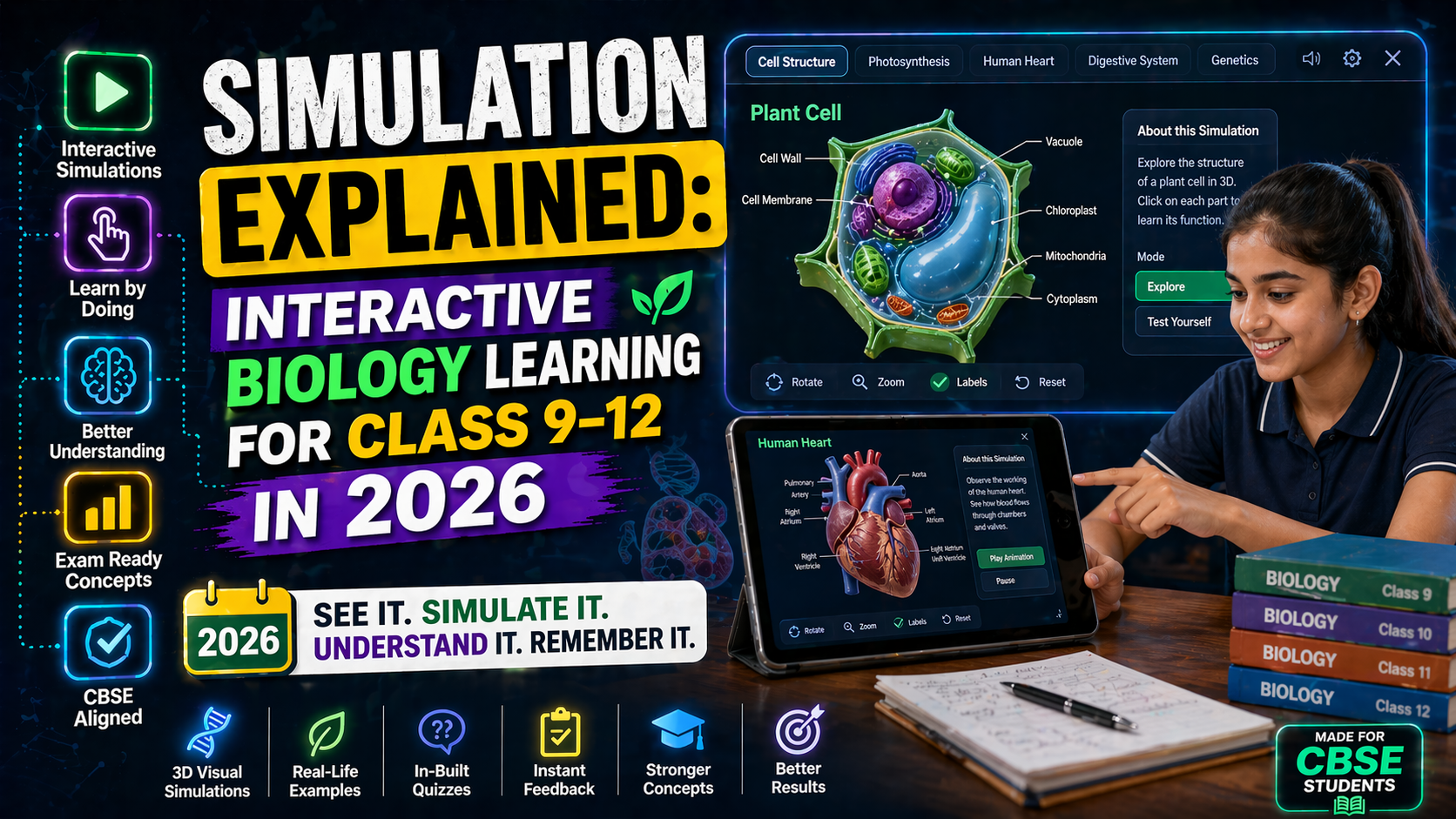
Struggling to visualize the heart diagram class 11 biology? You’re not alone—static diagrams in textbooks can’t show you how blood flows through chambers or how valves work in real time. What if you could *see* the heart beat, pulse, and respond to changes—just like in a real lab? With AI-powered interactive simulations, you don’t just memorize the heart diagram class 11 biology; you *discover* it. Let’s dive into how these tools make human anatomy click for CBSE/NEP 2020 students.
Why This Matters: The Gap Between Textbooks and Real Learning
In India’s classrooms, students spend hours memorizing heart diagram class 11 biology from NCERT books, but many struggle to connect the dots between theory and reality. According to the National Education Policy 2020, interactive learning is now a priority to bridge this gap. Yet, traditional labs are expensive, and static images fall short of engaging students—especially those preparing for NEET or JEE exams. That’s where AI-powered simulations step in: they turn abstract concepts like the heart diagram class 11 biology into *experiential* learning. Imagine manipulating a 3D heart, watching blood flow through valves, and even simulating diseases—all in seconds. This isn’t just about passing exams; it’s about *understanding* how the heart works.
For teachers, this means no more explaining the same heart diagram class 11 biology repeatedly. With AI, you can assign interactive labs where students explore mitosis and meiosis where does it occur in cells or how the heart adapts to exercise—all while tracking progress in real time. It’s learning that feels *real*.
Where Does the Heart Fit in Class 11 Biology?
The human circulatory system is a cornerstone of Class 11 biology, and the heart is its powerhouse. The heart diagram class 11 biology typically covers:
- Anatomy: Chambers (atria/ventricles), valves (tricuspid/bicuspid/aortic/pulmonary), and major vessels (aorta, vena cava).
- Physiology: How the heart pumps blood (systole/diastole), the role of the sinoatrial node (SA node), and how oxygenated/deoxygenated blood circulate.
- Pathology: Common disorders like arrhythmias, valve diseases, and how they disrupt the heart diagram class 11 biology.
But textbooks can’t show you *why* the tricuspid valve closes during systole or how exercise increases heart rate. Interactive simulations fill that gap by letting you:
- Zoom into the heart’s chambers to see blood flow.
- Adjust heart rate and observe how valves respond.
- Simulate conditions like hypertension or valve stenosis.
Why Static Diagrams Fail (And How Simulations Succeed)
Static heart diagram class 11 biology images are limited:
- No interactivity: You can’t click to see how blood moves through the aorta.
- No variables: You can’t test “what if” scenarios like “What happens if the mitral valve leaks?”
- No context: You don’t see how the heart connects to the lungs or body.
Simulations fix this by letting you:
- Drag and label parts of the heart diagram class 11 biology in 3D.
- Adjust parameters (e.g., heart rate, blood pressure) and watch effects.
- Compare healthy vs. diseased states side by side.
Mitosis and Meiosis Where Does It Occur? — A Hidden Link to the Heart
While the heart diagram class 11 biology focuses on the circulatory system, understanding mitosis and meiosis where does it occur is critical for grasping how the heart (and all tissues) regenerates and repairs itself. For example:
- Mitosis occurs in the heart’s endocardium (inner lining) and smooth muscle cells, helping repair damaged tissue after a heart attack.
- Meiosis isn’t directly involved in the heart, but it’s essential for understanding how stem cells (which *can* repair heart tissue) are generated in the body.
Interactive simulations can show you:
- Cell division in the heart’s endothelial cells (using mitosis and meiosis where does it occur visuals).
- How damaged heart muscle (myocardium) triggers repair mechanisms.
- A comparison of healthy vs. scarred heart tissue post-infarction.
Why This Matters for NEET/JEE Aspirants
Exams like NEET and JEE test *application*, not rote memorization. Questions often ask:
- “Explain how a leaky mitral valve affects blood flow in the heart diagram class 11 biology.”
- “Describe the role of mitosis in cardiac muscle repair.”
- “How does exercise increase cardiac output? Use a heart diagram class 11 biology to explain.”
Simulations help you *visualize* these answers, making them stick. For example, you can:
- Simulate mitral valve prolapse and see how it disrupts left atrial pressure.
- Model how endurance training thickens the myocardium (via hypertrophy).
- Explore how mitosis and meiosis where does it occur in stem cells could lead to future heart regeneration therapies.
Try It Live: The Heart Diagram Class 11 Biology Simulation
Try This Simulation Free
Open the interactive simulation on anAIza School — no download, no signup needed.
Open Simulation →Click to explore the heart diagram class 11 biology in 3D. Adjust heart rate, block valves, or simulate diseases—see how the system responds in real time.