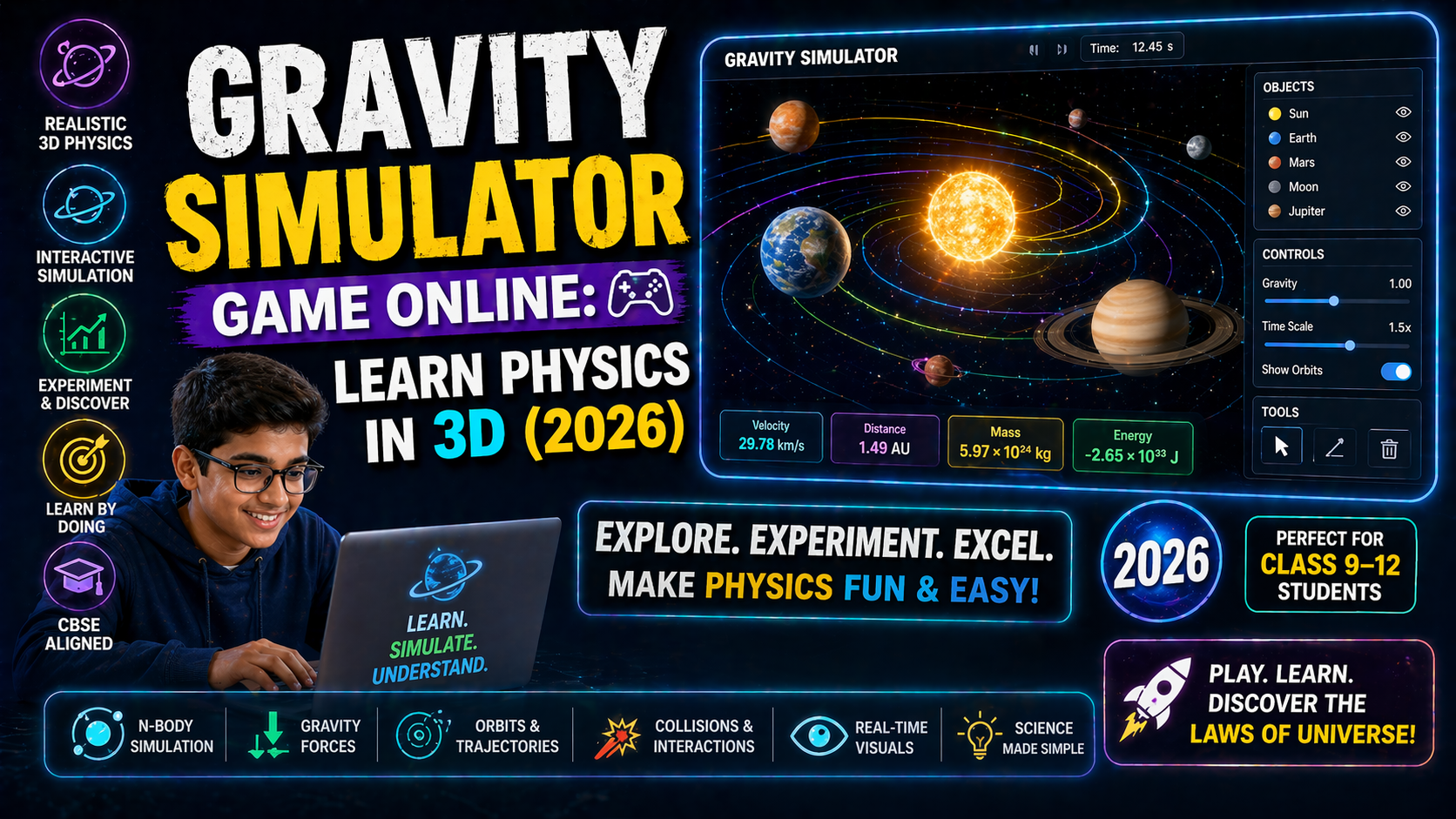
Friction is one of the most fundamental yet often misunderstood concepts in CBSE Physics for Classes 9–12. It’s not just a force that opposes motion—it’s a key player in everything from walking to rocket launches. In 2026, with NEP 2020 emphasizing experiential learning, understanding friction through interactive simulations is no longer optional—it’s essential. Whether you're a student preparing for board exams or a teacher looking to make physics engaging, AI-powered tools like SPYRAL AI Workbench are transforming how we learn about forces and motion.
In this guide, we’ll explore friction through the lens of CBSE syllabus requirements, simulate real-world scenarios, and show you how to use free online tools to visualize and master this concept—just as the NEP 2020 intends.
Why Friction Matters in CBSE Physics (Class 9–12)
Friction is a contact force that arises when two surfaces interact. In the CBSE Physics curriculum, it’s covered under:
- Class 9: Force and Laws of Motion (Chapter 9) – Types of friction, factors affecting it
- Class 11: Laws of Motion (Chapter 5) – Friction as a real-world force, coefficient of friction
- Class 12: Current Electricity (Chapter 3) – Friction in electrical contacts; Dual Nature of Radiation (Chapter 11) – Frictional forces in quantum contexts
Understanding friction isn’t just about memorizing formulas like f = μN. It’s about seeing how friction affects motion, energy loss, and even technological design—like why cars have anti-lock brakes or how athletes reduce drag.
With NEP 2020 pushing for competency-based learning, students must not only know the theory—they must apply it. That’s where simulations come in.
How to Simulate Friction: Interactive CBSE Physics Labs in 2026
Traditional labs use wooden blocks and spring balances to measure friction. While effective, they’re limited by time, cost, and scalability. AI-powered physics simulations solve these challenges by letting you:
- Change surface materials (wood, ice, rubber)
- Adjust normal force and angle of inclination
- Visualize friction force vs. applied force graphs
- Repeat experiments instantly with different parameters
These tools are fully aligned with NEP 2020’s emphasis on experiential learning and are now available for free on platforms like SPYRAL AI Workbench — Physics Simulations.
Example: Simulating Static vs. Kinetic Friction
Let’s say you’re studying for your Class 11 Physics exam. You need to understand why a book stays on a tilted table until a certain angle. With a friction simulator, you can:
- Set the surface to "wood on wood"
- Apply a gradual incline
- Watch the friction force increase until it matches the component of gravity pulling the book down
- See the exact angle where motion begins (this is the angle of repose)
This isn’t just watching—it’s interactive learning. You control the variables, see real-time graphs, and even export data for analysis—exactly what NEP 2020 encourages.
Try It Yourself: Friction Simulator Features
- Surface Library: Choose from wood, glass, ice, rubber, and more
- Force Graphs: Plot applied force vs. friction force in real time
- Energy Loss Calculator: See how much energy is lost to heat due to friction
- 3D View: Rotate and zoom to see forces in action
- NEP-Aligned Assessments: Get instant feedback on your understanding
These features are now available for free on SPYRAL AI Workbench, with no signup required for guest access.
Friction in Real-World CBSE Exam Questions (2026 Pattern)
CBSE exams increasingly test conceptual clarity through application-based questions. Here are some friction-related problems you might face in 2026:
Sample Question 1 (Class 9):
Q: A block of mass 2 kg is placed on a horizontal surface. The coefficient of static friction is 0.4. What is the maximum force that can be applied without moving the block?
Solution:
Maximum static friction: f_max = μ × N = 0.4 × (2 kg × 9.8 m/s²) = 7.84 N
You can simulate this exact scenario on SPYRAL’s Physics Workbench and see the force graph as you increase the applied force.
Sample Question 2 (Class 11):
Q: A car of mass 1000 kg is moving at 20 m/s. The coefficient of kinetic friction between the tires and road is 0.7. How far will the car skid before coming to rest?
Solution:
Use work-energy principle: Friction force × distance = Kinetic energy
f_k = μ_k × m × g = 0.7 × 1000 × 9.8 = 6860 N
KE = ½mv² = ½ × 1000 × 400 = 200,000 J
Distance = KE / f_k = 200,000 / 6860 ≈ 29.15 m
With simulations, you can visualize the car slowing down and measure the skid distance under different friction coefficients—great for understanding the physics behind road safety.
Sample Question 3 (Class 12):
Q: Explain how friction affects the efficiency of a transformer.
Solution:
While transformers don’t have moving parts, friction in mechanical components (like cooling fans) and eddy current losses due to magnetic hysteresis are related to resistive forces—conceptually linked to friction in energy dissipation.
This shows how friction concepts appear across subjects—from mechanics to electromagnetism.
NEP 2020 & AI: The Future of Friction Learning
The National Education Policy (NEP) 2020 emphasizes:
- Experiential learning over rote memorization
- Use of technology in classrooms
- Personalized and adaptive learning
- Integration of AI and simulations
Friction simulations perfectly align with these goals. They allow students to:
- Experiment: Try different surfaces, angles, and forces
- Visualize: See abstract concepts like normal force and friction cones
- Analyze: Use real-time data to draw conclusions
- Assess: Get instant feedback on their understanding
Teachers can use these tools to:
- Demonstrate concepts in real time
- Assign virtual lab experiments
- Track student progress with AI-powered analytics
- Align lessons with NEP 2020 outcomes
Platforms like SPYRAL’s NEP-aligned tools make this possible—free and accessible to all Indian schools.
Beyond Friction: Other CBSE Physics Simulations You Can Try in 2026
Friction is just one piece of the physics puzzle. SPYRAL AI Workbench offers a full suite of simulations aligned with CBSE syllabus:
- Lens Formula Calculator: Simulate image formation in convex/concave lenses
- Waves & Optics Simulation: Visualize interference, diffraction, and polarization
- Doppler Effect Simulator: Hear and see how frequency changes with motion
- Fluid Pressure & Buoyancy Lab: Explore Archimedes’ principle in 3D
- Ohm’s Law Resistor Simulator: Build circuits and measure current-voltage relationships
Each tool is designed to make abstract concepts tangible—perfect for CBSE students preparing for board exams or competitive tests.
Try It Free on SPYRAL
Everything discussed in this article is available for free on SPYRAL AI Workbench — Physics Simulations. No signup required for guest access — just open it and start learning.
Explore SPYRAL AI Workbench — Physics Simulations →FAQs: Friction CBSE for Students & Teachers (2026)
1. What is the difference between static and kinetic friction in CBSE Physics?
Static friction acts when objects are at rest and prevents motion. Kinetic (or dynamic) friction acts when objects are in motion. Static friction is usually greater than kinetic friction. For example, it’s harder to start pushing a heavy box than to keep it moving.
2. How can I calculate the coefficient of friction from a simulation?
In a friction simulator, apply a gradually increasing force until the object just starts to move. The maximum static friction force (f_max) is equal to the applied force at that point. Then use f_max = μ × N, where N is the normal force (usually mg). Solve for μ.
3. Are friction simulations useful for JEE/NEET preparation?
Absolutely! Many JEE and NEET questions test conceptual understanding of friction in inclined planes, circular motion, and energy loss. Simulations help you visualize and solve such problems faster and with greater accuracy.
4. Can teachers use these simulations in online classes?
Yes! SPYRAL AI Workbench is designed for classroom use. Teachers can share live simulations, assign virtual labs, and even integrate them into Google Classroom or Microsoft Teams. It’s fully NEP 2020-compliant and supports hybrid learning.
5. Is there a free tool to simulate friction for CBSE Class 9–12 students?
Yes! SPYRAL AI Workbench offers a free, no-signup friction simulator with real-time graphs, 3D visualization, and NEP-aligned assessments. You can access it instantly at tryspyral.com/workbench.
Friction isn’t just a force—it’s a gateway to understanding motion, energy, and technology. With AI-powered simulations, CBSE students in 2026 can learn physics not by reading, but by doing. Whether you're preparing for boards, JEE, or just curious about how the world works, mastering friction through interactive tools is the smartest move you can make.
Ready to experience physics like never before? Start simulating friction today—free, instant, and aligned with NEP 2020.