Home›
Blog›
Electrostatics CBSE Previous Year Questions 2026: Solve & Visualize with AI Simulations
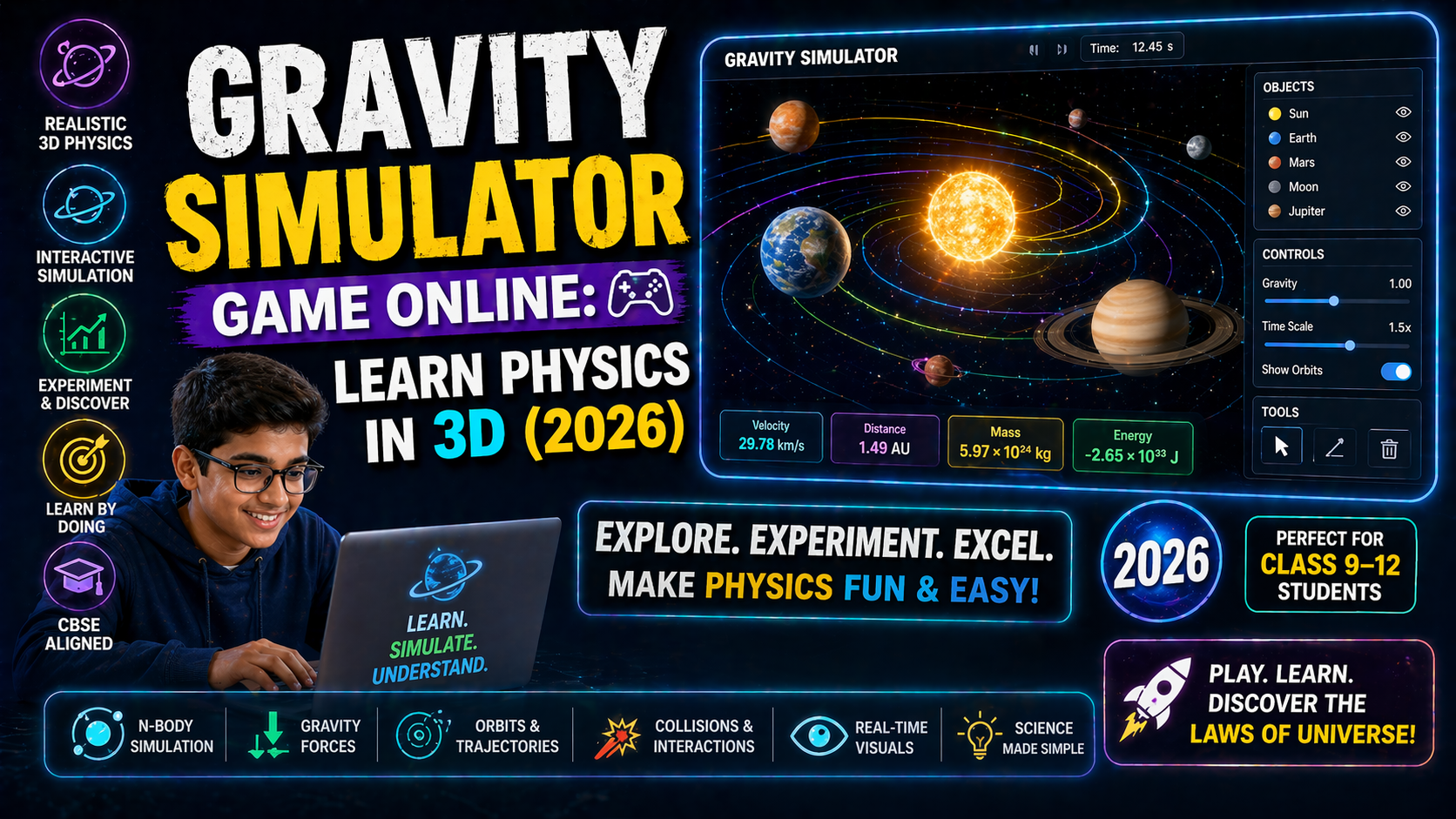
Are you preparing for CBSE Class 12 Physics 2026 exams and stuck on electrostatics previous year questions? You’re not alone. Every year, students face tough questions on Coulomb’s law, electric fields, and Gauss’s theorem — but visualizing these concepts can make them click instantly. With anAIza School by SPYRAL, you can solve CBSE electrostatics PYQs interactively and see charges, fields, and potentials move in real time. No more guessing — just experiment, visualize, and master.
This guide covers the most important electrostatics questions from CBSE 2020–2025, maps them to NCERT and NEP 2020 competencies, and shows you how to solve them using AI-powered simulations. Whether you're preparing for board exams, JEE, or NEET, these interactive tools will help you understand electrostatics deeply — not just memorize formulas.
Why This Matters: Electrostatics in CBSE 2026 and Beyond
Electrostatics is a core topic in CBSE Class 12 Physics and carries significant weight in board exams, JEE Main, and NEET. According to the NCERT Physics textbook (2024–25), electrostatics contributes about 8–10% of the total marks in Class 12 Physics. But here’s the catch: many students struggle not because they don’t know the formulas, but because they can’t visualize electric fields or forces in action.
NEP 2020 emphasizes experiential and competency-based learning, pushing schools to move beyond textbooks. Interactive simulations let you:
- See Coulomb’s law in action — adjust charges and distance, watch force change instantly
- Map electric fields around point charges and dipoles
- Apply Gauss’s theorem to real geometries like spheres and cylinders
- Solve previous year questions with real-time feedback and AI explanations
With AI-powered simulations, you’re not just answering questions — you’re experimenting like a physicist.
Top Electrostatics CBSE Previous Year Questions (2020–2025) and How to Solve Them
Here are the most frequently asked electrostatics questions in CBSE Class 12 exams over the past five years. We’ve grouped them by concept and show you how to solve them using interactive simulations.
1. Coulomb’s Law: Force Between Two Charges
Sample Question (CBSE 2023): Two point charges of +3 μC and −3 μC are placed 20 cm apart in vacuum. Find the magnitude and direction of the force between them.
How to Solve:
- Use Coulomb’s law: F = k·q₁·q₂ / r²
- Convert units: 3 μC = 3 × 10⁻⁶ C, 20 cm = 0.2 m
- Plug into formula: F = (9 × 10⁹) × (3 × 10⁻⁶) × (−3 × 10⁻⁶) / (0.2)²
- Calculate magnitude: |F| = 2.025 N
- Direction: Attractive (opposite charges)
But here’s the problem: most students get confused with signs and units. That’s where interactive Coulomb’s law simulations help.
⚗
Try This Simulation Free
Open the interactive simulation on anAIza School — no download, no signup needed.
Open Simulation →Change the charges, distance, and medium — watch the force vector update in real time.
In the simulation:
- Set q₁ = +3 μC, q₂ = −3 μC
- Set r = 20 cm
- See the force arrow appear — magnitude and direction update instantly
- Toggle between vacuum and medium (e.g., water) to see permittivity effects
This isn’t just solving — it’s feeling physics.
2. Electric Field Due to a Point Charge and Dipole
Sample Question (CBSE 2022): Calculate the electric field at a point 5 cm from a charge of +2 μC. Also, find the direction of the field.
How to Solve:
- Use formula: E = k·q / r²
- q = 2 × 10⁻⁶ C, r = 0.05 m
- E = (9 × 10⁹) × (2 × 10⁻⁶) / (0.05)² = 7.2 × 10⁶ N/C
- Direction: Radially outward (positive charge)
But what if you have a dipole? That’s where visualization becomes crucial.
⚗
Try This Simulation Free
Open the interactive simulation on anAIza School — no download, no signup needed.
Open Simulation →Draw charges, set positions, and watch the electric field lines form instantly.
In the simulation:
- Place a +2 μC charge at origin
- Place a test charge at 5 cm
- See the field vector and field lines appear
- Add a second charge to make a dipole — observe the field pattern change
This helps you understand not just the magnitude, but the direction and shape of electric fields — something missing in static diagrams.
3. Gauss’s Theorem: Electric Flux Through a Surface
Sample Question (CBSE 2021): A point charge of +5 μC is at the center of a spherical Gaussian surface of radius 10 cm. Calculate the total electric flux passing through the surface.
How to Solve:
- Use Gauss’s theorem: Φ = q / ε₀
- q = 5 × 10⁻⁶ C
- ε₀ = 8.85 × 10⁻¹² C²/N·m²
- Φ = (5 × 10⁻⁶) / (8.85 × 10⁻¹²) ≈ 5.65 × 10⁵ N·m²/C
But why does this work? Because the field is symmetric. To visualize this:
⚗
Try This Simulation Free
Open the interactive simulation on anAIza School — no download, no signup needed.
Open Simulation →Place a charge inside a sphere and see flux lines emerge uniformly.
In the simulation:
- Set charge = +5 μC at center
- Set radius = 10 cm
- See flux lines radiate outward uniformly
- Toggle to non-symmetric shapes (e.g., cube) — observe flux distribution
This helps you understand why Gauss’s theorem only works for symmetric charge distributions — a common point of confusion in exams.
4. Electric Potential and Potential Energy
Sample Question (CBSE 2024): Two charges of +1 μC and −1 μC are separated by 10 cm. Find the electric potential at the midpoint.
How to Solve:
- Electric potential due to a point charge: V = k·q / r
- For +1 μC: V₁ = (9 × 10⁹)(1 × 10⁻⁶) / 0.05 = 1.8 × 10⁵ V
- For −1 μC: V₂ = (9 × 10⁹)(−1 × 10⁻⁶) / 0.05 = −1.8 × 10⁵ V
- Total V = V₁ + V₂ = 0 V
But what does this mean? The midpoint is an equipotential point. To see this:
⚗
Try This Simulation Free
Open the interactive simulation on anAIza School — no download, no signup needed.
Open Simulation →Set two charges and trace the equipotential lines — see where V = 0.
In the simulation:
- Place +1 μC and −1 μC 10 cm apart
- Draw equipotential lines
- Observe the line where V = 0 — it’s the perpendicular bisector
- Change charge values and see how the zero-potential line shifts
What If You Changed This? 3 Interactive Scenarios to Master Electrostatics
Don’t just solve — experiment. Here are three “what-if” scenarios to deepen your understanding using simulations.
What if the medium changes from vacuum to water?
In vacuum, εᵣ = 1. In water, εᵣ ≈ 80. That means:
- Coulomb’s force decreases by a factor of 80
- Electric field strength drops
- Potential energy reduces
Use the Coulomb’s law simulation and toggle between vacuum and water. Watch the force arrow shrink instantly. This is how real-world electrostatics works — not just in theory.
What if the charges are not point charges but extended objects?
Real objects have size. How do we calculate force then? Use the simulation to model a charged rod or disk. Break it into small point charges and sum the forces. This is the essence of integration in electrostatics — and it’s visual in the simulation.
What if the charge is moving? Does Gauss’s theorem still apply?
Gauss’s theorem applies to static charges. For moving charges, we use different laws (e.g., Biot-Savart). But in the simulation, you can see how field lines change when a charge moves — preparing you for advanced topics like electromagnetic induction.
Frequently Asked Questions
What are the most important electrostatics CBSE previous year questions for 2026?
The most important questions revolve around Coulomb’s law, electric field due to point charges and dipoles, Gauss’s theorem, and electric potential. Questions from CBSE 2020–2025 papers often repeat these themes. Use interactive simulations to visualize and solve them in real time.
How can I use an electrostatics simulation to solve CBSE PYQs?
Start by identifying the concept in the question (e.g., Coulomb’s law). Open the simulation, set the given values (charges, distance), and watch the force or field update. Then, solve the question step by step using the simulation as a visual aid. AI explanations guide you through each step.
Is there a free electrostatics simulation for CBSE Class 12 students?
Yes! SPYRAL AI Workbench offers free interactive electrostatics simulations with real-time feedback and AI-powered explanations. No installation required — just open your browser and start experimenting.
Can I use electrostatics simulations for JEE and NEET preparation?
Absolutely. Many JEE and NEET questions are based on CBSE electrostatics concepts. Simulations help you visualize complex scenarios (e.g., multiple charges, non-uniform fields) that are common in competitive exams. You can also map simulations to specific JEE/NEET topics.
How does an electrostatics simulation help me understand Gauss’s theorem better?
Gauss’s theorem is abstract — but simulations make it tangible. You can place a charge inside a sphere and see flux lines radiate uniformly. Change the shape to a cube and observe how flux redistributes. This visual proof helps you understand why Gauss’s theorem only works for symmetric charge distributions.
What is the best way to visualize electric field lines using a simulation?
Use a simulation that allows you to place multiple charges and draw field lines dynamically. Adjust charge values and positions to see how field lines bend, merge, or form loops. This is far more effective than static textbook diagrams.
Are there interactive simulations for Ohm’s law and resistor circuits?
Yes! SPYRAL’s AI Workbench includes an Ohm’s law resistor simulation where you can adjust voltage, resistance, and see current change in real time. This is perfect for CBSE Class 12 physics and competitive exam prep.
Can I simulate fluid pressure and buoyancy alongside electrostatics?
Yes! The same platform includes a fluid pressure buoyancy simulation where you can adjust fluid density, object volume, and see buoyant force and pressure distribution. This is great for interdisciplinary learning and NEP 2020’s integrated science approach.
How do I use a lens formula calculator in electrostatics?
While lens formula is typically used in optics, some advanced electrostatics problems (e.g., electron optics, electron microscopes) involve lens-like behavior of electric fields. Use a lens formula calculator to model how electric fields focus charged particles — a great bridge between electrostatics and modern physics.
What’s the difference between electrostatics simulation and a real lab?
Simulations let you change variables instantly — something impossible in a real lab. You can set charges to extreme values, change mediums in seconds, and see results in real time. Simulations are safer, faster, and more flexible than physical labs, especially for complex geometries.
Are electrostatics simulations aligned with NEP 2020 and CBSE curriculum?
Yes. The simulations are mapped to NCERT Class 12 Physics chapters on electrostatics and cover all CBSE competencies. They also support NEP 2020’s emphasis on experiential learning, critical thinking, and interdisciplinary connections.
Can teachers use these simulations in classrooms?
Absolutely. Teachers can use the simulations during lectures, assign interactive problem-solving, or use the AI explanations to guide students. The platform includes a teacher dashboard for progress tracking and quiz generation — fully aligned with CBSE and NEP 2020.
Is there a thermodynamics simulation available for CBSE students?
Yes! SPYRAL’s AI Workbench includes a thermodynamics simulation where you can model gas laws, heat engines, and PV diagrams. This is perfect for Class 11 and 12 physics and chemistry students preparing for CBSE and competitive exams.
Final Tips: Ace Electrostatics CBSE 2026 with Simulations
Electrostatics doesn’t have to be intimidating. With interactive simulations, you can:
- Turn abstract formulas into visual experiments
- Solve CBSE previous year questions with real-time feedback
- Prepare for JEE, NEET, and board exams simultaneously
- Align your learning with NEP 2020’s competency-based approach
Remember: the best way to learn physics is to feel it, see it, and experiment. Don’t just read — interact.
Ready to master electrostatics? Open the simulation, set your charges, and start exploring. The future of learning is interactive — and it’s here today.
Further Reading and Resources
Practice What You Just Learned
SPYRAL's AI tools help you apply these concepts — answer writing lab, UPSC mock tests, AI feedback.
Try SPYRAL Free →