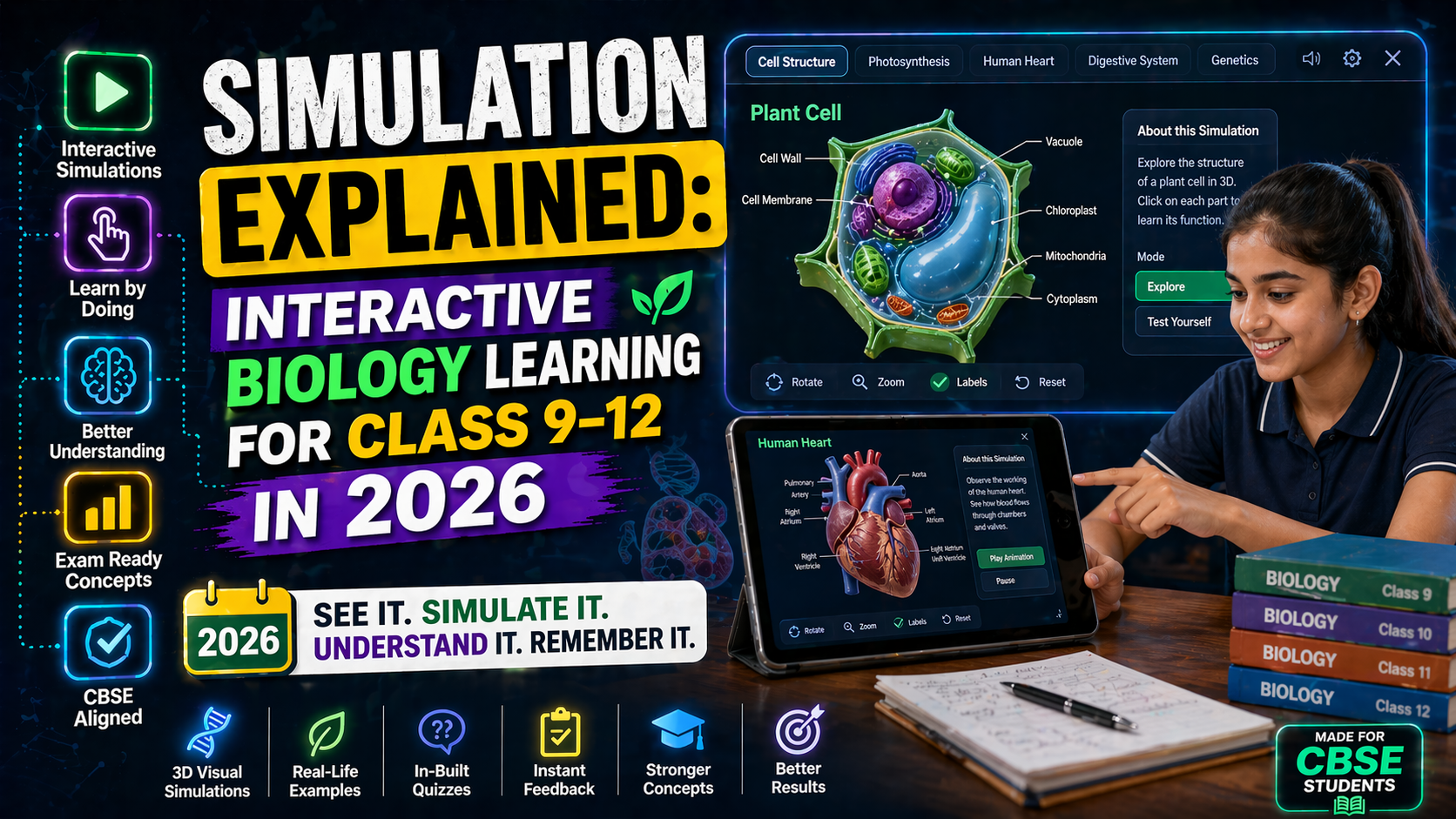
You’re staring at your Class 11 biology textbook, trying to memorize the stages of mitosis and meiosis, but the diagrams just won’t stick. You know mitosis is for growth and meiosis is for reproduction, but when it comes to anaphase, telophase, or crossing over, your brain feels like it’s stuck in interphase. What if you could see the chromosomes move, split, and recombine in real time? What if you could pause, rewind, and zoom into each stage until it clicks? That’s exactly what interactive cell division simulations do — and they’re the fastest way to turn confusion into clarity for your CBSE Class 11 biology exams in 2026.
In this guide, you’ll get concise, accurate cell division class 11 short notes that cover mitosis and meiosis, key differences, diagrams, and CBSE-aligned explanations. But more importantly, you’ll get to experience cell division through live simulations that feel like a real lab — no lab coat required. Whether you're preparing for your board exams, NEET, or just want to understand how life grows and reproduces, these interactive tools will make cell division unforgettable.
Why This Matters: From Textbook to Real Life
Cell division isn’t just a chapter in your NCERT book — it’s the foundation of life itself. Every time your skin heals, your hair grows, or a baby is born, cell division is at work. In CBSE Class 11 Biology (Chapter 10: Cell Cycle and Cell Division), you’re learning how life perpetuates itself at the microscopic level. But traditional notes and diagrams often leave students confused about the sequence, timing, and purpose of each stage.
That’s where interactive simulations come in. Instead of memorizing definitions, you see the spindle fibers form, chromosomes condense, and cells split. You can slow down anaphase to watch sister chromatids separate, or speed up meiosis I to see homologous chromosomes pair up. These aren’t just animations — they’re interactive labs where you control the variables and watch biology come alive.
For teachers, these simulations are a game-changer. You can project them in class, pause to explain, and let students experiment with different scenarios — like what happens if cytokinesis fails? Or how does crossing over affect genetic diversity? With AI-powered explanations built in, students get instant feedback, making your job easier and their learning deeper.
Understanding the Cell Cycle: The Big Picture cell division class 11 short notes
The cell cycle is the life story of a cell — from birth to division. It’s divided into two main phases: interphase and the M phase (mitotic phase). Interphase is where the cell grows, replicates its DNA, and prepares for division. The M phase is when the cell actually divides into two daughter cells.
1. Interphase: The Invisible Growth Engine
Interphase isn’t just a waiting period — it’s the most active part of the cell cycle. It’s divided into three sub-phases:
- G1 Phase (Gap 1): The cell grows in size and synthesizes proteins and organelles. It’s like the cell is stocking up on supplies before a big journey. In CBSE terms, this is where the cell prepares for DNA replication.
- S Phase (Synthesis): DNA replication happens here. The cell makes an exact copy of its genetic material. This is critical — if DNA isn’t copied correctly, the daughter cells could be missing vital instructions.
- G2 Phase (Gap 2): The cell continues to grow and prepares for mitosis. It checks that DNA replication was successful and repairs any errors. Think of it as a final quality check before the big split.
🔗 NCERT Class 11 Biology Chapter 10: Cell Cycle and Cell Division — the official source for your syllabus.
2. M Phase: Where the Magic Happens
The M phase is when the cell divides. It includes mitosis (division of the nucleus) and cytokinesis (division of the cytoplasm). Mitosis itself has four stages: prophase, metaphase, anaphase, and telophase. Each stage has a distinct visual signature that simulations make crystal clear.
📌 Prophase: Chromosomes condense and become visible. The nuclear envelope breaks down. Spindle fibers begin to form from the centrosomes.
📌 Metaphase: Chromosomes line up at the cell’s equator (metaphase plate). Spindle fibers attach to the centromeres via kinetochores.
📌 Anaphase: Sister chromatids separate and are pulled to opposite poles of the cell. This is where the magic of equal DNA distribution happens.
📌 Telophase: Chromosomes decondense. Nuclear envelopes reform around each set of chromosomes. The spindle apparatus disassembles.
🔗 Britannica: Cell Cycle — a trusted source for deeper understanding.
Mitosis vs Meiosis: The Ultimate Showdown mitosis and meiosis class 11 notes
This is where most students get tangled up. Both processes divide cells, but they have very different goals and outcomes. Let’s break it down with a table and then dive into simulations to see the difference in action.
| Feature | Mitosis | Meiosis |
|---|---|---|
| Purpose | Growth, repair, asexual reproduction | Sexual reproduction, genetic diversity |
| Number of divisions | 1 | 2 (Meiosis I and II) |
| Daughter cells | 2 diploid cells (identical to parent) | 4 haploid cells (genetically unique) |
| Chromosome number | Same as parent (2n → 2n) | Halved (2n → n) |
| Crossing over | No | Yes (in Prophase I) |
| Genetic variation | None (clones) | High (due to crossing over and independent assortment) |
Key Takeaway: Mitosis makes identical cells for growth and repair. Meiosis creates genetically diverse gametes (sperm and egg) for sexual reproduction. That’s why meiosis has two divisions and includes crossing over — to shuffle the genetic deck.
Diagrams That Make Sense: From 2D to 3D cell division class 11 diagram
Diagrams in textbooks are helpful, but they’re static. You can’t rotate them, zoom in, or see how changes affect the outcome. Interactive simulations let you do all that — and more.
For example, in a mitosis simulation:
- You can rotate the cell to see the spindle from all angles.
- You can pause at metaphase and count the chromosomes lined up at the plate.
- You can speed up or slow down the process to match your understanding.
- You can highlight specific structures like kinetochores or centrioles.
These aren’t just pretty pictures — they’re interactive 3D models that respond to your input. You can even label the parts yourself and get instant feedback on your accuracy. This is especially useful for NEET aspirants who need to visualize complex processes under time pressure.
📌 Pro Tip: Use the simulation to draw your own diagram. Label the stages, then compare it to your textbook. This active recall technique boosts memory retention by up to 50%, according to NCBI research on active learning.
Interactive Lab: Try It Yourself cell division simulation
Try This Simulation Free
Open the interactive simulation on anAIza School — no download, no signup needed.
Open Simulation →This plan turns passive learning into active mastery. And the best part? You’re not just memorizing — you’re experiencing biology.
Teacher’s Toolkit: How to Use Simulations in Class
Teachers, here’s how to integrate these simulations into your CBSE Class 11 biology lessons:
- Pre-Lesson: Assign students to explore the mitosis simulation at home. Ask them to note one question they have.
- In-Class: Project the simulation on a smartboard. Pause at each stage and ask: “What’s happening here? Why is this important?”
- Group Activity: Divide students into teams. Each team runs a “what if” experiment (e.g., no crossing over) and presents their findings.
- Assessment: Use the simulation’s built-in quiz to test understanding. Or ask students to create a 60-second video explaining mitosis using the simulation.
- Homework: Assign a reflection: “How would life be different if meiosis didn’t exist?”
With AI-powered explanations, students get instant feedback, and you get real-time data on their progress. It’s like having a teaching assistant in every device.
Beyond the Syllabus: Real-World Connections
Cell division isn’t just a textbook topic — it’s happening in your body right now. Here’s how it connects to real life:
- Cancer: Uncontrolled cell division leads to tumors. Understanding checkpoints in the cell cycle helps explain why cancer happens and how treatments (like chemotherapy) target dividing cells.
- Aging: As we age, cell division slows down. Stem cells in your bone marrow divide to make blood cells — but this process declines with age.li>
- Genetic Disorders: Errors in meiosis cause conditions like Down syndrome (extra chromosome 21) or Klinefelter syndrome (XXY chromosomes).
- Biotechnology: Scientists use mitosis to clone plants and animals. Meiosis is key to selective breeding and genetic engineering.
These connections make cell division relevant — not just another chapter to cram.
Final Thoughts: Stop Memorizing, Start Understanding
You don’t need to memorize every stage of mitosis or meiosis. What you need is to see it, do it, and teach it. That’s how you turn short notes into long-term memory.
These interactive simulations are your shortcut to mastery. They’re free, instant, and infinitely patient. You can run mitosis 10 times, slow down anaphase, or break the spindle — and the simulation will always show you the truth.
So next time you open your biology textbook, don’t just read. Simulate.
🔗 Ready to dive in? Open SPYRAL AI Workbench — Biology Simulations and start exploring mitosis and meiosis today. No signup. No ads. Just learning.
Resources & Further Reading
- NCERT Class 11 Biology Chapter 10: Cell Cycle and Cell Division — Official textbook
- Britannica: Cell Cycle — In-depth explanation
- Merriam-Webster: Mitosis — Definition and pronunciation
- Merriam-Webster: Meiosis — Definition and pronunciation
- Ministry of Education, India — For curriculum updates and policies