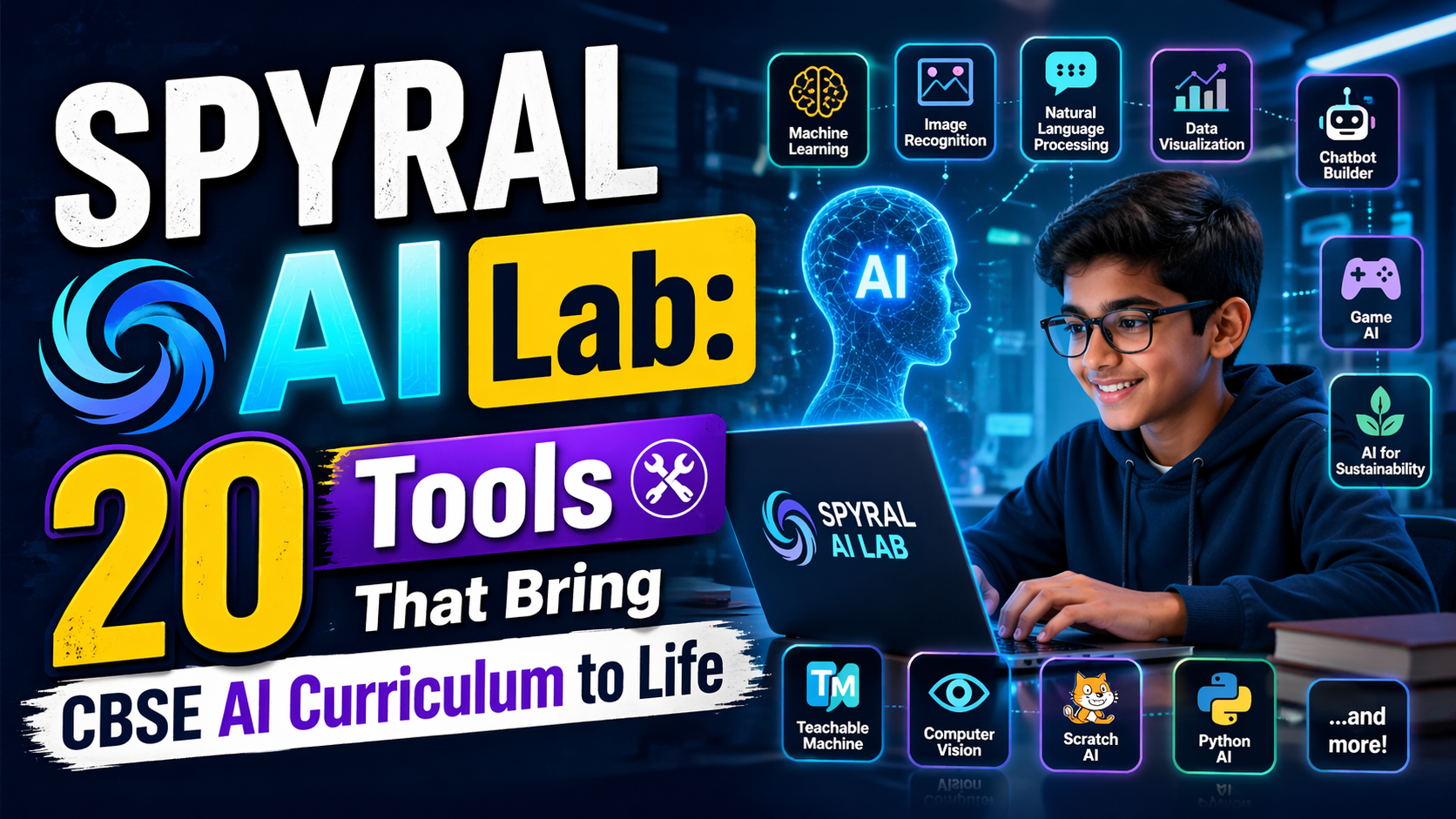
The Central Board of Secondary Education (CBSE) has introduced Artificial Intelligence (AI) as an elective subject for Class 9 students, aligning with the National Education Policy (NEP) 2020. This initiative aims to equip students with future-ready skills in AI, coding, and problem-solving from an early age.
In this guide, we’ll break down the CBSE AI Class 9 syllabus, project ideas, and free tools you can use to start learning AI in 2026. Whether you're a student, teacher, or parent, this post will help you navigate the exciting world of AI education in Indian schools.
Why AI in Class 9? Understanding the CBSE AI Curriculum
The CBSE AI curriculum for Class 9 is designed to introduce students to the fundamentals of AI, machine learning, and coding in a structured way. Here’s what makes it special:
- Hands-on learning: Students engage in practical projects rather than just theory.
- Python-based: The curriculum uses Python, a beginner-friendly programming language.
- NEP 2020 aligned: Focuses on experiential and skill-based learning.
- Future-ready: Prepares students for careers in AI, robotics, and data science.
By the end of Class 9, students will have a strong foundation in AI concepts, coding, and real-world applications.
CBSE Artificial Intelligence Class 9 Syllabus 2026 (Updated)
The CBSE AI syllabus for Class 9 is divided into theory and practical components. Here’s a breakdown of the key topics covered in 2026:
Unit 1: Introduction to Artificial Intelligence
- What is AI? Real-life examples (chatbots, self-driving cars, recommendation systems).
- Types of AI: Narrow AI vs. General AI.
- AI domains: Machine Learning, Natural Language Processing (NLP), Robotics, Computer Vision.
- AI in daily life: Virtual assistants, social media algorithms, healthcare diagnostics.
Unit 2: AI Project Cycle
- Problem scoping: Identifying real-world problems AI can solve.
- Data acquisition: Collecting and cleaning data.
- Data exploration: Analyzing data patterns.
- Model training: Building simple AI models.
- Evaluation: Testing and improving the model.
Unit 3: Introduction to Python Programming
- Basics of Python: Variables, data types, loops, and functions.
- Using libraries like
pandasfor data handling andscikit-learnfor AI models. - Writing simple AI programs (e.g., a chatbot or recommendation system).
Unit 4: AI Ethics and Society
- Ethical concerns in AI: Bias, privacy, and job displacement.
- AI and sustainability: How AI can help solve environmental challenges.
- Responsible AI use: Guidelines for students and developers.
Practical Work
- Hands-on coding exercises in Python.
- AI project development (e.g., a simple image classifier or chatbot).
- Presentation and evaluation of projects.
For the full syllabus, visit the CBSE Academic website.
CBSE AI Class 9 Project Ideas for 2026
Projects are a core part of the CBSE AI curriculum. Here are some project ideas students can work on in 2026:
Beginner-Level Projects
- Chatbot for School FAQs: A simple chatbot that answers common questions about school policies, exams, or events.
- Grade Predictor: A model that predicts student grades based on study hours and attendance.
- Weather Forecaster: A basic AI model that predicts weather based on historical data.
Intermediate-Level Projects
- Handwritten Digit Recognition: A model that recognizes handwritten digits (using the MNIST dataset).
- Spam Detector: An AI tool that classifies emails as spam or not spam.
- Emotion Analyzer: A program that detects emotions from text or facial expressions.
Advanced-Level Projects
- Self-Driving Car Simulation: A simple simulation of a car avoiding obstacles.
- AI-Powered Study Planner: A tool that suggests study schedules based on student performance.
- Fake News Detector: An AI model that identifies fake news articles.
These projects not only help students understand AI concepts but also boost their problem-solving and coding skills.
Free AI Tools for CBSE Class 9 Students in 2026
Learning AI doesn’t have to be expensive. Here are some free AI tools and platforms students can use to practice coding and AI:
1. SPYRAL AI Workbench
SPYRAL AI Workbench is a free, no-signup platform where students can:
- Write and run Python code for AI projects.
- Use pre-built AI models for quick prototyping.
- Access interactive tutorials and coding challenges.
2. Google’s Teachable Machine
A beginner-friendly tool to train simple AI models without coding. Students can create models for image, sound, or pose recognition.
3. Scratch with Machine Learning
Scratch, a visual programming tool, now includes machine learning blocks. Students can build AI games and animations easily.
4. Kaggle for Students
Kaggle offers free datasets and AI competitions for students. It’s a great way to practice data science and AI modeling.
5. Jupyter Notebooks (Google Colab)
Google Colab allows students to write and run Python code in the cloud for free. It supports libraries like TensorFlow and PyTorch.
For a complete list of free AI learning resources, check out our guide on Free AI Tools for Students.
How Teachers Can Integrate AI into Class 9 CBSE Curriculum
Teachers play a crucial role in making AI education engaging and effective. Here’s how they can integrate AI into the Class 9 curriculum:
1. Use Interactive Simulations
Tools like SPYRAL AI Workbench offer interactive simulations for AI concepts. Teachers can use these to demonstrate how AI models work in real time.
2. Organize AI Hackathons
Host school-level hackathons where students build AI projects in teams. This encourages collaboration and creativity.
3. Incorporate Real-World Examples
Show students how AI is used in industries like healthcare, finance, and entertainment. For example, discuss how AI is used in medical imaging or fraud detection.
4. Encourage Project-Based Learning
Instead of traditional exams, evaluate students based on their AI projects. This aligns with the NEP 2020 focus on experiential learning.
5. Provide Coding Workshops
Organize workshops on Python and AI libraries. Platforms like SPYRAL AI Workbench offer free coding tutorials for teachers and students.
For more tips, read our article on NEP 2020 and AI in Education.
FAQs About CBSE Artificial Intelligence Class 9
Is Artificial Intelligence a compulsory subject in CBSE Class 9?
No, AI is an elective subject in CBSE Class 9. Students can choose it as an additional subject alongside their regular curriculum.
Do I need prior coding experience to learn AI in Class 9?
No! The CBSE AI syllabus starts with the basics of Python programming, so no prior coding experience is required.
What are the career options after learning AI in Class 9?
Learning AI in Class 9 opens doors to careers in data science, machine learning, robotics, software development, and AI research. It also helps in competitive exams like JEE and NEET.
Are there any free online courses for CBSE AI Class 9?
Yes! Platforms like SPYRAL AI Workbench, Google’s Teachable Machine, and Kaggle offer free AI courses and tools for students.
How can parents support their child in learning AI?
Parents can encourage their child by providing access to free AI tools, enrolling them in coding workshops, and discussing real-world AI applications at home.
Try It Free on SPYRAL
Everything discussed in this article is available for free on SPYRAL AI Workbench. No signup required for guest access — just open it and start learning.
Explore SPYRAL AI Workbench →Final Thoughts: Embrace AI Learning in Class 9
The inclusion of Artificial Intelligence in CBSE Class 9 is a game-changer for Indian students. It equips them with skills that are in high demand in the job market and prepares them for a future driven by AI and technology.
By leveraging free tools like SPYRAL AI Workbench, students can start their AI journey without any barriers. Whether you're a student, teacher, or parent, now is the perfect time to dive into the world of AI and coding.
Ready to get started? Explore SPYRAL AI Workbench and begin your AI learning journey today!