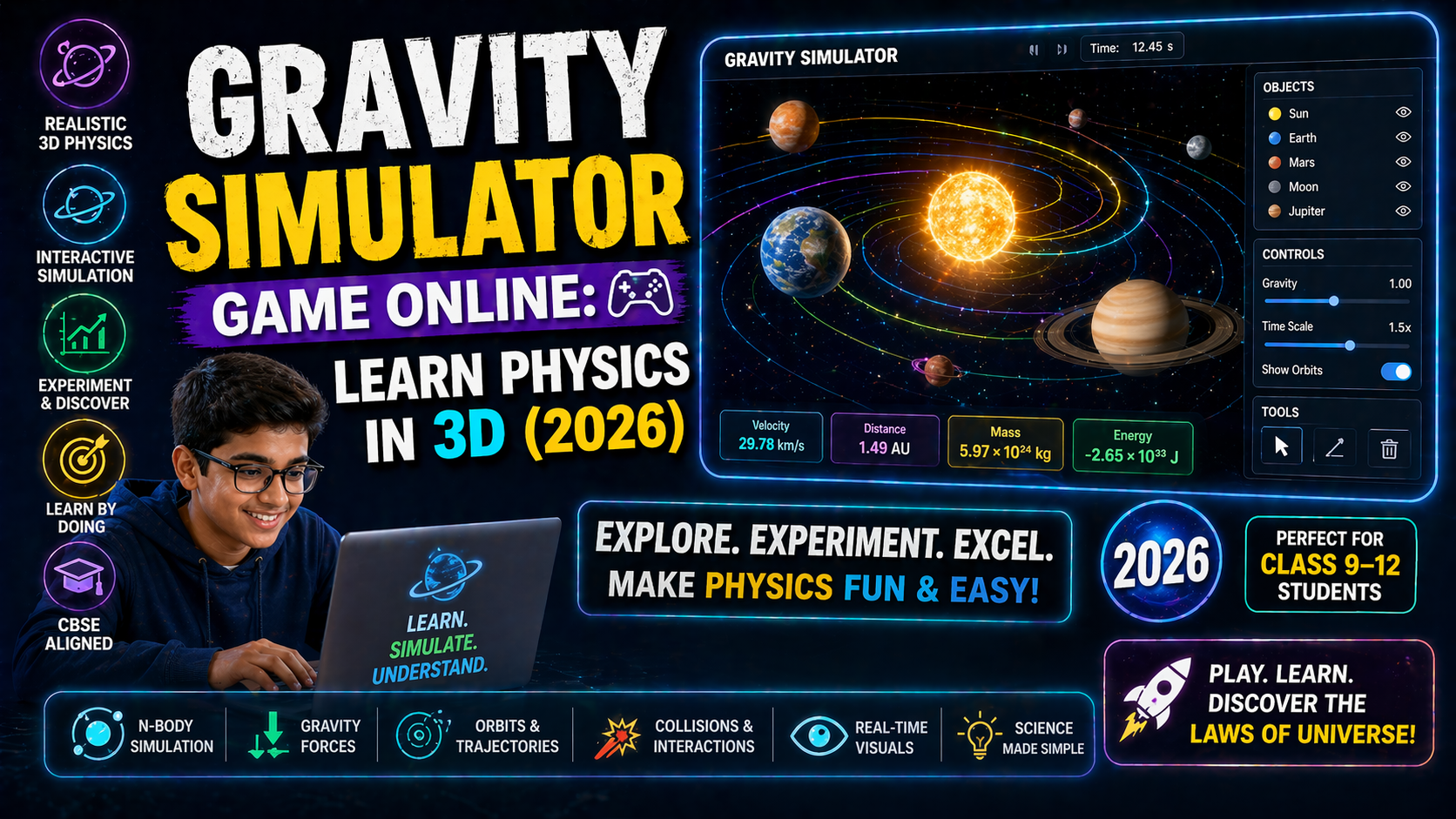
You’re staring at a physics textbook, trying to visualize how waves travel or how Ohm’s law works in a circuit — but the static diagrams just aren’t clicking. That’s where the virtual lab for NEP 2026 comes in. This isn’t just another online tool; it’s an AI-powered interactive physics lab designed specifically for CBSE Class 9–12 students and teachers, aligning perfectly with the National Education Policy (NEP) 2020’s vision of experiential learning. With simulations for waves and optics, electrostatics, Ohm’s law, fluid pressure and buoyancy, and even a lens formula calculator, you can now see, touch, and experiment with physics concepts in real time — no lab coat required.
Whether you're a student preparing for board exams or a teacher looking for engaging ways to explain complex topics, the virtual lab for NEP transforms abstract theories into tangible experiences. And the best part? It’s free, AI-powered, and designed for India’s CBSE curriculum. Ready to dive in? Let’s explore how these simulations can make physics not just understandable — but unforgettable.
Why This Matters: NEP 2020, CBSE, and the Power of Virtual Labs
The National Education Policy (NEP) 2020 emphasizes experiential learning, inquiry-based education, and the use of technology in classrooms. For CBSE students in Classes 9–12, this means moving beyond rote memorization and engaging with science through hands-on exploration. But real labs are expensive, time-consuming, and often inaccessible. That’s where virtual labs come in — and why they’re a game-changer for Indian education in 2026.
Imagine explaining electrostatics to a Class 12 student using a simulation where they can move charges around and see electric fields form in real time. Or letting a Class 10 student adjust the resistance in a circuit and watch how it affects current, directly visualizing Ohm’s law. These aren’t just animations — they’re interactive, AI-powered experiments that respond to student input, provide instant feedback, and even generate explanations. Schools across India are adopting these tools to meet NEP 2020’s goals: deeper understanding, critical thinking, and personalized learning.
And it’s not just theory. The virtual lab for NEP is built with India’s CBSE syllabus in mind. From waves and optics in Class 12 to fluid pressure and buoyancy in Class 9, every simulation is mapped to your curriculum. Teachers can track progress, assign experiments, and even generate quizzes — all within one platform. No more photocopying lab manuals or waiting for lab slots. With AI-powered explanations after every simulation, students get instant clarity. It’s learning by doing — the NEP way.
Waves and Optics Simulation: See Light and Sound Come Alive
Understanding Wave Motion with Real-Time Visuals
Wave motion is one of the most abstract concepts in physics — until you see it in action. In the waves and optics simulation on the virtual lab for NEP, students can:
- Generate transverse and longitudinal waves by adjusting frequency, amplitude, and wavelength.
- Observe interference patterns when two waves overlap — perfect for understanding constructive and destructive interference.
- See sound waves visualized as pressure variations, helping connect auditory experiences to mathematical models.
- Use the built-in ruler and timer to measure wave speed and period, reinforcing the wave equation: v = f × λ.
This isn’t just watching a video. Students control the variables — change the tension in a string, alter the medium, and watch how the wave speed changes. It’s kinesthetic learning meets digital exploration. And with AI explanations, if a student is confused about why wavelength decreases when frequency increases, the system breaks it down step by step — in simple language, tailored to their level.
Optics: From Reflection to Lens Formula
Optics can feel like a maze of formulas: 1/f = 1/v + 1/u, magnification, refractive index. But in the virtual lab for NEP, students can:
- Trace light rays through lenses and mirrors — concave, convex, plane — and see focal points form in real time.
- Use the lens formula calculator to input object distance and focal length, and watch the image form instantly. The simulation even draws the ray diagram for you.
- Explore total internal reflection by adjusting the angle of incidence and seeing when light bends or reflects.
- Measure magnification by comparing object and image sizes — no protractor needed.
Teachers love this because it turns a blackboard lecture into an interactive session. Students stop memorizing and start understanding. And with AI-generated notes after each experiment, revision becomes effortless.
Electrostatics Simulation: Charge, Field, and Potential Made Visual
Electrostatics is invisible — until you make it visible. The electrostatics simulation in the virtual lab for NEP lets students:
- Place positive and negative charges on a 2D plane and watch electric field lines form dynamically.
- Measure electric potential at any point using a virtual voltmeter — great for understanding equipotential surfaces.
- Observe Coulomb’s law in action by adjusting charge magnitudes and distances, and seeing how force changes.
- Explore shielding effects by placing a conductor in the field and watching how field lines behave.li>
This simulation is especially powerful for Class 12 students preparing for JEE or NEET. Instead of drawing field lines on paper, they see them form based on their input. The AI assistant explains why field lines never cross, how electric potential relates to work done, and even connects it to real-world applications like capacitors and lightning rods.
Teachers can use this to demonstrate complex concepts like electric dipole moments or Gauss’s law in a way that sticks. And since the simulation is browser-based, it works on any device — no special hardware needed.
Ohm’s Law Resistor Simulation: Build Circuits, See Current Flow
Ohm’s law: V = IR. Simple, right? But for many students, it’s just three letters. The Ohm’s law resistor simulation changes that. Students can:
- Drag resistors, batteries, and wires to build series and parallel circuits.
- Adjust voltage and resistance and watch current flow change in real time — with a live ammeter and voltmeter.
- See the I-V graph update instantly, helping them understand linearity and Ohmic vs. non-Ohmic conductors.
- Test combinations — what happens when you add a resistor in parallel? The simulation shows the drop in total resistance and increase in total current.
This is the kind of hands-on practice that builds intuition. Students stop guessing and start predicting. And with AI feedback, if they make a mistake — like connecting a battery backward — the system explains why it doesn’t work and how to fix it.
Perfect for CBSE Class 10 and 12 physics labs, this simulation aligns with the curriculum’s focus on practical applications of electricity. No more waiting for lab time — students can experiment anytime, anywhere.
Fluid Pressure and Buoyancy Simulation: Float, Sink, or Fly?
Why do some objects float while others sink? The fluid pressure and buoyancy simulation lets students explore Archimedes’ principle in a way that’s both fun and educational. They can:
- Drop objects into water and watch buoyancy forces act in real time.
- Adjust fluid density and see how it affects floating and sinking.
- Measure pressure at different depths using a virtual manometer — great for understanding P = ρgh.
- Experiment with shapes — why does a steel ship float but a steel cube sink? They’ll see the role of volume and displacement.li>
This simulation is ideal for Class 9 students learning about pressure and buoyancy, but it’s also useful for Class 11 physics revision. The AI assistant explains concepts like upthrust, density gradients, and Pascal’s law in simple terms, with visual aids.
Teachers can use it to demonstrate real-world applications — from submarines to hot air balloons — making the connection between theory and technology clear.
Lens Formula Calculator: Solve Optics Problems in Seconds
Optics problems can be tricky: sign conventions, focal lengths, image distances. The lens formula calculator in the virtual lab for NEP takes the guesswork out. Students can:
- Input object distance (u) and focal length (f) — the calculator instantly gives image distance (v) and magnification (m).
- See the ray diagram drawn automatically, showing the path of light through the lens.
- Toggle between convex and concave lenses and watch the image flip from real to virtual.li>
- Export results for lab reports or revision notes.
This isn’t just a calculator — it’s a learning tool. The AI explains each step: why the image is inverted, how magnification relates to size, and how to apply the sign convention correctly. Perfect for CBSE Class 12 students preparing for board exams or competitive tests like JEE.
And since it’s integrated into the simulation platform, students can jump from theory to practice in seconds — no switching between apps.
What If You Changed This? 3 Real-World Experiment Scenarios
Science isn’t about memorizing facts — it’s about asking “what if?”. Here are three scenarios to try in your virtual lab for NEP:
1. What if you double the frequency of a wave?
In the waves and optics simulation, increase the frequency from 1 Hz to 2 Hz. Watch as the wavelength halves. The AI assistant explains: Since wave speed is constant in a medium, increasing frequency decreases wavelength proportionally. This is the wave equation in action — and you just saw it happen.
2. What if you connect two resistors in parallel?
In the Ohm’s law resistor simulation, build a circuit with one resistor (say, 10 Ω) and measure the current. Now add a second 10 Ω resistor in parallel. The total resistance drops to 5 Ω, and current doubles. The AI explains: In parallel, resistances add inversely: 1/R_total = 1/R1 + 1/R2. No more confusion — just clear, visual proof.
3. What if you place a charged rod near a neutral conductor?
In the electrostatics simulation, bring a positively charged rod close to a neutral metal sphere. Watch as electrons in the sphere rearrange — creating induced charges. The AI breaks down electrostatic induction and its role in capacitors and lightning rods. You’ve just visualized a concept that’s invisible in real life.
These aren’t just experiments — they’re aha moments. And with AI-powered explanations, every “what if” leads to deeper understanding.
Try It Free on SPYRAL
Everything discussed in this article is available for free on SPYRAL AI Workbench — Physics Simulations. No signup required for guest access — just open it and start learning.
Explore SPYRAL AI Workbench — Physics Simulations →Frequently Asked Questions
What is a virtual lab for NEP 2026?
A virtual lab for NEP 2026 is an AI-powered online platform that simulates physics experiments aligned with India’s National Education Policy (NEP) 2020. It allows students and teachers to conduct interactive experiments in waves, optics, electrostatics, Ohm’s law, and more — without needing physical labs. These labs are designed for CBSE Class 9–12 students and support experiential learning, a key focus of NEP 2020.
How does the waves and optics simulation help with CBSE Class 12 physics?
The waves and optics simulation helps students visualize concepts like interference, diffraction, and lens formulas in real time. They can adjust variables like wavelength, focal length, and object distance, and see the effects instantly. This reinforces the CBSE Class 12 syllabus on wave optics and ray optics, making abstract concepts tangible. AI explanations after each experiment ensure students understand the underlying principles.
Can I use the electrostatics simulation to understand electric fields for JEE preparation?
Absolutely! The electrostatics simulation is ideal for JEE aspirants. You can place charges, draw field lines, measure potential, and observe Coulomb’s law in action. The AI assistant explains concepts like electric dipole moments, Gauss’s law, and equipotential surfaces — all crucial for JEE physics. Since the simulation is interactive and visual, it’s more effective than static diagrams in textbooks.
Is the Ohm’s law resistor simulation accurate for CBSE Class 10 experiments?
Yes! The Ohm’s law resistor simulation is designed to match CBSE Class 10 physics lab experiments. Students can build series and parallel circuits, adjust resistance and voltage, and measure current using virtual ammeters and voltmeters. The simulation even shows the I-V graph, helping students understand Ohmic and non-Ohmic conductors. It’s a safe, repeatable way to practice before real lab sessions.
What is fluid pressure buoyancy simulation and how does it work?
The fluid pressure buoyancy simulation lets students explore how objects float or sink in fluids by adjusting density, shape, and depth. They can measure pressure at different depths using a virtual manometer and observe upthrust forces. This simulation is based on Archimedes’ principle and Pascal’s law, helping students understand real-world applications like ship design and hot air balloons. It’s perfect for CBSE Class 9 physics.
How accurate is the lens formula calculator in the virtual lab?
The lens formula calculator is highly accurate and follows the standard lens formula: 1/f = 1/v + 1/u, with proper sign conventions. It draws ray diagrams automatically and shows image formation for both convex and concave lenses. Students can input object distance and focal length to get image distance and magnification instantly. The AI explains each step, making it a reliable tool for CBSE Class 12 optics problems.
Do I need to install anything to use the virtual lab for NEP?
No installation is required! The virtual lab for NEP runs in your web browser — on laptops, tablets, or even smartphones. Just visit the platform, choose a simulation, and start experimenting. There’s no need for plugins, downloads, or special hardware. It’s designed to be accessible to all students, regardless of their device.
Can teachers track student progress in the virtual lab?
Yes! Teachers can create accounts and assign simulations to students. The platform tracks time spent, variables changed, and quiz scores. Teachers can view detailed reports on student performance and identify areas where students struggle. This helps in personalized teaching and ensures no student is left behind — aligning with NEP 2020’s focus on inclusive education.
Is the virtual lab for NEP aligned with the CBSE syllabus?
Yes, all simulations in the virtual lab for NEP are mapped to the CBSE Class 9–12 physics syllabus. From waves and optics in Class 12 to pressure and buoyancy in Class 9, every experiment aligns with the curriculum. Teachers can use it as a supplementary tool for labs, revision, or flipped classroom activities. The AI-generated notes and explanations are also tailored to CBSE terminology and concepts.
How does the AI explanation work after each simulation?
After completing a simulation, students receive a detailed AI-generated explanation. The AI analyzes the variables they changed and the results they observed, then provides a step-by-step breakdown of the physics behind it. For example, if a student increases resistance in a circuit, the AI explains Ohm’s law, how current decreases, and why. The explanations are simple, visual, and tailored to the student’s level — making complex concepts easy to understand.
Can I use the virtual lab for NEP for competitive exam prep like JEE or NEET?
Absolutely! The simulations are designed to help students preparing for JEE and NEET. The electrostatics simulation covers Gauss’s law and dipole moments, the waves and optics simulation covers interference and diffraction, and the Ohm’s law simulation covers circuit analysis. The AI explanations are detailed enough to help with advanced problem-solving, and the interactive nature reinforces conceptual clarity — crucial for competitive exams.
Is the virtual lab for NEP free to use?
Yes! The virtual lab for NEP is completely free for students and teachers. You can access all simulations, AI explanations, and basic features without signing up. For advanced features like progress tracking and quiz generation, teachers can create free accounts. It’s part of SPYRAL’s mission to make quality STEM education accessible to all, in line with NEP 2020’s goals.
Ready to Experience Physics Like Never Before?
The virtual lab for NEP 2026 isn’t just another online tool — it’s a revolution in how Indian students learn physics. By turning abstract concepts into interactive, AI-powered experiments, it makes learning engaging, memorable, and aligned with NEP 2020. Whether you’re a student preparing for board exams, a teacher looking for innovative teaching tools, or a parent wanting to support your child’s learning, this platform has something for you.
From waves and optics simulations to electrostatics, Ohm’s law, fluid pressure and buoyancy, and even a lens formula calculator, every tool is designed to help you see, touch, and understand physics — without the lab coat or the wait. And with AI explanations after every experiment, you’re never left wondering “why?”
So why wait? Step into the future of learning. Try the virtual lab for NEP today — for free, no installation, no signup required. Physics isn’t just a subject anymore. It’s an experience.
Explore the Virtual Lab for NEP Now →
Internal Links
- SPYRAL AI Workbench — Physics Simulations
- AI-Powered Physics Simulations
- NEP 2020 Learning Tools
- Free STEM Tools for Students
External Links
- Learn more about experiential learning on Britannica.
- Explore the NCERT Class 12 Physics textbook for syllabus alignment.
- Read about NEP 2020’s impact on Indian education from The Hindu.
- Understand the Ohm’s law on Wikipedia.