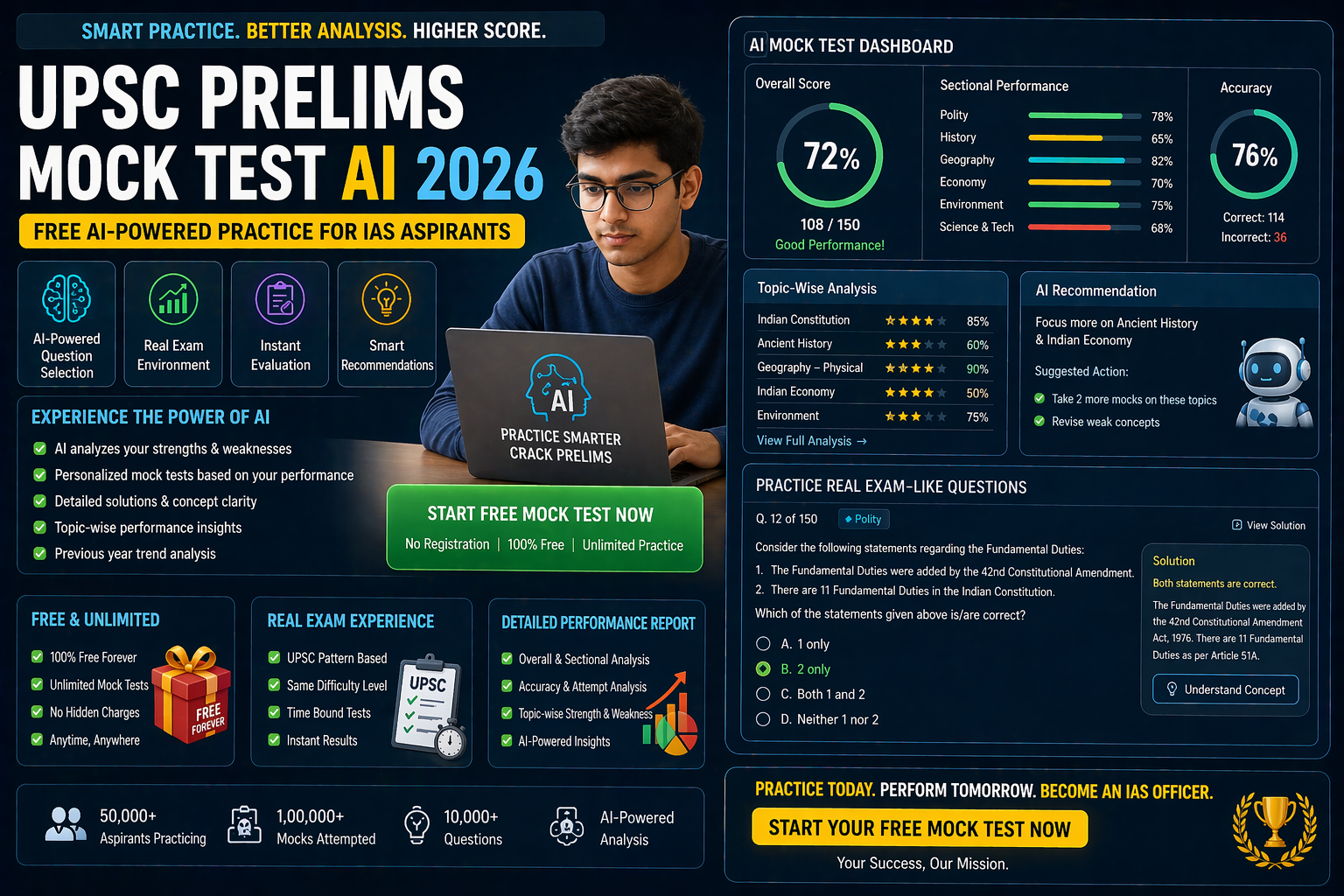
UPSC Mains 2026 is just around the corner, and for IAS aspirants, answer writing remains the most critical skill to master. While traditional coaching provides guidance, AI-powered tools are now revolutionizing how students prepare, offering instant feedback, structured templates, and data-driven insights to refine their writing.
In this guide, we’ll explore 10 proven strategies—backed by AI—to help you improve your UPSC Mains answer writing in 2026. Whether you're a beginner or a seasoned aspirant, these hacks will elevate your answers from average to exceptional.
Why UPSC Mains Answer Writing is Non-Negotiable in 2026
UPSC Mains 2026 will continue to test not just your knowledge but your ability to articulate, structure, and present it effectively. The exam evaluates:
- Clarity and coherence in arguments
- Relevance to the question asked
- Depth of analysis with balanced perspectives
- Presentation (handwriting, formatting, and readability)
Traditional methods like self-review or peer feedback are time-consuming and often subjective. This is where AI-powered answer evaluation comes in, providing objective, instant, and actionable feedback.
10 AI-Powered Hacks to Improve UPSC Mains Answer Writing in 2026
1. Use AI to Analyze Your Answer Structure
Most UPSC aspirants lose marks due to poor answer structure. AI tools can dissect your answers and highlight:
- Missing introduction or conclusion
- Overuse of jargon without explanation
- Lack of logical flow between paragraphs
- Wordiness or redundancy
Pro Tip: Compare your answer with model answers using AI. Tools like SPYRAL AI Workbench provide side-by-side comparisons to help you identify gaps.
2. Get Instant Feedback on Content Relevance
UPSC often tests your ability to stay on topic. AI can scan your answer and flag:
- Irrelevant points that don’t address the question
- Over-reliance on rote memorization
- Lack of examples or case studies
Example: If the question is about “climate change policies in India,” AI can detect if you’re drifting into global policies or historical context without relevance.
3. Optimize Word Count with AI Insights
UPSC Mains answers have word count constraints. AI tools analyze your answer length and suggest:
- Where to expand (e.g., add more examples)
- Where to trim (e.g., redundant explanations)
- Ideal paragraph lengths for readability
Rule of Thumb: Aim for 150-200 words per point in 10-mark questions and 250-300 words in 15-mark questions.
4. Improve Handwriting Recognition with AI
For offline practice, AI-powered OCR (Optical Character Recognition) tools can convert your handwritten answers into digital text for analysis. This helps you:
- Identify readability issues
- Check for spelling/grammar errors
- Compare with digital answer templates
Try It: Use SPYRAL’s OCR tool to digitize your answers and get instant feedback.
5. Leverage AI-Generated Answer Templates
Struggling with how to start or conclude your answers? AI can generate structured templates for common UPSC question types, such as:
- “Critically analyze” questions
- “Discuss” questions
- “Elucidate” questions
Example Template for “Critically Analyze”:
1. Introduction: Define the term/concept (20-30 words)
2. Body:
   a. Point 1: Argument in favor (with example)
   b. Point 2: Argument against (with example)
   c. Point 3: Balanced view (synthesis)
3. Conclusion: Way forward or balanced conclusion (20-30 words)
6. Use AI to Track Progress Over Time
Consistency is key in UPSC preparation. AI-powered progress trackers help you:
- Monitor improvements in answer quality
- Identify recurring mistakes (e.g., lack of structure, irrelevant points)
- Set weekly goals for answer writing practice
Tool Suggestion: SPYRAL’s AI Workbench offers a dashboard to track your answer writing journey.
7. Practice with AI-Graded Mock Tests
Traditional mock tests provide delayed feedback. AI-powered mock tests give you:
- Instant grading based on UPSC standards
- Detailed breakdown of marks lost (content, structure, presentation)
- Comparison with top performers
Try It Free: SPYRAL offers AI-graded UPSC Mains mock tests with no signup required.
8. Enhance Language and Tone with AI
UPSC expects a formal, concise, and analytical tone. AI tools can:
- Suggest replacements for informal language
- Highlight passive voice constructions
- Recommend stronger verbs for impact
Example: Replace “The government did many things” with “The government implemented multi-pronged policies, including X, Y, and Z.”
9. Simulate Exam Conditions with AI Timers
Time management is crucial in UPSC Mains. AI tools can simulate exam conditions by:
- Setting strict timers for each question
- Providing warnings when you exceed time limits
- Generating random questions for practice
Pro Tip: Practice writing answers in 15-20 minutes for 10-mark questions and 25-30 minutes for 15-mark questions.
10. Collaborate with AI-Powered Study Groups
UPSC preparation is lonely, but AI can help you connect with peers. Features include:
- Shared answer banks for peer review
- AI-moderated discussions on tricky topics
- Group challenges to improve answer writing speed
Platform Suggestion: Join SPYRAL’s AI Workbench community to collaborate with fellow aspirants.
How SPYRAL’s AI Workbench Can Help You Master UPSC Mains Answer Writing
SPYRAL’s AI Workbench is designed specifically for UPSC aspirants to improve answer writing through:
- Instant Answer Evaluation: Upload your answer and get AI-powered feedback on structure, content, and presentation.
- NEP-Aligned Assessments: Practice questions aligned with the latest UPSC syllabus and NEP 2020 guidelines.
- OCR for Handwritten Answers: Convert your handwritten answers into digital text for analysis.
- Progress Tracking: Monitor your improvement over time with detailed analytics.
- Free Tools: No signup required for guest access—just start practicing immediately.
Try It Free on SPYRAL
Everything discussed in this article is available for free on SPYRAL AI Workbench. No signup required for guest access — just open it and start learning.
Explore SPYRAL AI Workbench →Frequently Asked Questions (FAQs)
1. Can AI really improve my UPSC Mains answer writing?
Yes! AI tools like SPYRAL’s AI Workbench provide objective feedback on structure, content, and presentation, helping you identify and fix weaknesses faster than traditional methods.
2. Is AI answer evaluation as good as human feedback?
AI evaluation is instant and consistent, while human feedback can be subjective. However, combining both (AI for structure/content and human for nuanced insights) yields the best results.
3. How often should I practice answer writing with AI tools?
Aim for 2-3 answers per day during your revision phase. Use AI tools to analyze each answer and track progress weekly.
4. Can AI help with handwritten UPSC Mains answers?
Yes! SPYRAL’s OCR tool converts your handwritten answers into digital text, allowing AI to analyze them for structure, content, and readability.
5. Are there free AI tools for UPSC Mains answer writing?
Absolutely! SPYRAL offers free AI-powered answer evaluation with no signup required. You can also find free mock tests and OCR tools online.
Final Thoughts: Your UPSC Mains 2026 Success Starts with Better Answer Writing
UPSC Mains 2026 is a test of both knowledge and presentation. By leveraging AI-powered tools, you can sharpen your answer writing skills, get instant feedback, and track your progress like never before. Whether you’re a Class 12 student aiming for IAS or a working professional revising for the exam, these hacks will give you the edge you need.
Ready to transform your UPSC Mains preparation? Start practicing with SPYRAL AI Workbench today—no signup required!