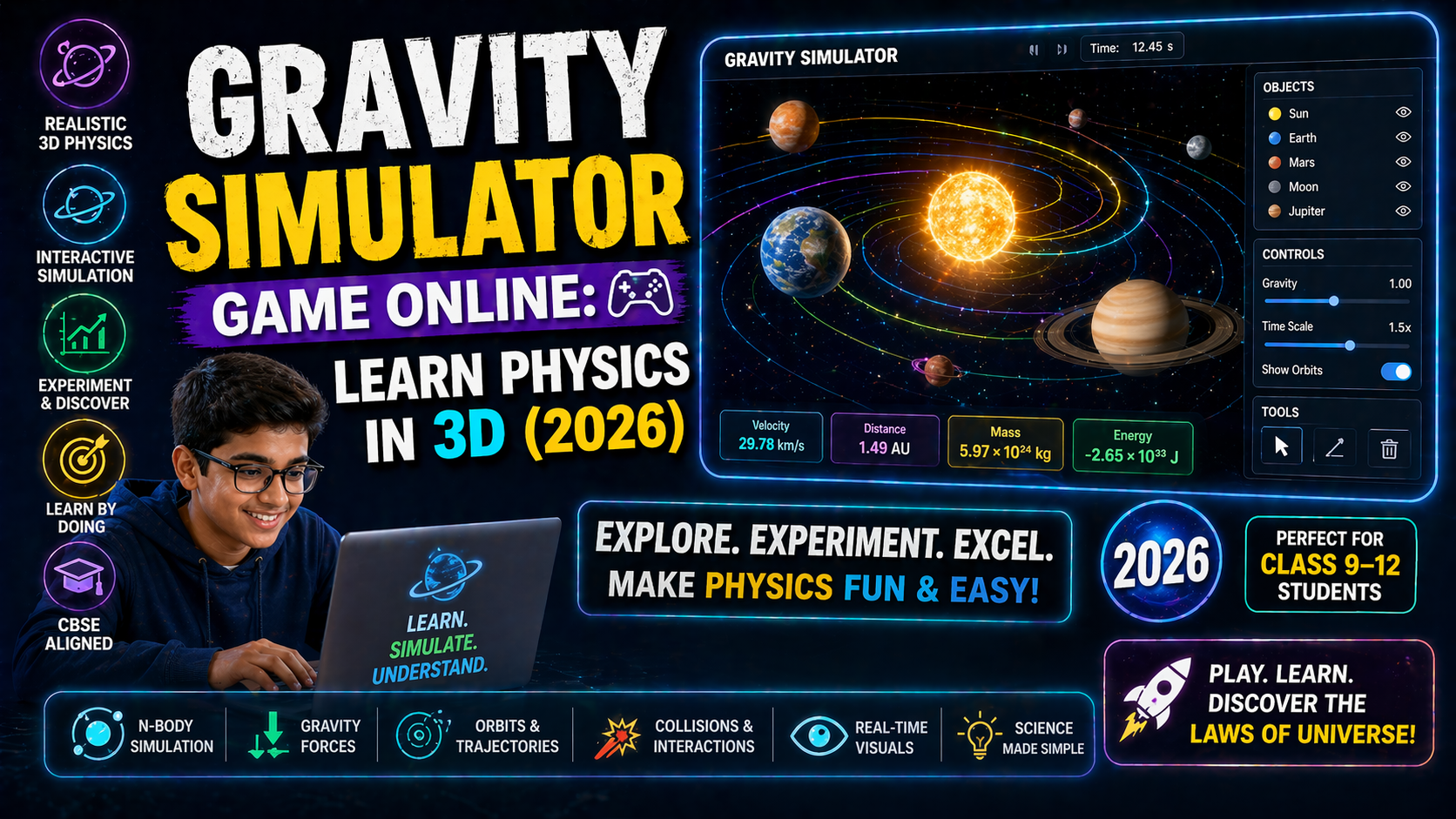
Struggling with thermodynamics CBSE questions? You’re not alone—students across India often find heat transfer, gas laws, and energy problems abstract until they see them in action. What if you could change variables in real time and watch how temperature, pressure, and work interact? With AI-powered simulations, you don’t just solve thermodynamics CBSE questions—you understand them by doing. No more guessing; just see how energy rules the universe.
This guide dives into the most common thermodynamics CBSE questions—from the first law to entropy—and shows you how to tackle them with interactive simulations. Whether you're prepping for Class 11 exams, NEET, or JEE, these tools will turn confusing concepts into clickable discoveries.
Why This Matters: Thermodynamics CBSE Questions Made Real for Indian Students
In India’s competitive education landscape, thermodynamics CBSE questions often feel like a puzzle with missing pieces. Teachers rush through theory, students scribble notes, and exams test recall—not understanding. But here’s the truth: NEP 2020 emphasizes experiential learning, and simulations are the bridge between theory and real-world grasp.
Imagine solving a thermodynamics CBSE question about an adiabatic process—and instead of memorizing formulas, you adjust the piston in a cylinder, watch pressure drop, and see temperature change in real time. That’s the power of interactive labs. For CBSE students, this means:
- No more blank stares when faced with thermodynamics CBSE questions about heat engines or entropy.
- Visual proof of why the first law of thermodynamics works (energy isn’t created or destroyed—just transformed).
- Instant feedback on mistakes—like seeing how your assumptions about fluid pressure or buoyancy actually affect outcomes.
- Alignment with NEP 2020: Hands-on learning that meets India’s new competency-based education standards.
For teachers, these simulations save hours of setup for thermodynamics CBSE practicals, while students—especially in rural areas with limited lab access—gain the same tactile understanding as urban peers.
The 4 Thermodynamics Concepts You’ll Master with Simulations
Let’s break down the thermodynamics CBSE questions you’ll encounter and how simulations make them click.
1. First Law of Thermodynamics: Energy Isn’t Lost—Just Transformed
The first law states that energy is conserved: ΔU = Q − W, where ΔU is internal energy change, Q is heat added, and W is work done. But how does this play out in real systems? Simulations let you:
- Add heat (Q) to a gas in a piston and watch its temperature and volume change.
- Do work (W) on the gas by compressing the piston—see how its internal energy rises.
- Compare adiabatic (no heat transfer) vs. isothermal (constant temperature) processes side by side.
Why it helps: You’ll no longer confuse thermodynamics CBSE questions about heat added vs. work done. Instead, you’ll see the direct relationship.
2. Gas Laws: Boyle’s, Charles’, and the Ideal Gas Equation
Thermodynamics CBSE questions about gas laws often trip students up because they’re abstract. Simulations fix this by letting you:
- Pressurize a gas in a container and see its volume shrink (Boyle’s Law: P∝1/V).
- Heat a gas while keeping pressure constant—watch its volume expand (Charles’ Law: V∝T).
- Combine all laws into the Ideal Gas Equation (PV = nRT) and tweak variables to see real-time effects.
Pro tip: Use simulations to answer thermodynamics CBSE questions like, *“A gas occupies 2L at 300K. What’s its volume at 600K if pressure is constant?”*—just adjust the slider and read the answer.
3. Heat Transfer: Conduction, Convection, and Radiation
Forget passive diagrams. Simulations let you:
- Place a hot rod in contact with a cold block—watch heat flow via conduction.
- Stir a liquid and see convection currents form as warm fluid rises.
- Shine a light on a surface and measure radiation absorption.
Example question: *“Why does a metal spoon feel colder than wood at room temperature?”* Simulate it: touch the spoon to your finger and observe the rapid heat transfer via conduction.
4. Entropy: The Arrow of Time in Thermodynamics
Entropy—the disorder of a system—is one of the trickiest thermodynamics CBSE questions. Simulations make it tangible:
- Watch a gas expand from a small container to a larger one—entropy increases as particles spread out.
- Compare reversible vs. irreversible processes (e.g., frictionless vs. frictional expansion).
- See how entropy relates to the second law: *“In an isolated system, entropy always increases.”*
Key insight: You’ll feel why entropy explains why ice melts and why heat flows from hot to cold—without memorizing formulas.
What If You Changed This? 3 Experiments to Try Now
Stop reading—do these to solve thermodynamics CBSE questions like a pro:
1. What If You Made a Gas Adiabatic?
In an adiabatic process, no heat is exchanged with the surroundings (Q = 0). Use the simulation to:
- Compress a gas quickly—observe its temperature rise (work done on the gas increases internal energy).
- Expand the gas suddenly—watch its temperature drop (gas does work on surroundings).
- Compare to an isothermal process (where temperature stays constant).
Thermodynamics CBSE question to solve: *“Explain why an adiabatic expansion cools a gas, while an isothermal expansion doesn’t.”*
2. What If You Added a Resistor to a Thermodynamic Cycle?
Yes, you read that right—ohm law resistor simulation meets thermodynamics! While resistors aren’t typically part of thermodynamics, they’re used in real-world systems like heaters or refrigerators. Try:
- Model a resistor as a heat source in a closed system—see how electrical work converts to thermal energy.
- Adjust resistance and observe how power dissipation (I²R) affects temperature.
- Connect it to a gas law simulation: How does heating a gas via a resistor change its pressure?
Thermodynamics CBSE question to solve: *“A resistor dissipates 50W of power in a gas. If the gas is at constant volume, how does its internal energy change?”*
3. What If You Simulated Fluid Pressure and Buoyancy?
While not pure thermodynamics, fluid pressure buoyancy simulation helps visualize how pressure gradients affect energy systems. Experiment with:
- Submerge an object in a fluid—watch buoyancy forces balance gravitational pull.
- Change fluid density and see how pressure varies with depth (Pascal’s Principle).
- Add heat to the fluid—observe how thermal expansion changes buoyancy.
Thermodynamics CBSE question to solve: *“Why does hot air rise? Use buoyancy principles to explain.”*
Thermodynamics CBSE Questions Solved: Sample Problems with Simulations
Let’s tackle thermodynamics CBSE questions you’ll see in exams—with simulations as your lab partner.
Problem 1: First Law Application
Question: *“100J of heat is added to a gas that does 60J of work. What’s the change in internal energy?”*
Solution with simulation: 1. Set Q = +100J (heat added). 2. Set W = +60J (work done by the gas). 3. The simulation shows ΔU = Q − W = 40J—internal energy increases by 40J. 4. Visual check: The gas’s temperature rises, confirming energy is stored internally.
Problem 2: Ideal Gas Law
Question: *“A gas at 27°C and 1 atm occupies 5L. What’s its volume at 127°C if pressure is constant?”*
Solution with simulation: 1. Input initial conditions: T₁ = 300K, P₁ = 1 atm, V₁ = 5L. 2. Set final temperature: T₂ = 400K (127°C). 3. The simulation applies Charles’ Law: V₂ = V₁ × (T₂/T₁) → V₂ ≈ 6.67L. 4. Drag the slider to confirm the volume expands as temperature rises.
Problem 3: Entropy Change
Question: *“Calculate the entropy change when 100g of water freezes at 0°C.”*
Solution with simulation: 1. Simulate a phase change: water → ice at constant temperature. 2. Observe entropy decreases (order increases as molecules align in ice). 3. Use the simulation’s entropy calculator: ΔS = −Q/T = −334J/K ÷ 273K ≈ −1.22J/K. 4. Note: This is an irreversible process (entropy of the universe increases due to heat loss to surroundings).
Why Simulations Beat Textbooks for Thermodynamics CBSE Questions
Textbooks describe thermodynamics; simulations make it feel real. Here’s why they’re superior:
- No more “why does this formula work?”—see it in action.
- Instant feedback on mistakes (e.g., “Your assumption about adiabatic processes is wrong—here’s why”).
- NEP 2020 compliant: Active learning over passive reading.
- Accessible anywhere—no lab equipment needed.
- Prep for NEET/JEE: Visualizing thermodynamics reduces exam anxiety.
For teachers, simulations turn thermodynamics CBSE practicals into 10-minute demos. For students, they turn thermodynamics CBSE questions into interactive puzzles.
Try It Free on SPYRAL
Everything discussed in this article is available for free on SPYRAL AI Workbench — Physics Simulations. No signup required for guest access — just open it and start learning.
Explore SPYRAL AI Workbench — Physics Simulations →Frequently Asked Questions
How can I solve thermodynamics CBSE questions about heat engines efficiently?
Use a thermodynamics simulation to model a Carnot cycle. Adjust temperatures of hot/cold reservoirs and watch efficiency (W/Qhot) change. You’ll see why real engines (like diesel cars) are less efficient than ideal ones—see the trade-offs in real time.
Can I use an ohm law resistor simulation to understand thermodynamics?
Absolutely! While resistors aren’t thermodynamics per se, they’re used in real-world systems like electric heaters. Simulate a resistor heating a gas: adjust resistance to see how power dissipation (I²R) raises temperature. This bridges electricity and thermodynamics—great for thermodynamics CBSE questions about energy conversion.
What’s the best way to visualize fluid pressure buoyancy simulation for CBSE thermodynamics?
Combine a fluid pressure simulation with a buoyancy tool. Submerge an object and adjust fluid density/temperature. You’ll see how thermal expansion affects buoyancy—directly answering thermodynamics CBSE questions about density changes in gases/liquids. Try it here.
How do I use a lens formula calculator to understand thermodynamics?
While lenses and thermodynamics seem unrelated, both involve energy transfer. Use a lens formula simulation to model how light (energy) refracts through media. Then, compare it to how heat transfers through conductors—both rely on gradient-driven flow. For thermodynamics CBSE questions about heat conduction, think of lenses as “light conductors.”
Are there simulations for electrostatics simulation that help with thermodynamics?
Yes! Electrostatics and thermodynamics overlap in concepts like potential energy. Simulate a charged particle moving in an electric field—then compare it to a gas molecule’s internal energy changes. Both systems follow conservation laws. For thermodynamics CBSE questions about potential energy in gases, electrostatics simulations provide a visual analogy.
How can I practice thermodynamics CBSE questions about adiabatic processes?
Use an adiabatic compression/expansion simulation. Set Q = 0 (no heat transfer) and adjust the piston speed. Watch temperature rise during compression and drop during expansion—this directly answers thermodynamics CBSE questions about work-energy relationships. Start here.
What’s the difference between an electrostatics simulation and a thermodynamics simulation?
Electrostatics simulates charged particle interactions (e.g., Coulomb’s Law), while thermodynamics simulates energy transfer in bulk systems (e.g., gases, fluids). However, both explore conservation laws—electrostatics conserves charge; thermodynamics conserves energy. For thermodynamics CBSE questions, focus on simulations with pistons, heat sources, or phase changes.
How do I use simulations for thermodynamics CBSE practicals without a lab?
Simulations replace real labs entirely. For example, to demonstrate the first law of thermodynamics, simulate a gas in a cylinder: add heat, do work, and measure internal energy changes. Teachers can assign virtual experiments—students submit screenshots of their simulations with explanations. Learn how NEP 2020 supports this.
Can I use a lens formula calculator to teach thermodynamics concepts?
Indirectly, yes! Both lenses and thermodynamic systems involve gradient-driven processes (light bends toward lower refractive index; heat flows toward lower temperature). Use a lens simulation to model how energy “focuses” (e.g., a convex lens converges light like a heat sink converges heat). For thermodynamics CBSE questions about heat transfer, think of lenses as “energy lenses.”
How do I explain the second law of thermodynamics using simulations?
Simulate a gas expanding into a vacuum. Observe entropy increase as particles spread out—this visually proves the second law: “In an isolated system, entropy always increases.”* Use the simulation’s entropy meter to quantify changes. For thermodynamics CBSE questions about irreversibility, compare reversible (slow) vs. irreversible (fast) expansions.
Are there free thermodynamics simulations for CBSE Class 11?
Yes! SPYRAL AI Workbench offers free, no-signup simulations for all CBSE thermodynamics topics. Try the first law, gas laws, or entropy modules—all aligned with NCERT and NEP 2020. Explore free tools here.
How can I use simulations for thermodynamics CBSE questions about real-world applications?
Simulate a heat engine (like a car engine) or a refrigerator. Adjust temperatures of hot/cold reservoirs and observe efficiency. For thermodynamics CBSE questions about power plants, model a Rankine cycle. These simulations connect theory to real-world energy systems—critical for NEET/JEE prep.
Ready to master thermodynamics CBSE questions? Dive into the simulations—no textbook needed.