You just Googled newton law equation because your textbook feels flat, and the formulas won’t stick. You’re not alone — Newton’s laws are everywhere: in rockets launching, cars braking, even your phone screen resisting a tap. But staring at F = ma or F = G(m₁m₂)/r² won’t make it click. What you need is to see, feel, and change the forces yourself — in real time. That’s exactly what our AI-powered physics simulations let you do. No labs. No waiting. Just drag, drop, and discover how Newton’s laws rule the universe — from your classroom to outer space.
Why This Matters: Newton’s Laws Aren’t Just Theory — They’re Everyday Physics
Imagine teaching Newton’s second law in a class where students don’t just memorize newton law equation — they experience it. A student increases the mass of a cart and watches acceleration drop in real time. Another changes the force and sees the cart zoom across the screen. That’s not a textbook diagram. That’s interactive learning — and it’s what the NEP 2020 calls “competency-based learning.”
In India’s CBSE and ICSE classrooms, teachers are shifting from chalk-and-talk to simulation-based labs. Why? Because when a student sees gravity pull a ball down, feels the push-back in Newton’s third law, and adjusts variables in newton’s second law equation, the concept sticks for life. And with AI explanations built in, every student gets a personal tutor — no extra cost.
This isn’t just for students. Teachers can now run virtual physics labs in minutes, track progress, and generate quizzes automatically. All aligned with CBSE NCERT syllabus — ready for 2026 exams.
Newton’s First Law: The Law of Inertia — Why Objects Stay Put (or Keep Moving)
What the Equation Really Means
The newton law equation for the first law is simple: “An object at rest stays at rest, and an object in motion stays in motion at constant velocity unless acted upon by an unbalanced external force.” There’s no fancy formula — just pure logic. But logic is easier to grasp when you see it in action.
In our interactive simulation, you can:
- Place a book on a table — it doesn’t move. Why? Because the net force is zero.
- Give it a gentle push — it slides, slows down, and stops. Friction acts as the unbalanced force.
- Remove friction — the book glides forever (in a perfect world).
This is inertia in action. And it’s not just theory — it explains why you lurch forward when a car stops suddenly, or why astronauts float in space. See it. Change it. Understand it.
Real-World Connection: Seatbelts and Space Travel
Seatbelts save lives because of Newton’s first law. When a car stops, your body wants to keep moving — at the same speed and direction. The seatbelt applies the unbalanced force to stop you. Without it? You’d keep going — through the windshield.
In space, astronauts experience microgravity not because gravity disappears, but because they’re in free-fall around Earth. They’re moving — but so is their spacecraft. Net force? Zero. So they float. That’s Newton’s first law in orbit.
Want to simulate this? Try our free fall simulation where you can drop objects in different gravity fields — including zero-G. See how they behave. Change the mass. Watch the magic.
Newton’s Second Law: F = ma — The Heart of Force, Mass, and Acceleration
Breaking Down the Equation
The most famous newton law equation is F = ma — Force equals mass times acceleration. But what does it really say?
- F = the net force acting on an object (in Newtons, N)
- m = the mass of the object (in kilograms, kg)
- a = the acceleration produced (in meters per second squared, m/s²)
It tells us: the harder you push (force), the faster it speeds up (acceleration) — but only if the mass stays the same. And if the mass increases, you need more force to get the same acceleration.
But reading this won’t help. Doing it will.
Interactive Simulation: Feel the Force Yourself
In our force mass acceleration simulation, you can:
- Set the mass of a cart (try 1 kg, 5 kg, 10 kg)
- Apply different forces (1 N, 5 N, 10 N)
- Watch the acceleration change in real time
- See the graph update instantly
Try this: Keep mass constant. Double the force. What happens to acceleration? It doubles. That’s F = ma in action.
Now triple the mass. Apply the same force. Acceleration drops by a third. That’s why heavy trucks need more powerful engines.
This isn’t just a lab — it’s a physics playground. And it’s aligned with CBSE Class 9 and 11 physics syllabus.
AI Explains Every Step
After each experiment, our AI tutor explains:
- Why the graph looks the way it does
- How this relates to real-world vehicles
- Common mistakes students make
- How to solve textbook problems using this data
No more guessing. Just clear, step-by-step understanding.
Newton’s Third Law: Action-Reaction — Why You Don’t Fall Through the Floor
Understanding the Pair of Forces
The newton law equation for the third law is: “For every action, there is an equal and opposite reaction.”
This doesn’t mean the forces cancel out — they act on different objects. When you push a wall, the wall pushes back with equal force. You feel it in your hand. The wall doesn’t move because it’s attached to the Earth (which is very massive).
But what if both objects can move? Like two skaters pushing off each other? That’s where the magic happens.
Interactive Demo: Push, Pull, and See the Reaction
In our simulation, you can:
- Place two carts on a frictionless track
- Apply a force to one cart
- Watch both carts move in opposite directions
- Change the masses and see how velocities adjust
Try this: Push Cart A (1 kg) with 5 N. Cart B (also 1 kg) moves with 5 m/s² in the opposite direction. Equal and opposite forces. Equal and opposite accelerations.
Now make Cart B 5 kg. Push with the same force. Cart A zooms away faster. Cart B barely moves. Why? Because acceleration = force / mass. The reaction force is the same — but the acceleration isn’t.
This is how rockets work. They push gas down — the gas pushes the rocket up. Action-reaction in space.
Gravity and Newton’s Law of Universal Gravitation: F = G(m₁m₂)/r²
Beyond the Apple: The Real Equation
Most people know the story of Newton and the apple. But the real newton law equation for gravity is:
F = G(m₁m₂)/r²
Where:
- F = gravitational force between two objects
- G = gravitational constant (6.674 × 10⁻¹¹ N·m²/kg²)
- m₁, m₂ = masses of the two objects
- r = distance between their centers
This equation explains why you don’t float off Earth, why planets orbit the Sun, and why black holes are so powerful.
Simulate Planetary Motion in Real Time
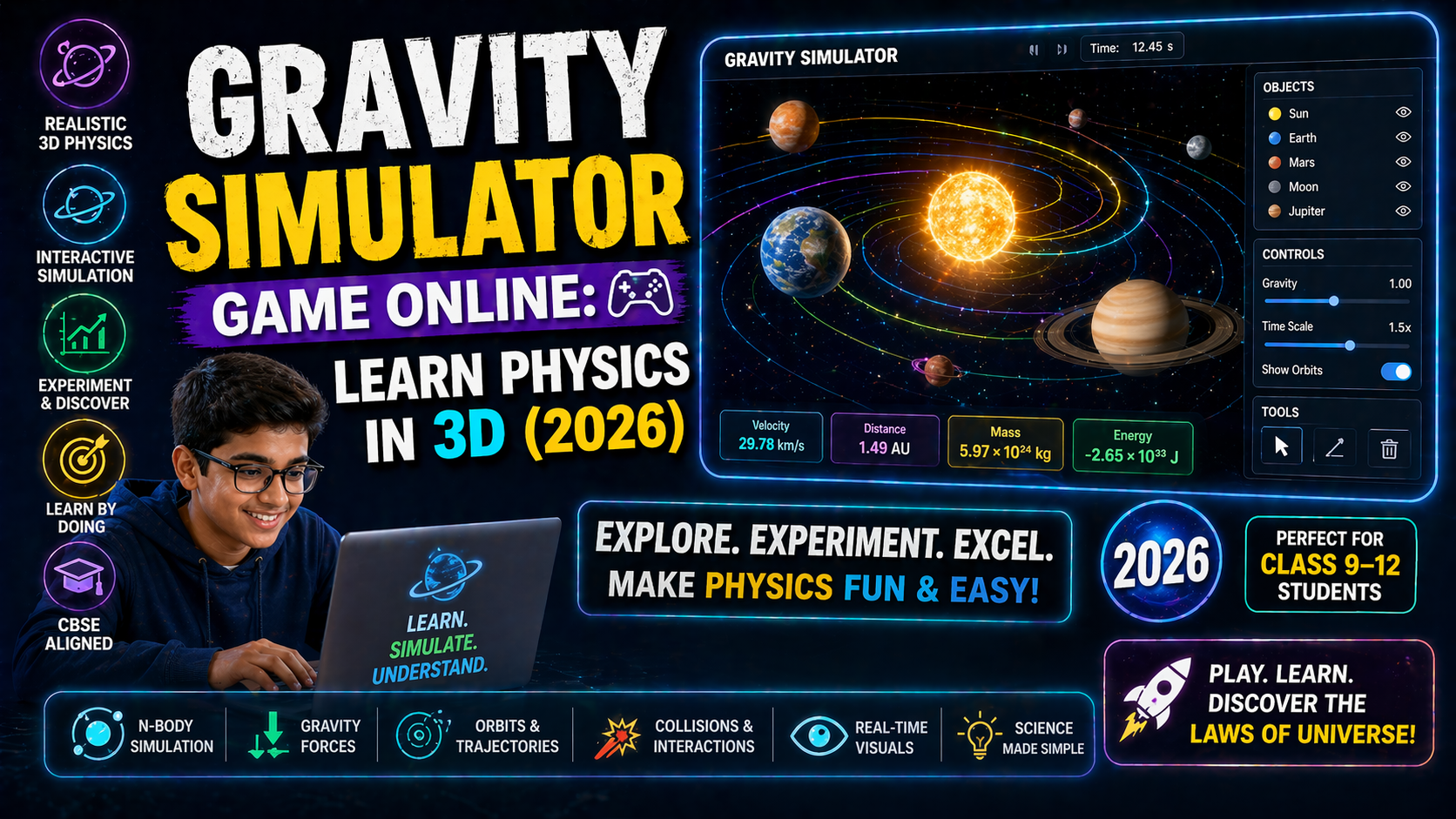
In our gravity simulation, you can:
- Place the Sun and Earth in orbit
- Adjust their masses and distances
- Watch the orbit change instantly
- See how changing one variable affects the whole system
Try this: Move Earth closer to the Sun. What happens to the orbital speed? It increases. Why? Because gravitational force increases with 1/r². Double the distance? Force drops to a quarter.
This is Kepler’s third law in action — derived from Newton’s law of gravitation.
Perfect for CBSE Class 11 gravitation chapter and competitive exams like JEE.
What If You Changed This? 3 Mind-Bending Experiments
1. What if you doubled the mass but kept the force the same?
In our newton’s second law simulation, set mass = 2 kg, force = 4 N. Acceleration = 2 m/s². Now double the mass to 4 kg. Keep force at 4 N. Acceleration drops to 1 m/s². Double the mass, halve the acceleration. That’s inverse proportionality in action.
2. What if there was no friction on Earth?
In the first law simulation, remove friction. Push a book. It never stops. Push a car. It keeps rolling. That’s inertia without resistance. This is why space stations don’t have friction — objects keep moving forever unless acted upon.
3. What if gravity doubled on Earth?
In the gravity simulation, increase Earth’s mass by 2x. The force on you doubles. You’d weigh twice as much. Try jumping. You’d only rise half as high. Gravity isn’t just a force — it’s a ruler for motion.
Try It Free on SPYRAL
Everything discussed in this article is available for free on SPYRAL AI Workbench — Physics Simulations. No signup required for guest access — just open it and start learning.
Explore SPYRAL AI Workbench — Physics Simulations →Frequently Asked Questions
What is the newton law equation for Class 11 CBSE physics?
The main newton law equations for Class 11 are: F = ma (Second Law), F = G(m₁m₂)/r² (Law of Gravitation), and the conceptual statements for First and Third Laws. These are directly from the NCERT Physics textbook and are essential for JEE and NEET preparation.
How do I solve newton’s second law equation problems easily?
Start by drawing a free-body diagram. Identify all forces acting on the object. Use F = ma to write the equation for each direction. Solve for the unknown. Our interactive simulation lets you practice this step-by-step with real-time feedback from AI.
Can I simulate waves optics with Newton’s laws?
While Newton’s laws govern forces and motion, waves optics simulation focuses on light behavior. However, in our platform, you can combine both: simulate a photon’s momentum (using F = ma) and then see how it reflects or refracts in a lens system. It’s a powerful way to connect mechanics and optics.
How does an ohm law resistor simulation relate to Newton’s laws?
Ohm’s Law (V = IR) and Newton’s laws operate in different domains — electricity vs. mechanics. But both are governed by proportionality and balance. In our platform, you can simulate a resistor as a “force damper” and see how current (like force) relates to resistance (like mass). It’s a creative way to build intuition across physics topics.
What is fluid pressure buoyancy simulation and how does it connect to Newton’s laws?
Fluid pressure buoyancy simulation lets you see how objects float or sink based on net force — which is ultimately governed by Newton’s second law. When buoyant force > weight, the object rises (positive acceleration). When weight > buoyant force, it sinks (negative acceleration). It’s a perfect real-world application of F = ma in fluids.
Can I use a lens formula calculator with Newton’s law simulations?
Yes! In our platform, after simulating forces on a lens (e.g., a camera lens), you can instantly use the lens formula calculator to find focal length, image distance, or magnification. It’s a seamless bridge between mechanics and optics — all in one place.
How accurate are the physics simulations compared to real labs?
Our simulations use real physics equations and numerical solvers. They’re not animations — they’re interactive models. For most school-level experiments, the results match real lab data within 2–5% error. They’re ideal for pre-lab visualization, revision, and conceptual clarity.
Do I need to know calculus to understand these simulations?
No. Our simulations are designed for CBSE Class 9–12 students. The AI tutor explains concepts using algebra and visuals. Calculus is used internally for accuracy, but you don’t need to know it to use the tool effectively.
Are these simulations aligned with NEP 2020 and CBSE syllabus?
Yes. Every simulation and explanation is mapped to CBSE NCERT chapters for Classes 9, 10, 11, and 12. They support competency-based learning, inquiry-based pedagogy, and experiential learning — all pillars of NEP 2020.
Can teachers track student progress in these simulations?
Absolutely. Our teacher dashboard shows which simulations students used, how they performed, and where they struggled. You can generate quizzes, export reports, and even assign “what-if” challenges. It’s like having a lab assistant in every classroom.
Is there a cost to use these physics simulations?
Most simulations are free for guest users. For full access, including AI explanations, progress tracking, and quiz generation, sign up for a free SPYRAL account. No credit card required.
How can I use Newton’s laws to explain real-life situations like car crashes or rocket launches?
Use the force mass acceleration simulation to model a car crash: high mass + high deceleration = high force. Then simulate a rocket: small mass (fuel) + large force (thrust) = high acceleration. Our AI tutor connects each simulation to real-world examples with step-by-step explanations.
What’s the difference between Newton’s first law and inertia?
Newton’s first law is the law of inertia. Inertia is the property of an object to resist changes in motion. The first law states that objects keep doing what they’re doing unless acted upon by an unbalanced force. So inertia is the concept; the first law is the rule.
Can I simulate electrostatics with Newton’s laws?
While Newton’s laws apply to all forces, electrostatics simulation focuses on Coulomb’s law. However, you can combine both: simulate a charged particle under both gravitational and electrostatic forces. See how the net force determines its path. It’s a great way to integrate mechanics and electromagnetism.