Home›
Blog›
Heart Free Treatment Hospital: Interactive Biology Simulations for CBSE Class 9–12 (NEP 2020)
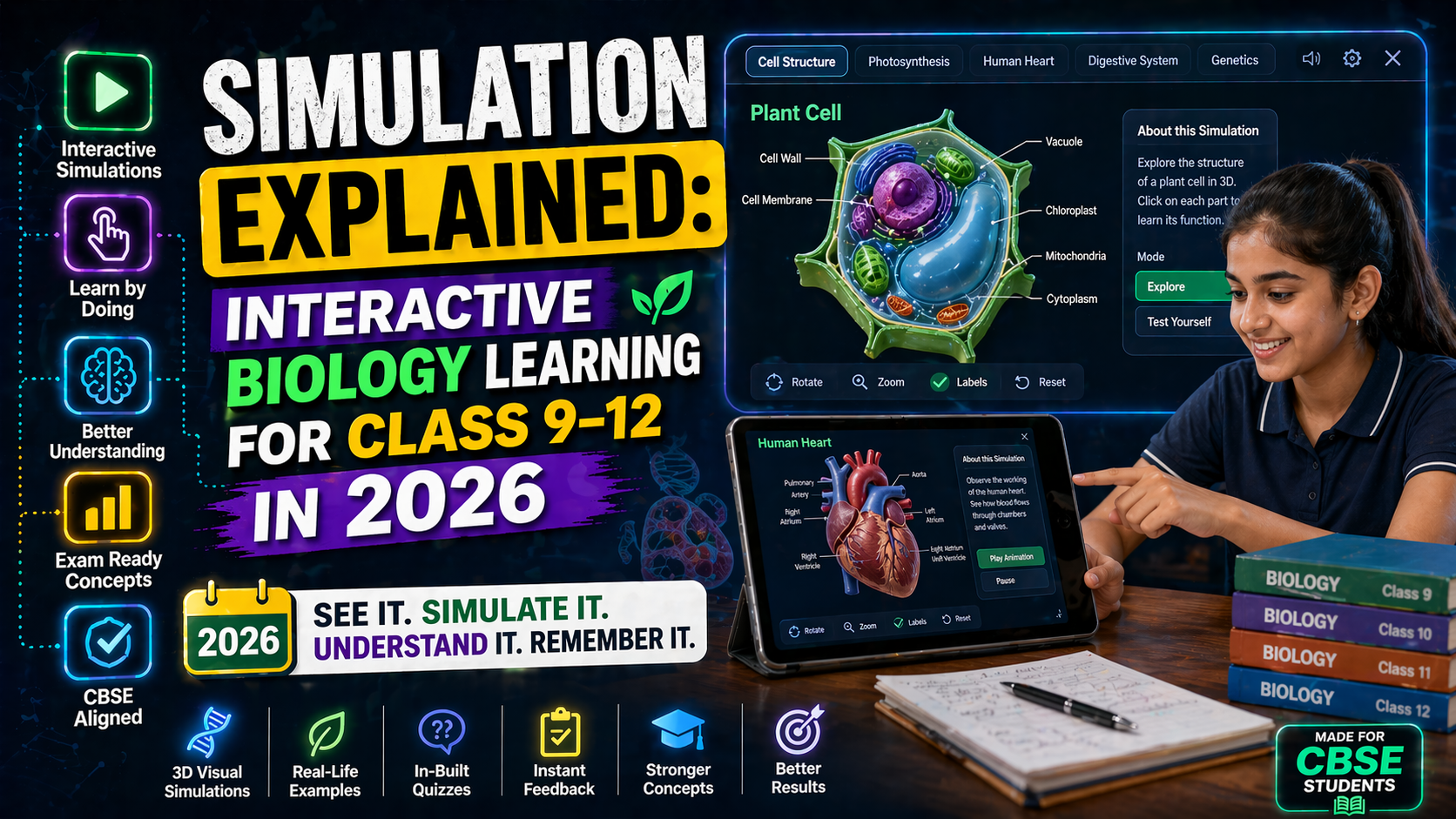
Tired of memorizing heart diagrams from textbooks or struggling to visualize how blood flows through the circulatory system? You don’t need a heart free treatment hospital to understand the human heart—just an interactive biology simulation! Imagine exploring the heart’s chambers, valves, and circulation pathways in real time, adjusting variables to see how changes affect blood flow. This guide will show you how to master the human heart with AI-powered simulations that align with CBSE Class 9–12 and NEP 2020, making learning feel as real as a hospital visit—without the stress.
Whether you're a student preparing for exams or a teacher looking for engaging tools, these simulations will transform your understanding of the heart’s anatomy and physiology. Let’s dive in!
Why This Matters: Learning the Heart Without a Hospital Visit
In India, biology is a core subject for CBSE and ICSE students, and the human heart is a critical topic for Classes 9–12. Traditional teaching methods often rely on static diagrams and textbook explanations, which can feel abstract and hard to retain. But what if you could see the heart beat, feel the pressure changes in arteries, and experiment with circulation pathways—all from your laptop or tablet?
Under the NEP 2020, India’s education policy emphasizes experiential learning and competency-based assessment. This means students need more than just theoretical knowledge—they need to discover, explore, and apply concepts in interactive ways. That’s where AI-powered simulations come in. They bridge the gap between theory and real-world understanding, making complex topics like the human heart feel tangible and exciting.
For teachers, these tools offer a way to engage students who learn differently—whether through visual, kinesthetic, or auditory methods. And for parents, they provide a way to support their child’s learning at home without expensive lab equipment or hospital visits. No more guessing how the heart works—just see it in action.
Understanding the Human Heart: From Anatomy to Function
The human heart is a marvel of engineering, pumping blood through the body’s circulatory system to deliver oxygen and nutrients while removing waste. But how does it actually work? Let’s break it down with the help of interactive simulations.
1. Anatomy of the Heart: Chambers, Valves, and Blood Vessels
The heart is divided into four chambers: the atria (upper chambers) and the ventricles (lower chambers). Blood flows through these chambers via one-way valves that prevent backflow. The right side of the heart handles deoxygenated blood, while the left side manages oxygenated blood.
To visualize this, imagine a heart free treatment hospital where you can open the heart like a book and see each chamber and valve in action. With an interactive simulation, you can:
- Zoom into the heart’s anatomy to see the atrial septum, ventricular septum, and coronary arteries.
- Adjust the heart rate to observe how quickly blood moves through the chambers.
- Highlight the valves (e.g., tricuspid, pulmonary, mitral, and aortic) to see how they open and close during the cardiac cycle.
⚗
Try This Simulation Free
Open the interactive simulation on anAIza School — no download, no signup needed.
Open Simulation →Explore the heart’s chambers and valves in real time. Adjust the heart rate and see how blood flows through the circulatory system.
2. The Cardiac Cycle: How the Heart Beats
The cardiac cycle consists of two main phases: systole (contraction) and diastole (relaxation). During systole, the heart pumps blood into the arteries, while during diastole, it fills with blood from the veins. This cycle repeats approximately 70–80 times per minute in a resting adult.
With an interactive simulation, you can:
- Observe the atria contracting first, pushing blood into the ventricles.
- Watch the ventricles contract, forcing blood into the pulmonary artery and aorta.
- See how the valves open and close to regulate blood flow and prevent backflow.
This hands-on approach helps students grasp the timing and coordination of the heart’s contractions, which is crucial for understanding conditions like arrhythmias or valvular heart disease.
3. Circulatory System: The Heart’s Role in Blood Flow
The heart is the center of the circulatory system, which includes the pulmonary circulation (heart to lungs) and systemic circulation (heart to the rest of the body). Blood carries oxygen and nutrients to cells and removes carbon dioxide and waste products.
In a simulation, you can:
- Trace the path of a red blood cell from the right atrium to the left ventricle and back again.
- Adjust the blood pressure to see how it affects circulation.
- Explore how oxygen-rich blood (red) and oxygen-poor blood (blue) move through the heart and lungs.
This visualization makes it easier to understand how the heart works as part of a larger system, not just as an isolated organ.
Heart Free Treatment Hospital: Simulating Medical Conditions
One of the most powerful aspects of interactive simulations is the ability to explore what-if scenarios. What if a valve malfunctions? What if the heart rate increases? These simulations allow you to experiment with medical conditions in a safe, virtual environment—much like a heart free treatment hospital where you can observe the effects of different conditions without real-world risks.
1. Valvular Heart Disease: Seeing the Effects of Stenosis or Regurgitation
Valvular heart disease occurs when the heart’s valves don’t open or close properly. In a simulation, you can:
- Simulate stenosis (narrowing of a valve) and observe how it restricts blood flow.
- Model regurgitation (leaky valve) and see how blood leaks backward.
- Compare healthy vs. diseased valves to understand the impact on circulation.
This helps students visualize how conditions like aortic stenosis or mitral regurgitation affect the heart’s efficiency and why treatment (like surgery) is necessary.
2. Arrhythmias: Exploring Irregular Heartbeats
Arrhythmias are irregular heart rhythms that can range from harmless to life-threatening. In a simulation, you can:
- Adjust the heart rate to create tachycardia (fast heartbeat) or bradycardia (slow heartbeat).
- Introduce extra beats (premature contractions) to see how they disrupt the cardiac cycle.
- Observe how the body compensates for irregular rhythms.
This simulation helps students understand why conditions like atrial fibrillation require medical intervention and how devices like pacemakers can help regulate the heart’s rhythm.
3. Heart Failure: Observing Reduced Pump Efficiency
Heart failure occurs when the heart can’t pump enough blood to meet the body’s needs. In a simulation, you can:
- Reduce the heart’s pumping efficiency and see how blood pools in the chambers.
- Adjust the blood pressure to simulate how the body compensates for reduced output.
- Explore how medications or lifestyle changes (like exercise) can improve heart function.
This simulation provides a tangible way to understand why heart failure patients often experience symptoms like fatigue or shortness of breath.
What If You Changed This?
Now that you’ve seen how the heart works in a simulation, let’s experiment with some what-if scenarios to deepen your understanding. Try these adjustments in the simulation and observe the results:
1. What If the Heart Rate Doubled?
Adjust the heart rate from 70 bpm to 140 bpm and observe:
- How quickly blood moves through the chambers.
- Whether the valves have enough time to open and close properly.
- How this might affect oxygen delivery to the body.
Hint: At higher heart rates, the heart may not fill completely between beats, reducing efficiency. This can lead to conditions like tachycardia.
2. What If One of the Valves Was Damaged?
Simulate a damaged mitral valve by allowing some blood to leak backward into the left atrium. Observe:
- How blood pools in the left atrium during ventricular contraction.
- Whether the left ventricle fills properly before the next beat.
- How this might lead to symptoms like shortness of breath.
Hint: This scenario mimics mitral regurgitation, a condition where the valve doesn’t close tightly, causing blood to flow backward.
3. What If the Blood Pressure Dropped Significantly?
Reduce the blood pressure to 80/50 mmHg (from a normal 120/80 mmHg) and observe:
- How the heart works harder to pump blood through the arteries.
- Whether the valves can still open and close effectively.
- How this might affect organ function, especially in the brain and kidneys.
Hint: Low blood pressure can lead to hypoperfusion, where organs don’t receive enough oxygen and nutrients.
Frequently Asked Questions
How can I access heart free treatment hospital-style simulations for free?
You can access free, interactive heart simulations on platforms like SPYRAL AI Workbench. These simulations allow you to explore the heart’s anatomy, circulation, and medical conditions without needing a hospital visit. No signup is required for guest access—just start experimenting!
Are there interactive biology simulations that align with CBSE Class 9–12?
Yes! Many platforms, including SPYRAL’s NEP-aligned simulations, offer interactive biology tools that cover CBSE Class 9–12 topics, including the human heart. These simulations are designed to meet the NEP 2020 curriculum’s focus on experiential learning.
Can I use a heart diagram explained with simulation to prepare for CBSE exams?
Absolutely! Interactive simulations like those on SPYRAL make it easier to visualize and understand complex concepts like the heart’s anatomy and function. These tools help you retain information better and perform well in exams by providing hands-on learning experiences.
Where can I find heart free images for CBSE that include simulations?
For heart free images combined with simulations, platforms like SPYRAL AI Workbench offer 3D interactive models. These simulations let you rotate, zoom, and explore the heart in real time, making static images feel dynamic and engaging.
How do 3D heart simulation for students help in understanding circulation?
3D heart simulations provide a real-time, interactive way to see how blood flows through the heart’s chambers and valves. You can adjust variables like heart rate or blood pressure to observe changes in circulation. This hands-on approach helps students grasp the heart’s function more intuitively than reading from a textbook.
Are there heart free fire name style simulations for biology?
While “heart free fire name style” might refer to a popular game, the closest educational equivalent is an interactive heart simulator online free that lets you explore the heart’s anatomy and physiology. Platforms like SPYRAL offer these simulations, allowing you to experiment with heart functions in a fun and engaging way.
What is a heart freedom simulation?
A heart freedom simulation refers to an interactive tool that lets you explore the heart’s function without restrictions, such as adjusting heart rate, blood pressure, or valve conditions. These simulations help students understand how the heart adapts to different scenarios, much like a heart free treatment hospital where you can observe the heart’s behavior in various states.
How can I use a heart simulator online free to study for Class 11 biology?
Free heart simulators like those on SPYRAL are perfect for Class 11 biology. You can use them to:
- Visualize the heart’s anatomy and circulation pathways.
- Experiment with heart rates and blood pressures to see their effects.
- Explore medical conditions like arrhythmias or valvular diseases.
These tools align with the CBSE curriculum and make learning interactive and engaging.
Yes! Many platforms offer heart free download 2026 simulations that you can use offline or online. For example, SPYRAL AI Workbench provides interactive heart simulations that you can access anytime. These tools are designed to be user-friendly and align with the latest CBSE and NEP 2020 guidelines.
What is the best way to learn the human heart using interactive 3D biology simulations?
The best way to learn the human heart with interactive 3D biology simulations is to:
- Start by exploring the heart’s anatomy in 3D to understand its structure.
- Adjust variables like heart rate or blood pressure to see real-time effects.
- Experiment with medical conditions to observe their impact on circulation.
- Use AI-powered explanations to clarify any doubts as you go.
Platforms like SPYRAL make this process intuitive and engaging.
How do AI-powered biology labs help in understanding the heart?
AI-powered biology labs enhance understanding by providing real-time feedback and explanations. For example, when you adjust the heart rate in a simulation, the AI can explain how this affects blood flow or valve function. This immediate feedback helps students grasp complex concepts faster and retain information better than traditional learning methods.
Are there any heart free hospital simulation tools for teachers?
Yes! Teachers can use platforms like SPYRAL AI Workbench to create heart free hospital simulation experiences for their students. These tools allow teachers to:
- Assign interactive labs to explore the heart’s function.
- Generate quizzes based on simulation experiments.
- Track student progress and identify areas where they need more practice.
This makes teaching more dynamic and aligned with NEP 2020’s focus on experiential learning.
Final Thoughts: Make Learning the Heart Feel Real
Understanding the human heart doesn’t have to be abstract or confusing. With interactive biology simulations, you can explore the heart’s anatomy, circulation, and medical conditions in a way that feels as real as a visit to a heart free treatment hospital. These tools align with CBSE Class 9–12 and NEP 2020, making learning engaging, hands-on, and effective.
Whether you're a student preparing for exams or a teacher looking for innovative teaching tools, these simulations offer a powerful way to master the human heart. So why wait? Try it out today and see the heart in action!
For more interactive biology simulations, visit SPYRAL AI Workbench—no signup required!
Tags
#CBSE Biology Class 9–12, #NEP 2020 Biology, #Interactive Heart Simulations, #Human Heart Anatomy, #Circulatory System, #AI-Powered Biology Labs, #Heart Free Treatment Hospital, #3D Heart Simulation, #Biology Simulations for Students, #CBSE Biology Tools, #NEP 2020 Learning, #Heart Free Images, #Heart Class 11 Biology