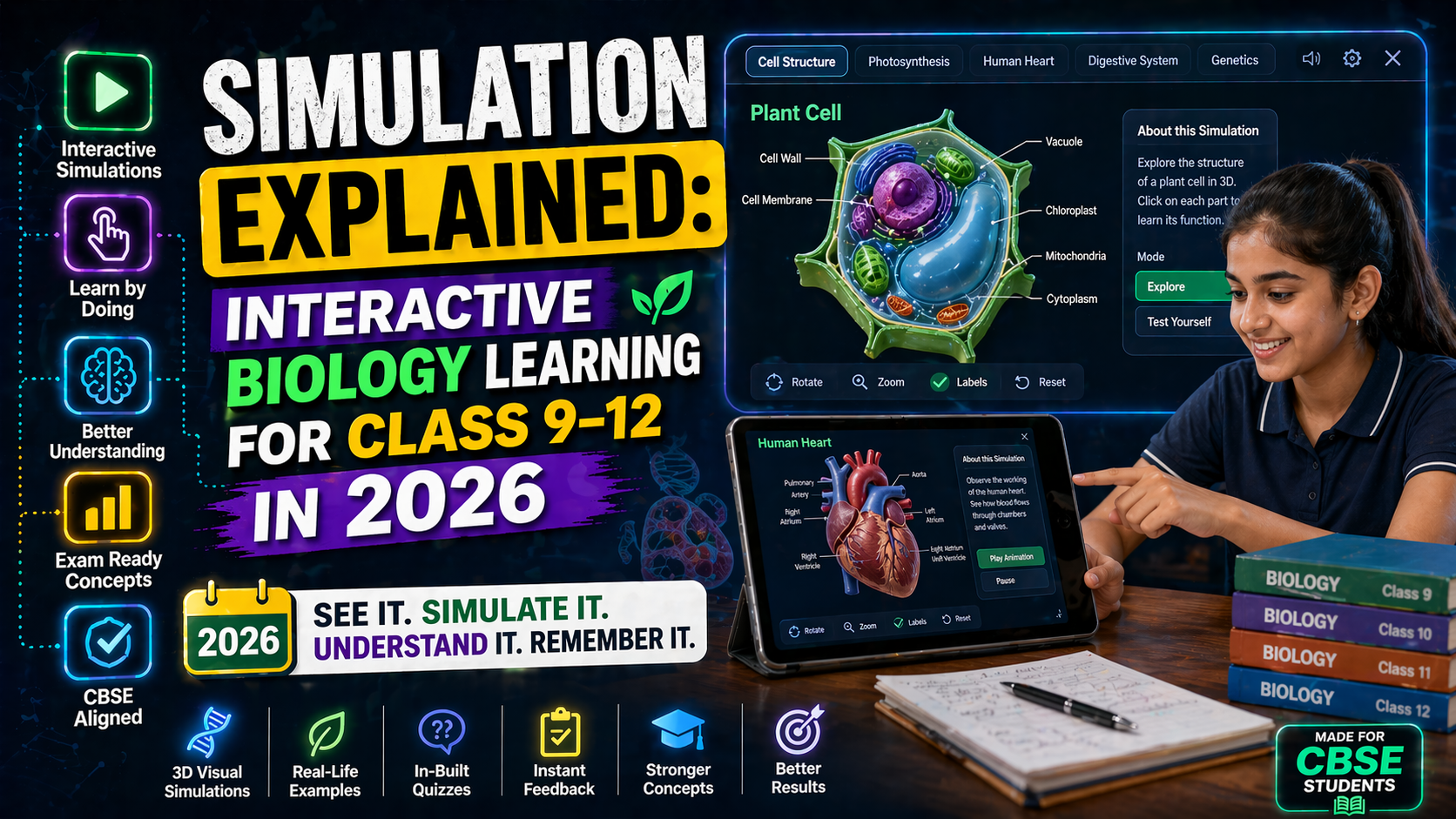
You just opened your Class 11 Biology textbook, stared at the heart diagram for the 10th time, and thought: ‘Why does this still feel so confusing?’ You’re not alone. The human heart isn’t just a pump — it’s a dynamic system with chambers, valves, electrical signals, and blood flow patterns that change with every beat. Memorizing labels on a 2D page doesn’t help you feel how it works.
That’s why we built interactive 3D simulations that let you see, hear, and manipulate the heart in real time — no textbook can do that. Whether you're preparing for CBSE exams, NEET, or just curious about how your body works, these simulations turn confusion into clarity. Let’s dive in.
Why This Matters: Beyond the Textbook
Understanding the heart isn’t just for exams — it’s about knowing how your body keeps you alive. A misfiring electrical signal? That’s an arrhythmia. A blocked artery? That’s a heart attack. These aren’t abstract concepts — they’re real, life-altering events. With interactive simulations, you can:
See blood flow in real time as valves open and close
Adjust heart rate and watch how it affects circulation
Simulate blockages and observe the body’s response
Explore ECG patterns linked to different heart conditions
This isn’t passive learning — it’s active discovery. And it’s what makes SPYRAL’s AI-powered simulations different from any textbook or video.
The Heart in 3D: What You Need to Know
1. Structure of the Heart: More Than Just Chambers
The heart has four chambers: two atria (upper) and two ventricles (lower). But it’s not just about left vs. right — it’s about function.
Right Atrium & Ventricle: Receives deoxygenated blood from the body and pumps it to the lungs via the pulmonary artery.
Left Atrium & Ventricle: Receives oxygenated blood from the lungs and pumps it to the body via the aorta.
But here’s the catch: the left ventricle has thicker walls because it pumps blood to the entire body, while the right ventricle only pumps to the lungs. Why? Because the systemic circuit (body) has higher resistance than the pulmonary circuit (lungs).
Want to see this in action? Rotate the 3D heart model in the simulation below and zoom into each chamber. The thickness changes dynamically as you toggle between views.
⚗
Try This Simulation Free
Open the interactive simulation on anAIza School — no download, no signup needed.
Change the variables yourself — see what happens in real time.
2. Blood Flow Pathway: Follow the Journey
The heart’s job is to keep blood moving in a precise loop. Here’s the path:
Deoxygenated blood enters the right atrium from the superior and inferior vena cava.
Blood flows through the tricuspid valve into the right ventricle.
The right ventricle pumps blood through the pulmonary valve into the pulmonary artery, which carries it to the lungs.
In the lungs, blood picks up oxygen and releases CO₂.
Oxygenated blood returns to the left atrium via the pulmonary veins.
Blood flows through the mitral (bicuspid) valve into the left ventricle.
The left ventricle pumps blood through the aortic valve into the aorta, which distributes it to the body.
This cycle repeats about 70 times per minute at rest. But what happens when the valves don’t close properly? Or when the heart rate speeds up during exercise? Simulate it yourself in the interactive model above.
3. Cardiac Cycle: The Rhythm of Life
The cardiac cycle is the sequence of events that occurs in one heartbeat. It has two main phases:
Diastole: The heart muscle relaxes, allowing chambers to fill with blood.
Systole: The heart muscle contracts, pumping blood out of the chambers.
But it’s not that simple. The atria contract first (atrial systole), then the ventricles (ventricular systole). The electrical system (sinoatrial node → atrioventricular node → Purkinje fibers) coordinates this timing. A delay or misfire here can cause serious issues.
In the simulation, you can adjust the timing of contractions and watch how it affects blood pressure and flow. See what happens when the AV node delays conduction — that’s the basis of heart block.
SIM EMBED SECTION
⚗
Try This Simulation Free
Open the interactive simulation on anAIza School — no download, no signup needed.
Change the variables yourself — see what happens in real time.
What If You Changed This? 3 Real-World Scenarios to Explore
Scenario 1: What Happens If a Valve Doesn’t Close Properly?
Imagine the mitral valve (between left atrium and ventricle) doesn’t close completely. This is called mitral regurgitation. Blood leaks backward into the atrium during systole.
Try this in the simulation:
Set the mitral valve to “leaky” mode.
Observe the backflow of blood into the left atrium.
Watch how the left ventricle has to work harder to maintain output.
Check the ECG — you might see changes in the P wave or QRS complex.
This is why patients with valve issues often feel fatigued — their heart is working overtime.
Scenario 2: How Does Exercise Affect Heart Rate and Blood Flow?
During exercise, your heart rate increases to deliver more oxygen to muscles. But how exactly does this happen?
Try this in the simulation:
Increase the “exercise intensity” slider.
Watch the heart rate rise from 70 bpm to 150+ bpm.
Observe the stroke volume (amount of blood pumped per beat) increase.
See how the coronary arteries (which supply the heart muscle) dilate to meet increased demand.
This is why athletes have lower resting heart rates — their hearts are more efficient.
Scenario 3: What Happens During a Heart Attack?
A heart attack (myocardial infarction) occurs when a coronary artery becomes blocked, cutting off blood flow to a part of the heart muscle. Without oxygen, that tissue starts to die.
Try this in the simulation:
Simulate a blockage in the left anterior descending (LAD) artery.
Watch the affected part of the left ventricle turn pale (indicating lack of blood flow).
Observe the drop in cardiac output and blood pressure.
See how the heart compensates by increasing heart rate (tachycardia).
This is why time is muscle — the faster the blockage is cleared (via stent or clot-busting drugs), the less damage occurs.
AI Explanations: Your Personal Biology Tutor
After every simulation, you get an AI-generated explanation that adapts to your actions. For example:
If you simulate a fast heart rate, the AI explains: ‘This is tachycardia. It can be caused by stress, fever, or heart disease. The ECG shows rapid, regular QRS complexes.’
If you create a valve leak, the AI says: ‘Mitral regurgitation causes a systolic murmur. The left ventricle hypertrophies over time due to increased workload.’
If you block a coronary artery, the AI warns: ‘This is a medical emergency. The affected myocardium becomes ischemic and may infarct (die) within minutes.’
This isn’t just information — it’s instant feedback that helps you connect cause and effect. No more guessing why something happens.
CBSE & NEET Alignment: Notes That Match Your Syllabus
Our simulations and notes are fully aligned with:
CBSE Class 11 Biology (NCERT) — Chapter 18: Body Fluids and Circulation
NEET 2026 — High-yield topics like cardiac output, ECG, and heart disorders
International Boards (IB, A-Level) — Functional anatomy and physiology emphasis
Each simulation includes:
Labeled 3D models
Interactive diagrams
AI-generated summaries
Quiz questions with instant feedback
Curriculum mapping to NCERT and NEET syllabi
You can even export your notes as PDFs or share them with your teacher for review.
Try It Free on SPYRAL
Everything discussed in this article is available for free on SPYRAL AI Workbench — Biology Simulations. No signup required for guest access — just open it and start learning.
1. Can I use these simulations for NEET preparation?
Absolutely! The simulations cover high-yield NEET topics like cardiac output, ECG interpretation, and heart disorders. Each session includes AI-generated explanations and quiz questions aligned with NEET patterns.
2. Do I need to install anything to use the simulations?
No. SPYRAL runs entirely in your browser — no downloads, no plugins. Works on desktop, tablet, and even mobile (though a larger screen is recommended for 3D models).
3. How accurate are the simulations compared to real anatomy?
Our simulations are built using real medical imaging data and peer-reviewed physiology models. They’re validated against standard physiology textbooks and used by educators worldwide. You’re seeing a scientifically accurate representation of the heart.
4. Can teachers use this in their classrooms?
Yes! Teachers can access the SPYRAL Teacher Dashboard to track student progress, assign simulations, and generate quizzes. It’s a powerful tool for flipped classrooms and hybrid learning.
All are free to use and aligned with CBSE, NEET, and international curricula.
6. Is there a mobile app for these simulations?
SPYRAL is optimized for mobile browsers, so you can use it on your phone or tablet. A dedicated app is in development for 2026 — stay tuned!
Ready to Master the Heart?
You don’t have to memorize anymore. With interactive 3D simulations and AI-powered explanations, you can see how the heart works, experiment with real conditions, and understand the science behind every beat.
This is biology you can feel — not just read about.