Home›
Blog›
Heart CBSE Class 11 & 12: Interactive 3D Simulations & AI Notes 2026
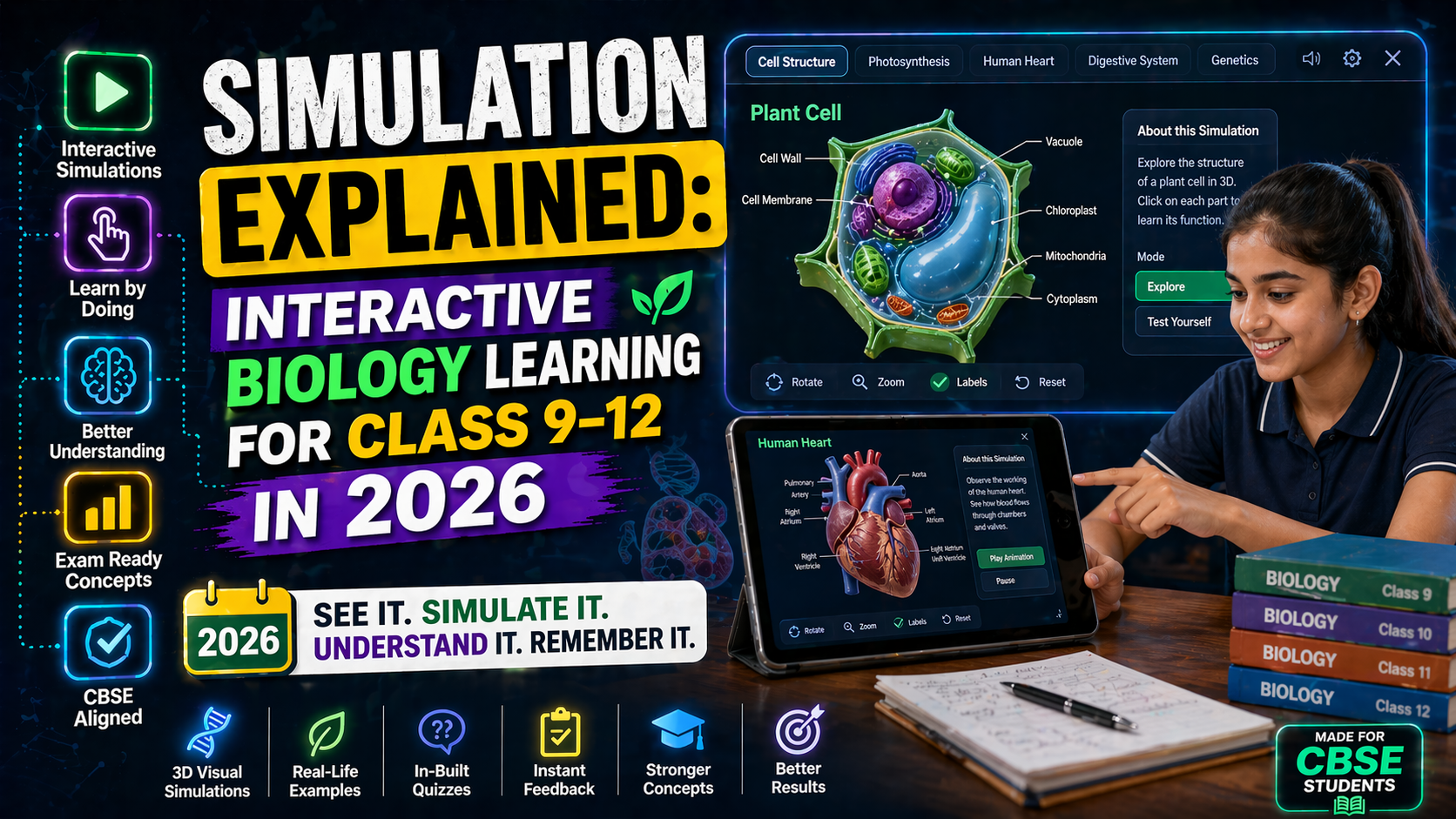
If you’ve ever stared at a static heart diagram in your NCERT textbook and wondered, ‘How does this actually work in real life?’, you’re not alone. The human heart is a dynamic organ pumping 7,000 liters of blood daily — and CBSE Class 11 & 12 biology demands you understand it deeply. But memorizing labels isn’t enough. You need to see the valves open and close, feel the pressure changes, and trace the electrical signals that trigger each heartbeat. That’s where interactive 3D simulations come in — and anAIza School’s AI-powered platform delivers exactly that.
In this guide, we’ll walk you through the heart CBSE syllabus using real-time interactive simulations, AI-generated explanations, and step-by-step visualizations. Whether you're preparing for Class 11 exams, NEET, or just curious about how your heart works, these tools will help you learn by doing — not just by reading. Let’s dive in.
Why This Matters for CBSE Students in 2026
The CBSE Class 11 & 12 Biology syllabus places strong emphasis on human physiology, especially the circulatory system. According to the NCERT Biology textbook (2026 edition), understanding the heart involves not just labeling parts, but grasping cardiac output, sinoatrial node function, and oxygen transport. Traditional methods — textbooks, diagrams, and videos — fall short when it comes to dynamic processes like blood flow or ECG generation.
That’s why the National Education Policy (NEP) 2020 encourages the use of interactive simulations and AI tools in classrooms. The policy highlights that ‘experiential learning’ improves retention and critical thinking — especially in science. With anAIza School, you get a free virtual heart lab where you can:
- Adjust heart rate and see how stroke volume changes
- Simulate a heart attack and observe blood flow blockage
- Generate an ECG trace and identify arrhythmias
- Explore membrane transport across capillary walls
These aren’t just animations — they’re interactive, measurable, and curriculum-aligned. And the best part? You can try them right now — no installation, no login required.
Understanding the Human Heart: A CBSE-Aligned Breakdown
Let’s explore the heart CBSE syllabus using interactive simulations. We’ll cover anatomy, function, and common exam topics — all visualized in real time.
1. Heart Anatomy: From Chambers to Valves (Interactive 3D Model)
The heart has four chambers: two atria (upper) and two ventricles (lower). Blood flows in one direction thanks to valves — tricuspid, pulmonary, mitral, and aortic. But how do they open and close? And what happens if one fails?
With anAIza School’s 3D heart model, you can:
- Rotate the heart to view from all angles
- Click on each valve to see its position and function
- Toggle between systole and diastole to observe chamber contractions
- Simulate valve regurgitation (leakage) and stenosis (narrowing)
This is far more effective than a textbook diagram. You’re not just looking — you’re interacting.
⚗
Try This Simulation Free
Open the interactive simulation on anAIza School — no download, no signup needed.
Open Simulation →Change the variables yourself — see what happens in real time.
2. The Cardiac Cycle: Systole, Diastole, and Blood Flow
The cardiac cycle is a sequence of electrical and mechanical events that repeat with every heartbeat. It includes:
- Atrial systole: Atria contract, pushing blood into ventricles
- Ventricular systole: Ventricles contract, pumping blood to lungs and body
- Diastole: All chambers relax and fill with blood
But how do pressure gradients drive this flow? And why does the left ventricle have thicker walls?
In the cardiac cycle simulator, you can:
- Adjust heart rate (e.g., 60 bpm vs 120 bpm)
- See real-time pressure changes in each chamber
- Observe valve movements during each phase
- Measure cardiac output (CO = stroke volume × heart rate)
This aligns perfectly with CBSE Class 11 Biology Chapter 18: Body Fluids and Circulation.
3. Electrical Activity: The SA Node and ECG Generation
The heartbeat is triggered by electrical impulses from the sinoatrial (SA) node — the heart’s natural pacemaker. These impulses travel through the atria, AV node, bundle of His, and Purkinje fibers, causing coordinated contractions.
An ECG (electrocardiogram) records this electrical activity. A normal ECG has three main waves:
- P wave: Atrial depolarization
- QRS complex: Ventricular depolarization
- T wave: Ventricular repolarization
In the ECG simulator, you can:
- Generate a normal ECG trace
- Simulate arrhythmias: tachycardia, bradycardia, atrial fibrillation
- Adjust conduction delays (e.g., AV block)
- See how heart rate affects R-R interval
This is especially useful for NEET aspirants and students preparing for CBSE Class 12 exams.
4. Blood Flow and Oxygen Transport: From Lungs to Body
Blood flows in two circuits:
- Pulmonary circulation: Heart → Lungs → Heart (oxygen-poor to oxygen-rich)
- Systemic circulation: Heart → Body → Heart (oxygen-rich to oxygen-poor)
But how does oxygen move from alveoli to blood? And how does CO₂ return?
In the blood flow simulator, you can:
- Trace a red blood cell’s journey from vena cava to aorta
- Observe oxygen and CO₂ exchange in capillaries
- Simulate anemia and see reduced oxygen delivery
- Explore membrane transport across capillary walls (diffusion, filtration)
This ties directly to CBSE topics on respiration and body fluids.
Membrane Transport Simulation: How Oxygen Crosses Capillary Walls
One of the most underrated but exam-critical concepts is membrane transport. In the systemic circulation, oxygen diffuses from capillaries into tissues, while CO₂ diffuses in the opposite direction. This happens via:
- Simple diffusion (O₂ and CO₂ are lipid-soluble)
- Facilitated diffusion (glucose via GLUT transporters)
- Bulk flow (plasma and solutes moved by pressure gradients)
In the membrane transport simulation, you can:
- Adjust oxygen concentration gradients
- Observe diffusion rates across different membrane types
- Simulate edema (fluid buildup) due to high blood pressure
- Test how temperature and pH affect transport rates
This simulation helps you understand not just the heart, but also homeostasis and kidney function — key topics in CBSE Class 11 Biology.
Meiosis and Mitosis Simulation: Why It Matters for Heart Health
Wait — what does cell division have to do with the heart? Everything.
The heart’s ability to pump depends on healthy cardiac muscle cells (cardiomyocytes). These cells rarely divide in adults, but during development and repair, mitosis and meiosis play crucial roles. For example:
- Mitosis helps repair minor damage (e.g., after a mild heart attack)
- Meiosis ensures gametes (sperm/egg) have the correct chromosome number for fetal heart development
In the meiosis mitosis simulation, you can:
- Observe chromosome separation in cardiac cell mitosis
- Simulate errors like nondisjunction (leading to congenital heart defects)
- Compare mitosis in cardiomyocytes vs stem cells
- Explore how mutations affect heart cell function
This is especially relevant for students studying genetics and developmental biology in CBSE Class 12.
Epidemic Spread Simulation: How Heart Health Affects Populations
This might seem unrelated — but it’s not. Cardiovascular diseases (CVDs) are the leading cause of death globally, according to the World Health Organization (2026 report). Understanding how heart disease spreads — metaphorically — helps in public health planning.
In the epidemic spread simulation, you can:
- Model how lifestyle factors (smoking, diet) affect heart disease prevalence
- Simulate vaccination programs to reduce CVD risk
- Observe herd immunity effects in a population
- Compare urban vs rural heart health trends
This connects biology to real-world applications and aligns with CBSE’s focus on applied biology and social health.
Krebs Cycle Simulator: Energy for the Beating Heart
The heart never stops. It beats over 100,000 times a day, requiring a constant supply of ATP. This energy comes from the Krebs cycle (also called the citric acid cycle) in mitochondria of cardiac cells.
In the Krebs cycle simulator, you can:
- Trace the entry of acetyl-CoA and its conversion to CO₂
- Observe NADH and FADH₂ production
- Simulate how oxygen deficiency (hypoxia) affects ATP output
- Link Krebs cycle output to oxidative phosphorylation in the electron transport chain
This simulation helps you understand why aerobic respiration is vital for heart function — and why heart attacks are so dangerous (they cut off oxygen supply).
Food Web Simulator: How Nutrition Affects Heart Health
Your diet directly impacts your heart. A balanced food web includes:
- Carbohydrates → glucose → ATP
- Proteins → amino acids → enzymes and muscle repair
- Fats → fatty acids → energy storage and hormone production
But what happens when you consume too much saturated fat or salt?
In the food web simulator, you can:
- Build a heart-healthy diet and observe metabolic effects
- Simulate atherosclerosis (plaque buildup in arteries)
- Test how antioxidants (e.g., from fruits) reduce oxidative stress
- Model the impact of high-sodium diets on blood pressure
This ties into CBSE Class 11 Biology Chapter 16: Digestion and Absorption and Chapter 18: Body Fluids and Circulation.
What If You Changed This? 3 Heart Simulation Experiments
Ready to experiment? Try these “what-if” scenarios in the heart simulator. Change one variable at a time and observe the outcome.
1. What if the SA node fails?
In a healthy heart, the SA node fires about 70 times per minute. But what if it stops? The AV node can take over — but at a slower rate (40–60 bpm). In the simulator:
- Turn off the SA node
- Observe the ECG trace change from normal sinus rhythm to junctional rhythm
- Measure the drop in heart rate and cardiac output
- Simulate the insertion of an artificial pacemaker
This helps you understand heart block and arrhythmias — key NEET and CBSE topics.
2. What if a coronary artery is blocked?
A heart attack (myocardial infarction) often results from a blocked coronary artery. In the simulator:
- Block the left anterior descending (LAD) artery
- Observe reduced blood flow to the left ventricle
- See oxygen levels drop in the affected area
- Simulate clot-busting drugs (thrombolytics) and observe reperfusion
You’ll see why time is critical in treating heart attacks.
3. What if you increase afterload?
Afterload is the resistance the heart must overcome to pump blood into the aorta. High afterload (e.g., due to hypertension) makes the heart work harder. In the simulator:
- Gradually increase afterload by narrowing the aorta
- Observe increased ventricular pressure during systole
- Measure stroke volume and cardiac output
- Simulate the use of beta-blockers to reduce afterload
This helps you understand hypertension and heart failure.
Frequently Asked Questions
What is the heart CBSE syllabus for Class 11 and 12 in 2026?
The CBSE Class 11 Biology syllabus includes Body Fluids and Circulation (Chapter 18), covering heart anatomy, cardiac cycle, ECG, blood pressure, and disorders. Class 12 includes Human Health and Disease and Reproductive Health, where heart-related topics like hypertension and lifestyle diseases are discussed. All concepts are aligned with NCERT 2026.
How can I visualize the human heart CBSE diagram interactively?
Use anAIza School’s 3D heart model on the SPYRAL AI Workbench. You can rotate, zoom, and click on parts like valves and chambers. Each part is labeled with NCERT-compliant names and functions. No installation needed — just open the simulator in your browser.
Is there a free heart rate simulator for CBSE students?
Yes! The heart rate simulator on anAIza School lets you adjust heart rate, stroke volume, and cardiac output. You can simulate bradycardia, tachycardia, and even fibrillation. It’s perfect for understanding how heart rate affects blood pressure and oxygen delivery.
What is membrane transport simulation and how does it relate to the heart?
Membrane transport simulation lets you observe how oxygen, CO₂, and nutrients cross capillary walls. This is crucial for heart function because the heart muscle relies on efficient oxygen delivery. You can simulate diffusion, filtration, and even edema — helping you understand conditions like heart failure.
Can I simulate the cardiac cycle CBSE-style with real-time graphs?
Absolutely. The cardiac cycle simulator shows real-time pressure-volume loops, ECG traces, and valve movements. You can adjust heart rate and contractility to see how they affect stroke volume and cardiac output — exactly as per CBSE Class 11 NCERT.
How does the meiosis mitosis simulation help in understanding heart development?
Cardiac muscle cells form during embryogenesis through mitosis. Errors in cell division can lead to congenital heart defects. The meiosis mitosis simulation lets you observe chromosome separation and simulate nondisjunction, helping you link genetics to heart health.
What is an epidemic spread simulation and how is it connected to heart health?
While not directly about the heart, epidemic spread simulation helps model how lifestyle diseases like obesity and diabetes — major risk factors for heart disease — spread in populations. You can simulate public health interventions and see their impact on cardiovascular disease prevalence.
Is there a Krebs cycle simulator for CBSE Class 12 Biology?
Yes. The Krebs cycle simulator lets you trace acetyl-CoA through the cycle, observe NADH/FADH₂ production, and simulate how oxygen deficiency affects ATP output. This is essential for understanding why the heart needs a constant energy supply.
How can I use the food web simulator to learn about heart-healthy diets?
The food web simulator lets you build diets and observe their metabolic effects. You can simulate the impact of high-sodium, high-fat, or high-antioxidant diets on heart health. It’s a great way to apply CBSE Class 11 Biology concepts on digestion and nutrition.
Are these heart simulations aligned with NEP 2020 and CBSE guidelines?
Yes. All simulations are designed to support NEP 2020’s emphasis on experiential learning and CBSE’s competency-based education. They cover NCERT 2026 syllabus topics and include AI-generated explanations that adapt to your learning pace.
Can teachers use these simulations in classrooms for CBSE biology?
Yes! Teachers can use the SPYRAL AI Workbench to run live demos, assign virtual labs, and track student progress. The platform includes a teacher dashboard with curriculum mapping (CBSE, ICSE, IB, AP) and quiz generation tools.
Do I need to install anything to use the heart simulations?
No installation required. All simulations run in your web browser on any device — laptop, tablet, or smartphone. Just open tryspyral.com/workbench and start exploring.
How accurate are the AI explanations in the heart simulations?
The AI explanations are based on NCERT 2026 Biology textbooks and peer-reviewed sources. Each simulation includes step-by-step AI notes that explain the science behind what you’re seeing — from valve mechanics to ECG interpretation.
Conclusion: Learn the Heart CBSE Way — By Doing
The human heart isn’t a static diagram — it’s a living, beating organ with electrical rhythms, pressure waves, and complex transport systems. For CBSE Class 11 & 12 students, understanding the heart means more than memorizing labels. It means seeing how it works, experimenting with variables, and connecting theory to real life.
With anAIza School’s interactive 3D simulations and AI-powered explanations, you’re not just preparing for exams — you’re building a deeper understanding of human biology. Whether you're simulating a heart attack, tracing oxygen through capillaries, or modeling epidemic spread, you’re learning by doing — the way science was meant to be taught.
Ready to explore? Try the heart CBSE simulations today — for free.
Note: All simulations and AI tools mentioned are part of the SPYRAL AI Workbench — Biology Simulations, aligned with NEP 2020 and CBSE 2026 curriculum.