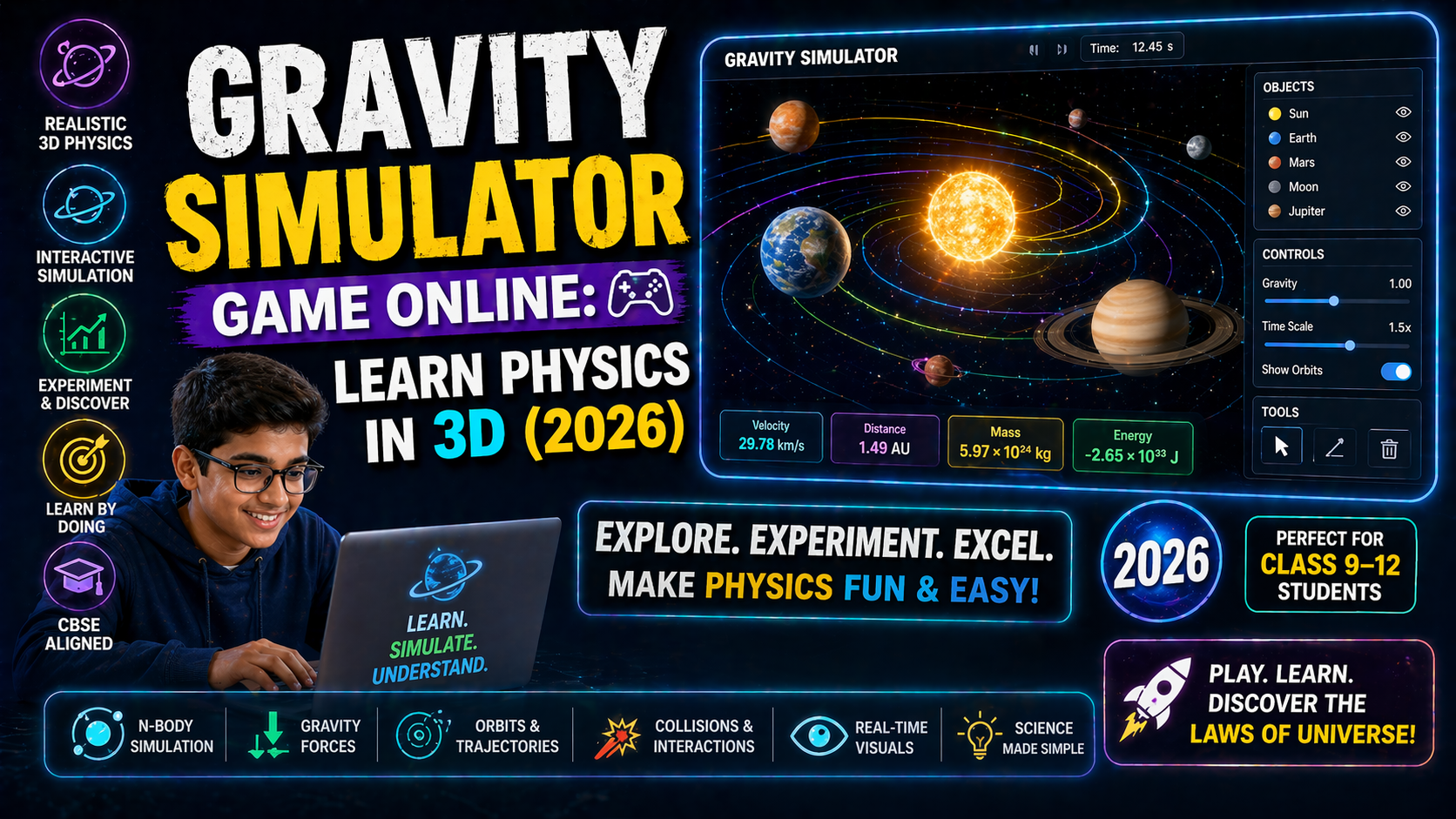
Imagine firing a cannonball horizontally in a room where gravity suddenly vanishes. Instead of curving down, the ball moves in a straight line forever — or until it hits a wall. This isn’t science fiction; it’s physics in a gravity-free zone, and you can simulate it right now using advanced AI-powered physics labs.
For students in Class 9–12 preparing under the CBSE curriculum and aligned with NEP 2020, understanding how forces behave without gravity is not just fascinating — it’s essential for mastering concepts like projectile motion, fluid dynamics, and electrical circuits. With SPYRAL’s AI Workbench, you can now run these experiments in a virtual gravity-free zone anytime, anywhere — no lab coat or rocket required.
Why a Gravity-Free Zone Matters in Physics Education
In a traditional classroom, gravity is always present. While that’s great for real-world learning, it can make certain abstract concepts harder to grasp. For example:
- Projectile motion becomes a curved parabola because of gravity.
- Fluid pressure and buoyancy depend on gravitational acceleration.
- Electrical circuits behave differently when components aren’t aligned vertically.
By removing gravity in a simulation, students can isolate variables and observe pure physics — making it easier to understand Newton’s laws, conservation of momentum, and energy transfer. This approach is fully aligned with NEP 2020, which emphasizes experiential and inquiry-based learning.
How SPYRAL’s Gravity-Free Zone Simulation Works
SPYRAL’s AI Workbench offers a zero-gravity physics sandbox where you can:
- Turn gravity on or off with a single click.
- Place objects like balls, springs, resistors, or fluids in a 3D space.
- Apply forces, change velocities, and observe motion in real time.
- Use built-in tools like a projectile motion simulator, Ohm’s law resistor simulation, and fluid pressure buoyancy simulation.
Each simulation is powered by AI, ensuring accurate physics calculations and smooth visualization. You can even save your experiments and revisit them later — perfect for revision or group projects.
Top 5 Physics Simulations You Can Run in a Gravity-Free Zone (2026)
1. Projectile Motion Simulator (No Parabola!)
In a gravity-free zone, a projectile launched horizontally will travel in a straight line at constant speed — forever, unless it hits an obstacle. This helps students understand:
- Newton’s First Law (inertia).
- The role of gravity in real-world trajectories.
- How to separate horizontal and vertical motion.
Try it: Use the projectile motion simulator on SPYRAL AI Workbench and toggle gravity to see the difference instantly.
2. Ohm’s Law Resistor Simulation (Circuit in Zero-G)
Electrical circuits aren’t affected by gravity — but orientation can change how heat dissipates. In SPYRAL’s Ohm’s law resistor simulation, you can:
- Arrange resistors in series or parallel.
- Change voltage and observe current flow.
- Rotate the circuit to see if gravity affects resistance (it doesn’t — but it’s fun to test!).
This simulation reinforces CBSE Class 12 Physics concepts and prepares students for competitive exams like JEE.
3. Fluid Pressure & Buoyancy Simulation (Floating in Space)
Buoyancy depends on gravity. In a gravity-free zone, objects don’t float or sink — they stay wherever you place them. This simulation lets you:
- Fill a tank with water and drop objects.
- Observe how pressure changes with depth (without gravity’s influence).
- Compare behavior in Earth’s gravity vs. zero-g.
Ideal for CBSE Class 9 and 11 students studying pressure and Archimedes’ principle.
4. Lens Formula Calculator in Zero-G
Optics isn’t gravity-dependent — but simulating lenses in a 3D space helps students visualize focal length, object distance, and image formation more clearly. Use the lens formula calculator to:
- Adjust object distance and focal length.
- See real-time image formation on a screen.
- Test combinations of convex and concave lenses.
Perfect for CBSE Class 10 and 12 Physics revision.
5. Doppler Effect Simulator (Sound in a Vacuum)
Sound needs a medium — and in a gravity-free zone, you can simulate sound waves in a vacuum. The Doppler effect simulator lets you:
- Move a sound source and observer.
- Observe frequency shifts without atmospheric interference.
- Understand how gravity (or lack of it) affects wave propagation.
Great for advanced physics students and UPSC aspirants studying wave mechanics.
How to Use SPYRAL’s Gravity-Free Zone Simulation (Step-by-Step)
- Visit SPYRAL AI Workbench at tryspyral.com/ai-workbench.
- Select the Physics Simulations tab.
- Choose a simulation: Projectile Motion, Ohm’s Law, Fluid Pressure, Lens Calculator, or Doppler Effect.
- Toggle gravity on/off using the control panel.
- Set parameters like mass, velocity, resistance, or focal length.
- Run the simulation and observe the results in real time.
- Save your experiment or share it with your teacher/class.
No installation, no login required for guest access — just open and start learning.
Try It Free on SPYRAL
Everything discussed in this article is available for free on SPYRAL AI Workbench — Physics Simulations. No signup required for guest access — just open it and start learning.
Explore SPYRAL AI Workbench — Physics Simulations →Why Teachers Are Using Gravity-Free Zone Simulations in 2026
Educators across India are adopting AI-powered simulations to enhance NEP 2020-aligned teaching. Here’s how a gravity-free zone helps:
- Differentiated Learning: Students can explore at their own pace.
- Concept Reinforcement: Visualizing abstract ideas reduces misconceptions.
- Preparation for Competitive Exams: JEE, NEET, and Olympiads often test conceptual clarity.
- Safe & Cost-Effective: No lab equipment or hazardous materials needed.
- CBSE & State Board Aligned: Simulations match the latest syllabus and exam patterns.
Schools using SPYRAL’s platform report improved engagement and higher scores in physics assessments. Many have integrated these simulations into their NEP 2020 lesson plans under the “Experiential Learning” mandate.
Real-World Applications: Where Gravity-Free Physics Applies
While we can’t eliminate gravity on Earth, understanding zero-g physics is crucial for:
- Space Missions: Astronauts train in neutral buoyancy labs that mimic microgravity.
- Satellite Design: Engineers use simulations to test how components behave in orbit.
- Medical Devices: Some surgical tools operate in near-zero-g environments during parabolic flights.
- Robotics: Robots on the ISS must function without relying on gravity for stability.
By mastering these concepts early, students gain a competitive edge in STEM careers.
Frequently Asked Questions (FAQs)
Is a gravity-free zone simulation accurate for CBSE exams?
Yes. The simulations are built using real physics equations and validated against CBSE syllabus requirements. They help students understand core concepts, which are then applied in exams.
Do I need to install anything to use these simulations?
No. SPYRAL’s AI Workbench runs entirely in your web browser. No downloads, no sign-up required for guest access.
Can I use these simulations for JEE/NEET preparation?
Absolutely. Many JEE and NEET toppers use SPYRAL’s simulations to visualize complex topics like projectile motion, electrostatics, and fluid dynamics.
How does this align with NEP 2020?
NEP 2020 emphasizes experiential learning, multidisciplinary studies, and the use of technology in education. SPYRAL’s simulations provide hands-on, inquiry-based learning that aligns perfectly with these goals.
Are these simulations free for schools?
Yes. SPYRAL offers free access to all physics simulations for students and teachers. Schools can also integrate these tools into their LMS under our NEP 2020 partnership programs.
Can I save my experiments?
Currently, simulations can be run in real time, and you can take screenshots or notes. SPYRAL is working on a save/export feature for future updates.