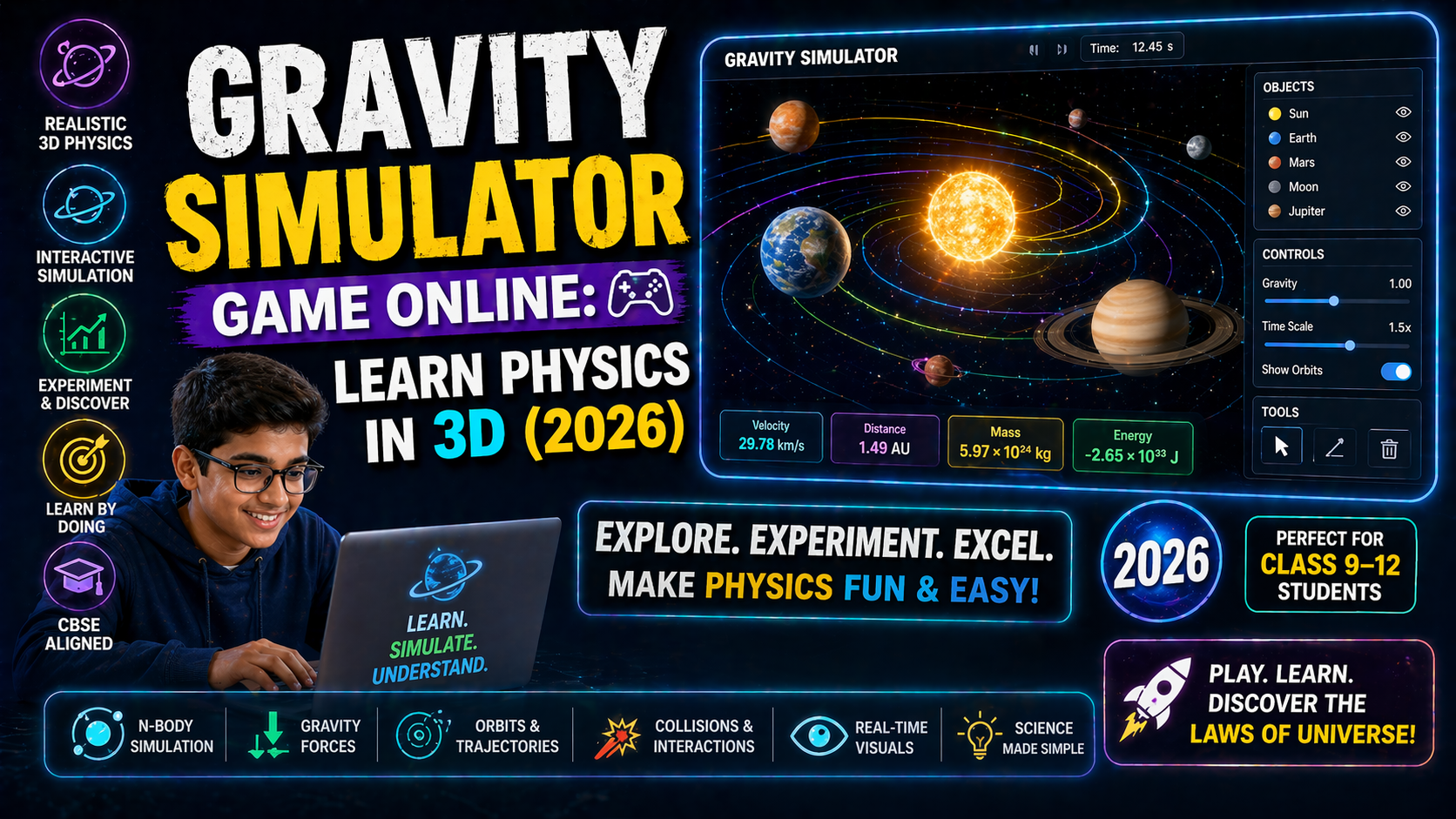
Imagine conducting physics experiments where gravity doesn’t exist. No falling objects, no weight, no resistance—just pure, unaltered physics in action. This isn’t science fiction; it’s a reality made possible by gravity-free room simulations in 2026. These interactive tools allow Class 9–12 CBSE students and teachers to explore physics concepts in a zero-gravity environment, making learning more engaging and intuitive.
With the integration of AI and NEP 2020-aligned tools, simulating a gravity-free room has never been easier. Whether you're studying projectile motion, fluid dynamics, or electromagnetic fields, these simulations provide a hands-on experience that textbooks simply can’t match. Let’s dive into how you can use these tools to enhance your physics learning in 2026.
Why Simulate a Gravity-Free Room in Physics?
Gravity is one of the most fundamental forces in physics, but understanding its effects can sometimes complicate experiments. A gravity-free room simulation removes this variable, allowing students to focus on other core concepts like:
- Projectile motion without the influence of gravity
- Fluid pressure and buoyancy in a weightless environment
- Electromagnetic fields and their behavior in space
- Ohm’s Law and resistor simulations in a controlled setting
- Doppler effect experiments without atmospheric interference
These simulations align with the NEP 2020 guidelines, which emphasize experiential learning and the use of technology in classrooms. By simulating a gravity-free environment, students can visualize abstract concepts and develop a deeper understanding of physics principles.
How to Simulate a Gravity-Free Room Online in 2026
Thanks to advancements in AI and EdTech, simulating a gravity-free room is now accessible to students and teachers across India. Here’s how you can get started:
1. Use AI-Powered Physics Simulators
Platforms like SPYRAL AI Workbench offer interactive physics simulations that mimic a gravity-free environment. These tools use AI to generate realistic scenarios where students can manipulate variables and observe outcomes in real time. For example:
- Projectile motion simulator: Launch objects in a zero-gravity setting and observe their trajectories without the influence of gravity.
- Fluid pressure buoyancy simulation: Study how fluids behave in a weightless environment, perfect for understanding buoyancy and pressure.
- Ohm’s Law resistor simulation: Experiment with electrical circuits in a gravity-free space to see how resistors behave without external forces.
These simulations are designed to be user-friendly, making them ideal for both students and teachers. No prior coding experience is required—just open the tool and start experimenting!
2. Explore 3D Gravity Simulators
For a more immersive experience, 3D gravity simulators allow students to visualize physics concepts in a three-dimensional space. These tools are particularly useful for understanding complex phenomena like orbital mechanics and gravitational interactions. Some popular options include:
- Free 3D gravity simulator online: These platforms let you create custom gravity fields and observe how objects move within them.
- Gravity orbit simulator: Perfect for studying planetary motion and orbital dynamics without the constraints of Earth’s gravity.
These simulators are not only educational but also fun, making them a great addition to any physics classroom.
3. Integrate Simulations into CBSE Curriculum
The CBSE curriculum for Class 9–12 includes several topics that can benefit from gravity-free simulations, such as:
- Class 11 Physics: Gravitation, projectile motion, and fluid dynamics
- Class 12 Physics: Electromagnetic induction, alternating current, and semiconductor physics
Teachers can use these simulations to demonstrate complex concepts in a more interactive way. For example, instead of drawing diagrams on a blackboard, they can use a fluid pressure buoyancy simulation to show how objects behave in a weightless environment. This aligns with the NEP 2020 goal of making education more experiential and student-centered.
Top Physics Simulations for a Gravity-Free Room in 2026
Here are some of the best physics simulations available in 2026 that you can use to create a gravity-free environment for your experiments:
1. Projectile Motion Simulator
A projectile motion simulator allows you to launch objects in a zero-gravity setting and observe their trajectories. This tool is perfect for understanding the effects of initial velocity, angle, and air resistance (or lack thereof) on an object’s path. Students can tweak variables and see how changes impact the outcome in real time.
2. Fluid Pressure Buoyancy Simulation
In a gravity-free room, fluids behave differently than on Earth. A fluid pressure buoyancy simulation lets you explore how fluids distribute pressure and how buoyancy works in a weightless environment. This is particularly useful for understanding concepts like Archimedes’ principle and Pascal’s law.
3. Ohm’s Law Resistor Simulation
Electrical circuits behave differently in a gravity-free environment due to the absence of weight-induced stresses. An Ohm’s Law resistor simulation allows students to experiment with resistors, voltage, and current in a controlled setting. This tool is ideal for visualizing how Ohm’s Law applies in different scenarios.
4. Doppler Effect Simulator
The Doppler effect describes how the frequency of a wave changes for an observer moving relative to its source. In a gravity-free room, students can study this phenomenon without atmospheric interference. A Doppler effect simulator lets you adjust the speed of the source and observe how the frequency changes.
5. Lens Formula Calculator
While not a simulation per se, a lens formula calculator is an essential tool for physics students. It allows you to calculate focal length, image distance, and magnification for lenses in a gravity-free environment. This tool is particularly useful for optics experiments in Class 12 Physics.
How to Use These Simulations in Your Classroom
Integrating gravity-free room simulations into your physics classroom is easier than you think. Here’s a step-by-step guide to get started:
Step 1: Choose the Right Simulation Tool
Select a simulation tool that aligns with your lesson plan. For example, if you’re teaching projectile motion, use a projectile motion simulator. If you’re covering fluid dynamics, opt for a fluid pressure buoyancy simulation.
Step 2: Set Up the Experiment
Configure the simulation to mimic a gravity-free environment. Most tools allow you to toggle gravity on or off, so you can compare results with and without gravity. This helps students understand the impact of gravity on different physics phenomena.
Step 3: Conduct the Experiment
Encourage students to manipulate variables and observe the outcomes. For example, in a Doppler effect simulator, students can change the speed of the source and measure how the frequency changes. This hands-on approach reinforces theoretical concepts.
Step 4: Analyze the Results
After conducting the experiment, discuss the results as a class. Ask students to explain why certain phenomena occurred and how gravity influenced the outcomes. This collaborative learning approach aligns with the NEP 2020 emphasis on critical thinking and discussion.
Step 5: Extend the Learning
Encourage students to explore further by tweaking variables or trying new experiments. For example, they can use a lens formula calculator to design their own optics experiments or a Ohm’s Law resistor simulation to build custom circuits.
Benefits of Using Gravity-Free Room Simulations in 2026
Incorporating gravity-free room simulations into your physics curriculum offers several benefits:
- Enhanced Understanding: Visualizing abstract concepts in a gravity-free environment helps students grasp complex ideas more easily.
- Interactive Learning: Simulations make learning more engaging and fun, reducing the monotony of traditional lectures.
- Alignment with NEP 2020: These tools support the NEP 2020 goals of experiential learning and the use of technology in education.
- Accessibility: Most simulation tools are available online for free, making them accessible to students and teachers across India.
- Customization: Teachers can tailor simulations to fit their lesson plans, ensuring that students learn exactly what they need.
Try It Free on SPYRAL
Everything discussed in this article is available for free on SPYRAL AI Workbench — Physics Simulations. No signup required for guest access — just open it and start learning.
Explore SPYRAL AI Workbench — Physics Simulations →Frequently Asked Questions (FAQs)
What is a gravity-free room simulation?
A gravity-free room simulation is a digital tool that mimics a zero-gravity environment, allowing students to conduct physics experiments without the influence of gravity. These simulations are used to visualize and understand complex physics concepts in a controlled setting.
Are gravity-free room simulations aligned with the CBSE curriculum?
Yes! Gravity-free room simulations align with the CBSE Class 9–12 Physics curriculum, particularly topics like gravitation, projectile motion, fluid dynamics, and electromagnetic fields. They are also in line with the NEP 2020 guidelines for experiential learning.
Do I need coding experience to use these simulations?
No! Most gravity-free room simulations are designed to be user-friendly and require no coding experience. Platforms like SPYRAL AI Workbench offer drag-and-drop interfaces, making it easy for students and teachers to get started.
Can I use these simulations on my mobile device?
Yes! Most online physics simulators are compatible with both desktop and mobile devices. This makes it easy for students to access simulations on the go, whether they’re in the classroom or studying at home.
Are there any free gravity-free room simulations available in 2026?
Absolutely! Many platforms, including SPYRAL AI Workbench, offer free gravity-free room simulations. These tools are designed to be accessible to all students and teachers, ensuring that everyone can benefit from interactive physics learning.
By incorporating gravity-free room simulations into your physics curriculum, you can make learning more interactive, engaging, and aligned with the NEP 2020 goals. Whether you’re a student or a teacher, these tools offer a unique way to explore the wonders of physics in 2026 and beyond.
Ready to dive in? Explore the SPYRAL AI Workbench — Physics Simulations today and start experimenting in a gravity-free environment!