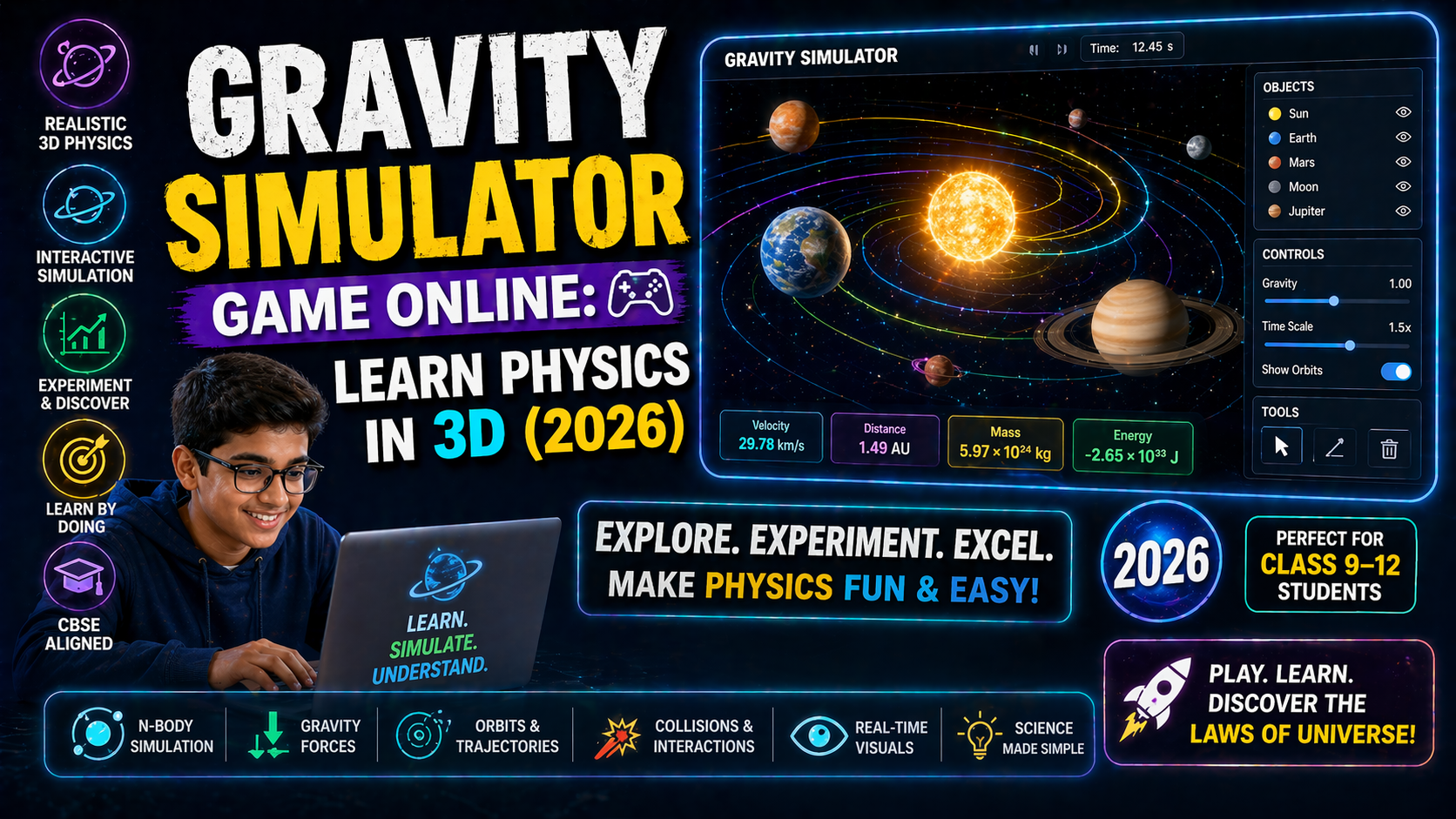
What if you could explore physics without the annoying drag of friction? With friction free 3000 simulations, you can now witness the pure, uninhibited behavior of forces, energy, and motion—just like in a real lab, but without the mess or limitations. Whether you're a CBSE Class 9–12 student struggling to visualize frictionless motion or a teacher looking for interactive tools to make physics click, these simulations are your gateway to understanding physics like never before.
Imagine sliding a block across a table with zero resistance, watching electrostatic charges repel without interference, or observing how lenses bend light without any distortion. These aren’t just theoretical concepts—they’re live, interactive experiences that help you grasp physics intuitively. And the best part? You can do all this for free on SPYRAL’s AI-powered platform, designed to align with CBSE’s NEP 2020 curriculum and make learning feel real.
Why This Matters for CBSE Students and Teachers in 2026
Physics isn’t just about memorizing formulas—it’s about seeing how the world works. For CBSE students, especially those preparing for Class 9–12 exams or competitive tests like NEET and JEE, understanding concepts like friction, electrostatics, and thermodynamics can feel overwhelming. Traditional textbooks and chalkboard diagrams only take you so far. But with friction free 3000 simulations, you can:
- Visualize abstract concepts like never before—watch how forces interact in real time without the confusion of real-world friction.
- Experiment safely and repeatedly—test hypotheses without worrying about breaking equipment or safety hazards.
- Prepare for exams with confidence—see how theory applies to real-world scenarios, making it easier to solve problems in NEET, JEE, or even your school tests.
- Align with NEP 2020’s focus on discovery learning—the National Education Policy emphasizes hands-on, experiential learning, and these simulations do exactly that.
For teachers, these tools are a game-changer. They save time on lab setup, reduce costs, and make it easier to explain complex topics like simulations of electrostatics or thermodynamics. Plus, the AI-powered explanations adapt to each student’s understanding, ensuring no one gets left behind.
The Science Behind Friction Free 3000: Why It’s a Game-Changer
Friction is everywhere—it slows down moving objects, generates heat, and even helps us walk. But what if we could remove friction entirely? That’s where friction free 3000 simulations come in. These aren’t just theoretical models; they’re real-time, interactive physics labs that let you explore the world as if friction didn’t exist. Here’s how they work:
- Real-time physics engines calculate forces, motion, and energy without the interference of friction, giving you a pure, unfiltered view of how physics operates.
- AI-driven explanations break down complex concepts like electrostatics or thermodynamics into simple, visual steps, making it easier to understand.
- Curriculum-aligned content—every simulation is designed to match CBSE’s Class 9–12 syllabus, ensuring you’re learning what you need to know for exams.
- No equipment needed—unlike traditional labs, these simulations run entirely online, so you can explore physics from anywhere, anytime.
Whether you’re studying electrostatics, thermodynamics, or even Ohm’s law, these simulations give you a friction-free zone to experiment and discover.
Electrostatics Simulation: See Charges Move Without Resistance
Ever wondered how electrostatic forces work in a world without friction? In this simulation, you can place charged objects and watch them interact without any interference. Adjust the charge, distance, and type of objects (positive or negative) to see how they repel or attract. This is perfect for understanding concepts like Coulomb’s law or electric fields—key topics for CBSE Class 11 Physics.
Try it out: Change the charge of two objects and observe how the force between them changes. Notice how the friction-free environment lets you see the pure effect of electrostatic forces!
Thermodynamics Simulation: Explore Heat and Energy Without Friction
Thermodynamics can feel abstract, but this simulation makes it tangible. Watch how heat transfers between objects in a friction-free system, where no energy is lost to resistance. Adjust temperatures, materials, and even the presence of a heat source to see how energy flows. This is ideal for understanding laws of thermodynamics, heat engines, and even real-world applications like refrigerators or power plants.
Fun fact: In a real-world scenario, friction would cause energy loss as heat. But here, you can see 100% efficiency in energy transfer—pure thermodynamics in action!
Ohm’s Law Resistor Simulation: Current Flow Without Resistance
Ohm’s law is a cornerstone of electricity, but it’s often hard to visualize. This simulation lets you adjust voltage, resistance, and current in a friction-free circuit. See how changing one variable affects the others—without worrying about wire resistance or other real-world factors. It’s perfect for CBSE Class 10 and 12 students studying electricity and magnetism.
Experiment with different resistor values and observe how the current changes. Notice how the simulation eliminates friction from the circuit, giving you a clear view of Ohm’s law in action.
Fluid Pressure and Buoyancy Simulation: Buoyancy Without Friction
Ever wondered how objects float or sink in a fluid? This simulation lets you explore fluid pressure and buoyancy in a friction-free environment. Adjust the density of the fluid, the shape and size of objects, and even the presence of other forces like gravity. You’ll see how buoyancy works without the drag of friction affecting the results.
This is a great tool for understanding Archimedes’ principle and Pascal’s law—key concepts for CBSE Class 9 and 10 Physics.
Lens Formula Calculator: Light Bending Without Distortion
Lenses are everywhere—from glasses to cameras—but how do they actually work? This simulation lets you adjust the focal length, object distance, and image distance of a lens in a friction-free optical system. Watch how light bends and forms images without any distortion from real-world imperfections.
Use the lens formula calculator to predict where the image will form based on the lens type (convex or concave) and object placement. It’s perfect for CBSE Class 11 and 12 students studying optics.
What If You Changed This?
One of the best things about these simulations is that you can test your own ideas. Here are three scenarios to try:
- What if you made a charged object’s charge zero? In the electrostatics simulation, set the charge of one object to zero and observe how the force between the two objects changes. What happens when both charges are zero? Can you predict the outcome before running the simulation?
- What if you removed all friction in a thermodynamics system? In the thermodynamics simulation, set the system to have zero friction (if possible) and observe how heat transfers between objects. How does this compare to a system with friction?
- What if you placed a concave lens in front of a convex lens? In the lens formula simulation, stack a concave lens in front of a convex lens and adjust the object distance. What happens to the image formed? Can you predict whether it will be real or virtual?
These experiments aren’t just for fun—they help you build intuition for how physics works in different scenarios. And because there’s no friction, you can focus solely on the core principles.
Try It Free on SPYRAL
Everything discussed in this article is available for free on SPYRAL AI Workbench — Physics Simulations. No signup required for guest access — just open it and start learning.
Explore SPYRAL AI Workbench — Physics Simulations →Frequently Asked Questions
How does a friction free 3000 simulation help me understand physics better?
Friction-free simulations remove the interference of real-world friction, letting you focus solely on the core physics principles. For example, in an electrostatics simulation, you can see how charges interact without the drag of friction affecting the results. This makes it easier to grasp concepts like force, energy, and motion in a pure, unfiltered way.
Can I use these simulations for my CBSE Class 11 electrostatics exam prep?
Absolutely! These simulations are designed to align with the CBSE Class 11 Physics syllabus. You can explore electrostatics, thermodynamics, and other key topics in a hands-on way, making it easier to visualize and remember concepts for your exams.
How does the thermodynamics simulation work without friction?
The thermodynamics simulation uses a physics engine that calculates energy transfer between objects without accounting for friction. This means you can see how heat moves purely based on temperature differences and material properties, giving you a clearer understanding of thermodynamics laws like the first and second laws.
What’s the best way to use the ohm law resistor simulation for my Class 10 Physics project?
Start by adjusting the voltage and resistance values in the simulation to see how the current changes. Then, compare your observations with Ohm’s law (V = IR). You can also experiment with different resistor combinations to understand series and parallel circuits. This hands-on approach will help you grasp the concept deeply and make your project stand out!
How can I use the fluid pressure buoyancy simulation to explain why some objects float?
In the buoyancy simulation, adjust the density of the fluid and the object’s density. When the object’s density is less than the fluid’s density, it floats due to the buoyant force (Archimedes’ principle). Try changing the shape of the object—does it affect buoyancy? This simulation helps you see how pressure and buoyancy work together to determine whether an object sinks or floats.
Is there a way to use the lens formula calculator to predict image formation for my NEET prep?
Yes! The lens formula calculator lets you input the focal length (f) and object distance (u) to predict the image distance (v) using the lens formula: 1/f = 1/v - 1/u. For NEET prep, practice with different lens types (convex and concave) and object placements to understand how images form. This simulation is a great tool for visualizing real-world applications like microscopes and telescopes.
Can I use these simulations for NEET/JEE preparation?
These simulations are perfect for NEET and JEE prep because they help you visualize complex physics concepts in an interactive way. For example, the thermodynamics simulation can help you understand heat engines, while the electrostatics simulation can clarify concepts like electric fields and potential. The hands-on approach aligns well with the problem-solving skills required for these competitive exams.
How does the friction free 3000 simulation differ from traditional physics labs?
Traditional physics labs are limited by real-world factors like friction, air resistance, and equipment constraints. The friction-free simulations eliminate these variables, allowing you to focus on the core physics principles. Additionally, these simulations are accessible anytime, anywhere, and don’t require expensive lab equipment. They’re also safer for experiments that might be risky in a real lab.
Can I adjust the variables in the simulations to match real-world scenarios?
While the simulations are designed to be friction-free for clarity, you can still adjust variables to model real-world scenarios. For example, in the thermodynamics simulation, you can introduce small amounts of friction to see how it affects energy transfer. Similarly, in the electrostatics simulation, you can adjust the distance between charges to mimic real-world interactions. This flexibility helps you bridge the gap between theory and practice.
Are these simulations aligned with the NEP 2020 curriculum?
Yes! The simulations are designed to align with the National Education Policy 2020’s emphasis on experiential and discovery-based learning. They provide interactive, hands-on experiences that help students explore physics concepts deeply, which is a key goal of NEP 2020. Teachers can also use these tools to create engaging, curriculum-aligned lessons for their students.
How can I use the friction free 3000 simulations for my school’s physics lab?
These simulations are perfect for enhancing your school’s physics lab. They can be used as a supplement to traditional labs, allowing students to explore concepts safely and repeatedly. Teachers can also use them to demonstrate complex ideas in class or assign interactive experiments as homework. Plus, they’re cost-effective and require no additional equipment, making them ideal for schools with limited resources.
What’s the difference between a friction free 3000 simulation and a PhET simulation?
While PhET simulations are excellent, the friction-free simulations on SPYRAL go a step further by providing AI-powered explanations after every interaction. This means you get real-time feedback and step-by-step breakdowns of how physics works, making it easier to understand complex concepts. Additionally, these simulations are curriculum-aligned for CBSE and include features like quiz generation and progress tracking for teachers.
Can I use these simulations for my ICSE or state board exams?
While these simulations are primarily designed for CBSE, many of the physics concepts covered—like electrostatics, thermodynamics, and optics—are also relevant to ICSE and state board syllabi. You can use them to reinforce your understanding of these topics, which will benefit you regardless of your board. Always cross-reference with your specific syllabus to ensure full alignment.