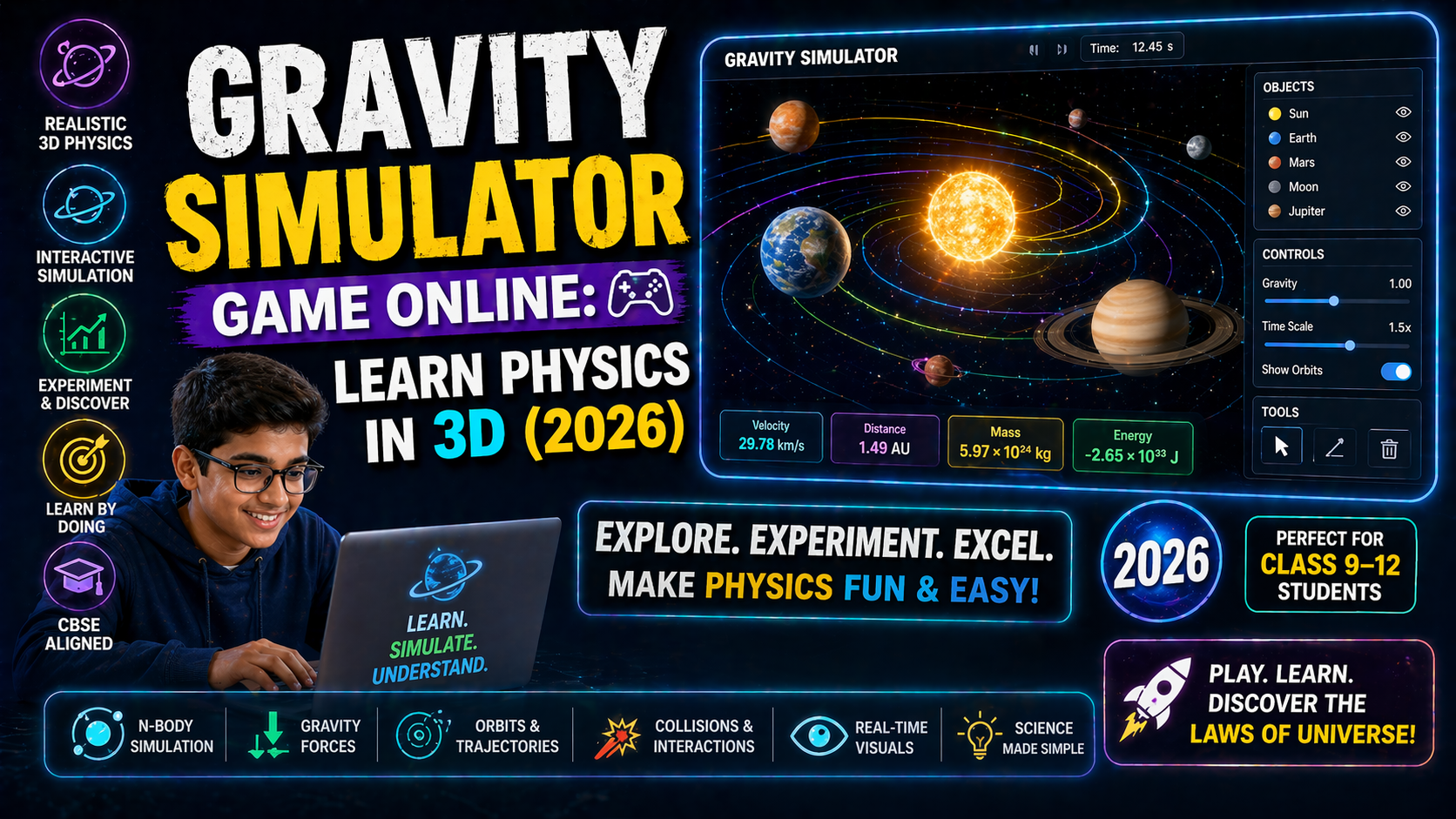
You’re staring at your CBSE physics textbook, reading about friction, but the words just aren’t clicking. You know friction opposes motion, but how does it *really* work? Why does a book slide differently on wood versus ice? And how do you actually *see* the difference between static and kinetic friction? You’re not alone — most students feel the same frustration. But what if you could *see* friction in action, change the surfaces, adjust the forces, and watch what happens in real time? That’s exactly what AI-powered interactive simulations let you do. No lab? No problem. You can now experiment with friction anytime, anywhere — and get instant AI explanations to clear up every doubt.
Why This Matters
Friction isn’t just a topic in your textbook — it’s everywhere. Walking without slipping? Friction. Brakes stopping a car? Friction. Even typing on your keyboard relies on friction between your fingers and the keys. But understanding friction isn’t just about memorizing formulas — it’s about seeing how forces interact, how surface types change outcomes, and how to apply these ideas in real-world problems. With interactive simulations, you can finally *feel* physics, not just read about it. And for CBSE students preparing for exams or competitive tests like JEE and NEET, mastering friction with visual tools can be the difference between confusion and confidence.
What Is Friction? A Quick Refresher
Friction is a force that resists the relative motion between two surfaces in contact. It comes in two main types:
- Static friction: The force that keeps an object at rest. It matches the applied force up to a maximum value.
- Kinetic (or sliding) friction: The force that opposes motion once the object is moving.
Friction depends on:
- The nature of the surfaces (roughness, material)
- The normal force pressing the surfaces together
- Whether the object is moving or at rest
But here’s the catch — textbooks often describe these ideas in words and diagrams. You can’t *see* the force changing as you change the surface or the angle. That’s where interactive simulations come in.
Friction Formula (CBSE Class 11 Reference)
You’ll often see the formula:
f = μN
Where:
- f = frictional force
- μ = coefficient of friction (depends on surface materials)
- N = normal force (usually equal to weight on a flat surface)
But what does μ really mean? Is it the same for all surfaces? How do you find it? And how does it change when you tilt the surface? These questions are hard to answer with just a textbook. But with a simulation, you can adjust μ, tilt the surface, and watch the friction force update instantly.
How AI Simulations Help You Learn Friction
Traditional labs are great, but they’re limited by time, equipment, and safety. With AI-powered interactive simulations, you get:
- Real-time visualization of friction forces as you change variables
- Instant AI explanations after every experiment — no waiting for a teacher
- Safe, repeatable experiments — try tilting a block 100 times without breaking anything
- Curriculum alignment with CBSE Class 9, 10, 11, and 12 physics syllabi
What You Can Do in a Friction Simulation
You’re not just watching — you’re in control. You can:
- Change the surface material (wood, ice, rubber, metal)
- Adjust the angle of the incline
- Add or remove weights to change the normal force
- Switch between static and kinetic friction modes
- See force vectors, motion graphs, and energy loss due to friction
This isn’t just a video — it’s a fully interactive lab where you *are* the scientist. And the best part? Every time you run an experiment, the AI explains what happened, why it happened, and how it connects to your CBSE syllabus.
SIM EMBED SECTION
What If You Changed This? 3 Real Experiments to Try
Ready to experiment? Here are three what-if scenarios to try in the simulation. Each one reveals a key concept about friction.
1. What if you replace a wooden block with a rubber one on the same surface?
Try it: Set the incline angle to 10°, use a wooden block first, then switch to rubber. Watch the friction force increase. Why? Rubber has a higher coefficient of friction (μ) than wood. This is why car tires are made of rubber — to increase grip. In CBSE terms, this connects to μ values and surface properties.
2. What if you add more weight to the block?
Increase the mass from 1 kg to 5 kg. What happens to the friction force? It increases proportionally. That’s because friction depends on the normal force, which increases with weight. This is a direct application of f = μN. Try calculating μ from the simulation data — the AI will guide you.
3. What if you tilt the surface to 45°? Does the block slide?
At a certain angle (called the angle of repose), the block starts to slide. This angle depends on μ. Try it with different surfaces. You’ll see that rougher surfaces have higher angles of repose. This is a classic CBSE lab concept — and now you can do it virtually, anytime.
Connecting to CBSE Syllabus and Exams
Friction is a core topic in CBSE Class 9 (Chapter 10: Gravitation), Class 11 (Chapter 5: Laws of Motion), and Class 12 (Chapter 2: Units and Measurements, and applications in mechanics). It’s also crucial for competitive exams:
- JEE Main/Advanced: Expect problems involving inclined planes, μ values, and friction in pulleys
- NEET: Friction in biomechanics (e.g., walking, joint forces)
- CBSE Board Exams: Practical-based questions and derivations involving friction
With interactive simulations, you can:
- Visualize the angle of repose and derive the formula
- Understand why a car skids on a wet road (lower μ)
- See how lubricants reduce friction by changing surface properties
And the AI will map every experiment to your CBSE chapter and learning outcomes.
Common Misconceptions About Friction
Let’s clear up some confusion that trips up many students:
Misconception 1: Friction always opposes motion
Reality: Friction opposes *relative motion* between surfaces. In walking, friction acts *forward* on your foot (helping you move), while your foot pushes backward on the ground. So friction can actually *enable* motion.
Misconception 2: Smoother surfaces always have less friction
Reality: Not always. Very smooth surfaces (like two glass plates) can have high friction due to strong intermolecular forces. That’s why ice is slippery — a thin layer of water reduces contact and friction. This is called hydroplaning.
Misconception 3: Friction only depends on surface area
Reality: Friction depends on the *normal force* and the *coefficient of friction*, not directly on area. A wider book doesn’t necessarily have more friction — unless you’re pressing it harder. Try it in the simulation: change the block size, keep weight and surface the same — does friction change? It shouldn’t.
Teacher Tip: Use Simulations in Class
Teachers can use these simulations to:
- Demonstrate friction concepts before a lab
- Assign virtual lab reports with AI-generated explanations
- Create “what-if” challenges for students to solve
- Track student progress with built-in analytics
No lab equipment? No problem. The simulation runs on any device with a browser. And with AI explanations, students get instant feedback — even outside class hours.
Try It Free on SPYRAL
Everything discussed in this article is available for free on SPYRAL AI Workbench — Physics Simulations. No signup required for guest access — just open it and start learning.
Explore SPYRAL AI Workbench — Physics Simulations →FAQs: Friction in CBSE Physics 2026
Is friction always harmful?
Not at all. Friction is essential for many everyday activities. Without friction, you couldn’t walk, write, or even hold objects. It’s only harmful when it causes energy loss (like in machinery) or overheating. That’s why we use lubricants — to reduce *unwanted* friction.
How is friction tested in CBSE practical exams?
In CBSE Class 10 and 12 practicals, you might be asked to determine the coefficient of friction between two surfaces using an inclined plane. You’ll measure the angle at which a block starts to slide (angle of repose), then use μ = tan θ to find μ. With a simulation, you can practice this experiment as many times as you want — and get AI help with calculations.
👉 Learn more about NEP-aligned practicals with AI support.
Can friction be zero?
Theoretically, yes — in a frictionless environment (like space with no contact). But in real life, even ice has some friction. The closest we get is super-smooth surfaces in vacuum chambers. In simulations, you can set μ = 0 and see what happens — objects glide forever!
How does friction relate to Newton’s laws?
Friction is a real-world force that illustrates Newton’s laws perfectly. For example:
- First Law: A book stays at rest on a table because static friction balances any small push.
- Second Law: When you push a heavy box, friction determines how fast it accelerates.
- Third Law: When your foot pushes the ground backward, friction pushes your foot forward — enabling walking.
Why do we study friction in Class 11 if it’s in Class 9?
CBSE revisits concepts at increasing depth. In Class 9, you learn about friction as a force opposing motion. In Class 11, you analyze it using Newton’s laws, inclined planes, and μ values. In Class 12, you might explore its role in circular motion or biomechanics. Simulations help bridge these levels by letting you adjust complexity as you learn.
👉 Want to explore forces in 3D? Try our AI Workbench for advanced simulations.
How can I remember the difference between static and kinetic friction?
Think of it like this: Static friction is the “holding back” force — it prevents motion. Kinetic friction is the “slowing down” force — it opposes motion once it starts. In the simulation, you’ll see the friction force jump when the block starts moving — that’s the switch from static to kinetic friction.