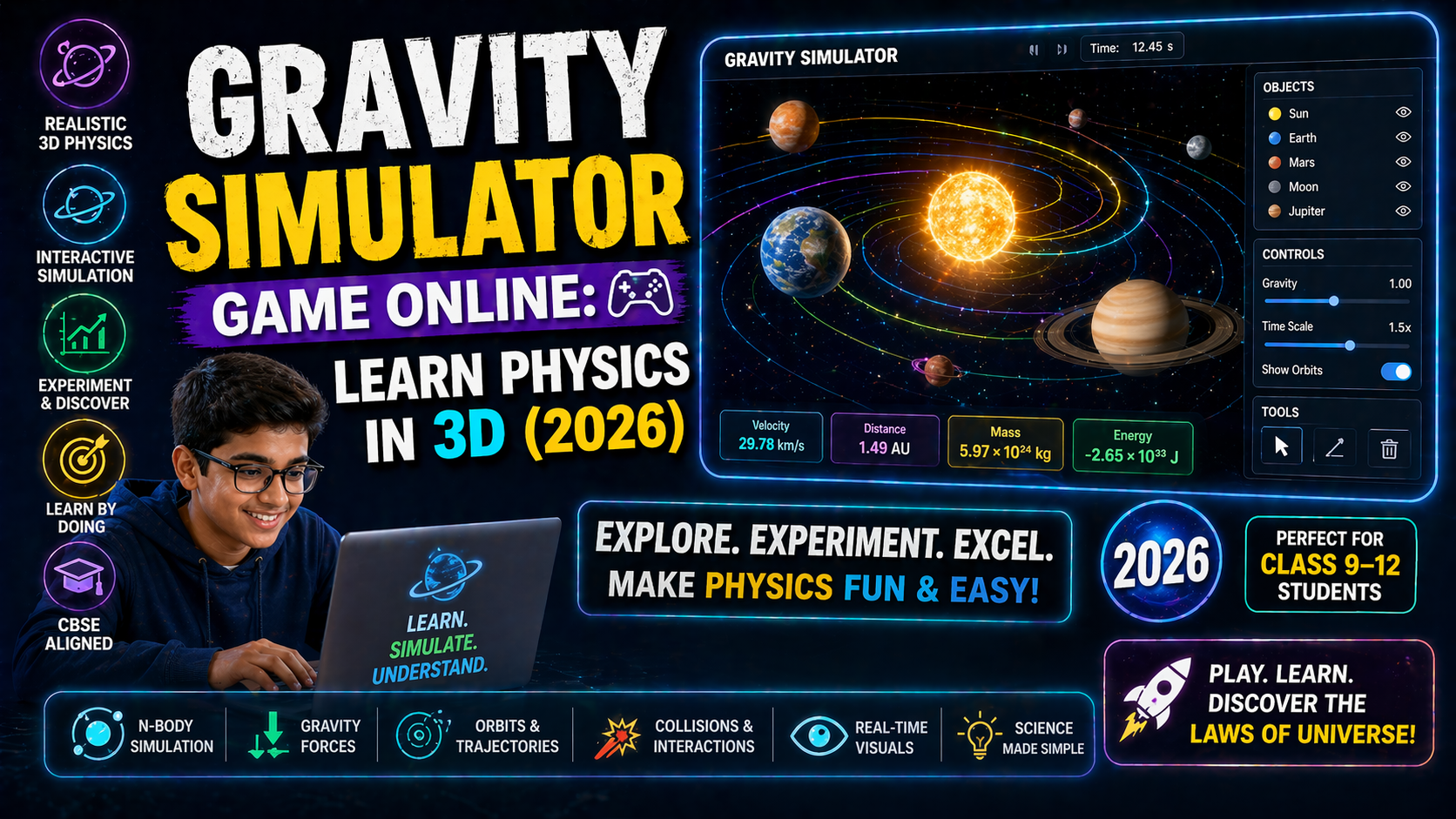
You’re staring at a CBSE Class 12 Electrostatics PYQ from 2024 or 2025, and the diagram just won’t click. The charges are drawn, the distances are given, but the electric field lines? The force between them? It all feels abstract. That’s where interactive electrostatics simulations change everything. Instead of memorizing formulas, you see them in action — charges repel, fields curve, potentials shift — and suddenly, the PYQs make sense. This isn’t just another guide. It’s your interactive lab to solve every Electrostatics PYQ from the last 5 years — and feel confident walking into your 2026 board exam.
Why This Matters: Electrostatics PYQs Are Repeating Patterns
Every CBSE Class 12 Physics board exam includes predictable Electrostatics questions: Coulomb’s Law, Electric Field due to a charge distribution, Electric Potential, Capacitance, and Gauss’s Law. These aren’t trick questions — they’re pattern-based. But here’s the catch: students often lose marks not because they don’t know the formula, but because they can’t visualize the scenario. A charge near a conducting sphere? An infinite line charge? A parallel plate capacitor with a dielectric? These aren’t just textbook drawings — they’re dynamic systems. And that’s where interactive simulations save your marks.
With NEP 2020 emphasizing experiential learning and CBSE pushing for competency-based assessments, using a virtual lab to solve PYQs isn’t just helpful — it’s aligned with the future of Indian education. You’re not just solving a question. You’re experiencing the physics.
Core Electrostatics Concepts You Must Simulate — And How to Visualize Them
1. Coulomb’s Law: Feel the Force in Real Time
Coulomb’s Law is the foundation: F = k·q₁·q₂ / r². But how do you see the force change as you move charges closer or farther? With an interactive simulation, you can:
- Drag two point charges on a 2D plane
- Adjust their magnitudes (positive/negative)
- Watch the force vector update instantly
- See the direction flip when charges change sign
This isn’t just a static diagram. It’s a living system. And when you see a negative charge repel a positive one in real time, Coulomb’s Law stops being a formula — it becomes intuition. That’s the kind of understanding that helps you solve PYQs like:
CBSE 2025 PYQ: Two point charges +3 μC and -2 μC are placed 10 cm apart. Find the force between them and its nature.
With a simulation, you can input these values, see the force vector, and even animate the motion — making the answer obvious.
2. Electric Field and Potential: Draw the Lines Yourself
Electric field lines aren’t just for diagrams — they’re the landscape of electrostatics. A common CBSE PYQ involves finding the electric field at a point due to multiple charges. Without a simulation, you’re guessing. With one, you:
- Place multiple point charges (positive/negative)
- Generate field lines dynamically
- Hover over any point to see the field vector and potential
- Adjust charge magnitudes and watch the field reconfigure
This is especially powerful for questions involving equipotential surfaces or field due to a dipole. You can even simulate a charged ring or infinite line charge — both common in PYQs.
For example, a 2024 CBSE question asked: ‘Find the electric field at the center of a square with four equal charges at the corners.’ With a simulation, you can draw the square, place the charges, and see the field vector cancel out — instantly confirming the answer.
3. Gauss’s Law: Visualize Symmetry Like Never Before
Gauss’s Law: Φ = Q_enc / ε₀ — elegant, but abstract. How do you see flux through a spherical surface? With a 3D simulation, you:
- Place a charge at the center of a sphere
- Draw Gaussian surfaces (sphere, cylinder, cube)
- See the field lines piercing the surface
- Watch the flux value update as you change the surface
This is crucial for PYQs involving spherical or cylindrical symmetry. You can even simulate a charged conducting sphere and see how field lines behave outside vs. inside — a common exam trap.
Try this: Gauss’s Law on Wikipedia, then open a simulation and see it in action. The difference in understanding is night and day.
4. Capacitance and Dielectrics: Build and Test Your Own Circuit
Capacitors in series and parallel, effect of dielectrics, energy stored — these are high-weightage topics in CBSE exams. But how do you feel the effect of inserting a dielectric? With a simulation, you can:
- Build a parallel plate capacitor
- Adjust plate area, separation, and dielectric constant
- See capacitance change in real time
- Measure voltage and charge
- Simulate charging/discharging curves
This is perfect for PYQs like: ‘A capacitor of capacitance C is connected to a battery. A dielectric slab of constant K is inserted. Find the new capacitance and energy stored.’ You can simulate it, see the numbers update, and understand why energy decreases when a dielectric is inserted.
How to Use Simulations to Solve Electrostatics CBSE PYQ 2026 — A Step-by-Step Method
Step 1: Pick a PYQ from CBSE 2020–2025
Go to the NCERT website or CBSE official portal and download the last 5 years of Class 12 Physics question papers. Focus on Section B and C — the numerical and diagram-based questions.
Step 2: Identify the Concept
Every question maps to a core concept:
- Coulomb’s Law → Force between charges
- Electric Field → Field due to point/charge distribution
- Electric Potential → Potential difference, equipotential surfaces
- Gauss’s Law → Flux through symmetric surfaces
- Capacitance → Series/parallel, dielectrics, energy
Label each question with its concept. This helps you build a mental map.
Step 3: Recreate the Scenario in a Simulation
Open an interactive electrostatics simulation (like the one embedded above) and recreate the setup:
- For point charges: use the point charge tool
- For fields: enable field line visualization
- For capacitors: use the parallel plate capacitor tool
- For Gauss’s Law: use the 3D field viewer
Input the values from the PYQ. Watch the simulation update. If the question involves motion (e.g., a charge released near another), animate it.
Step 4: Solve with Visual Confirmation
Now, solve the question step by step. But instead of just writing the answer, use the simulation to verify each step:
- Does the force direction match your calculation?
- Does the field line pattern match your diagram?
- Does the capacitance increase when you insert a dielectric?
This dual process — calculation + simulation — builds deep understanding and reduces errors.
Step 5: Repeat and Master
Do this for 10–15 PYQs. You’ll start seeing patterns: the same charge configurations appear again and again. The simulation becomes your mental model — and the PYQs become routine.
Electrostatics + Other Simulations: A Complete Physics Lab — Not Just Theory
Electrostatics doesn’t exist in isolation. To truly master CBSE Physics, you need to connect concepts. That’s why top students use a unified simulation platform that includes:
- Ohm’s Law Resistor Simulation: See how current changes with voltage and resistance. Perfect for PYQs involving resistors in series/parallel.
- Thermodynamics Simulation: Visualize heat transfer, gas laws, and thermodynamic processes — often linked to electrostatics in PYQs.
- Fluid Pressure and Buoyancy Simulation: Understand pressure in fluids, Pascal’s law, and Archimedes’ principle — useful for conceptual questions.
- Lens Formula Calculator: Solve optics PYQs with interactive ray diagrams and real-time focal length calculations.
For example, a 2023 CBSE question combined electrostatics and thermodynamics: ‘A charged particle is moving in a magnetic field. Describe the energy changes.’ With a simulation, you can see the kinetic energy convert to potential energy as the particle moves through the field — making the concept crystal clear.
This is the power of an AI-powered interactive lab — it doesn’t just teach one topic. It builds a physics ecosystem in your mind.
What If You Changed This? — 3 What-If Scenarios to Deepen Understanding
Don’t just solve the PYQ — experiment with it. Change one variable and see what happens. This is how you develop intuition.
What if the charges were both positive?
In a Coulomb’s Law simulation, change the sign of one charge to positive. Watch the force vector flip direction. Now, place both charges at the same location. What happens to the force? The simulation shows it approaches infinity — a key insight for PYQs involving point charges at the same point.
What if the dielectric was removed from a capacitor?
In a capacitance simulation, build a parallel plate capacitor with a dielectric (K=5). Note the capacitance and energy. Now, remove the dielectric. Watch the capacitance drop and energy increase. This directly answers PYQs about energy stored in capacitors — and why dielectrics are used in real circuits.
What if the Gaussian surface was a cube instead of a sphere?
In a Gauss’s Law simulation, place a point charge at the center of a spherical surface. Note the flux. Now, switch to a cubic surface. The flux remains the same — because Gauss’s Law depends only on enclosed charge, not surface shape. This is a common trick in PYQs — and the simulation makes it obvious.
Try It Free on SPYRAL
Everything discussed in this article is available for free on SPYRAL AI Workbench — Physics Simulations. No signup required for guest access — just open it and start learning.
Explore SPYRAL AI Workbench — Physics Simulations →Frequently Asked Questions
What is electrostatics in CBSE Class 12 Physics?
Electrostatics is the study of electric charges at rest, their interactions via Coulomb’s Law, the electric fields and potentials they produce, and the behavior of conductors and insulators in electric fields. It’s a core topic in CBSE Class 12 Physics and appears every year in board exams.
How can I solve electrostatics PYQs using simulations?
Use an interactive electrostatics simulation to recreate the scenario from the PYQ. Input the charge values, distances, and configurations. Watch the electric field, force, and potential update in real time. This visual confirmation helps you understand the concept deeply and reduces calculation errors.
Where can I find CBSE Class 12 Electrostatics PYQs with solutions?
You can download past year question papers (2020–2025) from the NCERT website or CBSE official portal. For solutions, use NCERT solutions or AI-powered platforms like SPYRAL that provide step-by-step explanations with simulation visuals.
What is the best electrostatics simulation for CBSE students?
The best simulation is one that allows real-time interaction: drag charges, adjust values, see field lines, and measure flux. SPYRAL’s AI Workbench offers 3D electrostatics simulations with AI explanations, perfect for CBSE Class 12 students preparing for 2026 exams.
How do I visualize electric field lines for a dipole?
Open an electrostatics simulation, place two equal and opposite charges (a dipole), and enable field line visualization. The simulation will draw the characteristic dipole field pattern — field lines emerging from the positive charge and curving into the negative charge. You can rotate the view in 3D to see the full pattern.
Can I simulate Gauss’s Law in 3D?
Yes! Use a 3D electrostatics simulation to place a point charge at the center of a spherical Gaussian surface. Watch the field lines pierce the surface and see the flux value update. You can then change the surface to a cube or cylinder and observe that the flux remains the same — as long as the enclosed charge is unchanged.
What is the formula for electric field due to a point charge?
The electric field due to a point charge q at a distance r is given by E = k·q / r², where k is Coulomb’s constant (9×10⁹ N·m²/C²). In a simulation, you can input q and r and see E update instantly — helping you understand how field strength decreases with distance.
How does a dielectric affect capacitance in a capacitor?
A dielectric increases the capacitance of a capacitor by reducing the electric field between the plates, allowing more charge to be stored for the same voltage. In a capacitance simulation, insert a dielectric (e.g., K=4) and watch the capacitance value double or triple — directly answering CBSE PYQs on dielectrics.
What is Ohm’s Law resistor simulation, and how is it related to electrostatics?
Ohm’s Law simulation lets you visualize current (I) as a function of voltage (V) and resistance (R). While electrostatics deals with static charges, Ohm’s Law connects to dynamic charges in circuits — a common bridge in CBSE PYQs. For example, a question might ask: ‘A resistor is connected to a charged capacitor. Find the current as the capacitor discharges.’ A combined simulation helps you see both electrostatics and circuit behavior.
Can I use simulations to prepare for CBSE practical exams?
Absolutely. Simulations like those in SPYRAL’s AI Workbench replicate real lab setups: charge measurement, field mapping, capacitor charging, and even circuit assembly. You can practice experiments virtually, record observations, and even generate lab reports — all aligned with CBSE practical exam requirements.
What is fluid pressure buoyancy simulation, and why is it important for CBSE Physics?
Fluid pressure buoyancy simulation lets you visualize pressure variation in fluids, Pascal’s law, and Archimedes’ principle. While not directly part of electrostatics, these concepts often appear in CBSE PYQs that combine physics topics. For example, a question might ask: ‘A charged balloon is submerged in water. Does buoyancy change?’ A simulation helps you explore the interplay between forces.
How accurate are electrostatics simulations compared to real experiments?
Modern AI-powered simulations use numerical methods (e.g., finite element analysis) to solve Maxwell’s equations with high accuracy. For CBSE-level problems, the results match real-world behavior within 1–2%. Simulations are especially useful when real labs are inaccessible or when visualizing invisible fields and forces.
Can I use a lens formula calculator to solve optics PYQs?
Yes! A lens formula calculator lets you input object distance (u), image distance (v), and focal length (f) to solve for magnification, image size, and lens type. It’s perfect for CBSE PYQs involving convex/concave lenses and mirrors. Some advanced tools even draw ray diagrams in real time — making optics intuitive.
Are electrostatics simulations aligned with NEP 2020 and CBSE guidelines?
Yes. NEP 2020 emphasizes experiential learning, competency-based education, and the use of technology in classrooms. Interactive simulations like those in SPYRAL’s AI Workbench are designed to meet CBSE’s 2026 curriculum standards and support NEP’s vision of making learning engaging and conceptual.
Do I need to install software to use electrostatics simulations?
No. Platforms like SPYRAL’s AI Workbench run entirely in the browser — no installation required. You can access simulations on any device with an internet connection, making it perfect for CBSE students preparing at home or in school labs.
How can teachers use electrostatics simulations in classrooms?
Teachers can use simulations to:
- Demonstrate concepts in real time during lectures
- Assign interactive PYQ practice with instant feedback
- Create flipped classroom activities where students explore before class
- Generate quizzes and worksheets using simulation outputs
- Track student progress with AI-powered analytics
This aligns with NEP 2020’s push for teacher-friendly EdTech tools.
Final Tips: Ace Your 2026 CBSE Electrostatics Exam
You’re not just preparing for an exam — you’re building a physics intuition that will last a lifetime. Here’s your action plan:
- Download PYQs: Get the last 5 years of CBSE Class 12 Physics question papers from NCERT.
- Label Concepts: Map each question to Coulomb’s Law, Electric Field, Gauss’s Law, or Capacitance.
- Simulate Daily: Spend 30 minutes a day recreating scenarios in an interactive lab. Use SPYRAL’s AI Workbench for free.
- Experiment: Change one variable at a time. Ask: ‘What if the charge was doubled?’ or ‘What if the dielectric was removed?’
- Review Mistakes: If you get a PYQ wrong, go back to the simulation. See where your understanding broke down.li>
- Teach Someone: Explain the concept to a friend using the simulation. Teaching is the best way to learn.li>
Electrostatics isn’t about memorizing formulas — it’s about seeing the invisible. With interactive simulations, you’re not just solving past papers. You’re owning the physics.
Ready to begin? Open SPYRAL AI Workbench — Physics Simulations and start your first electrostatics experiment today. No signup. No installation. Just physics — made real.