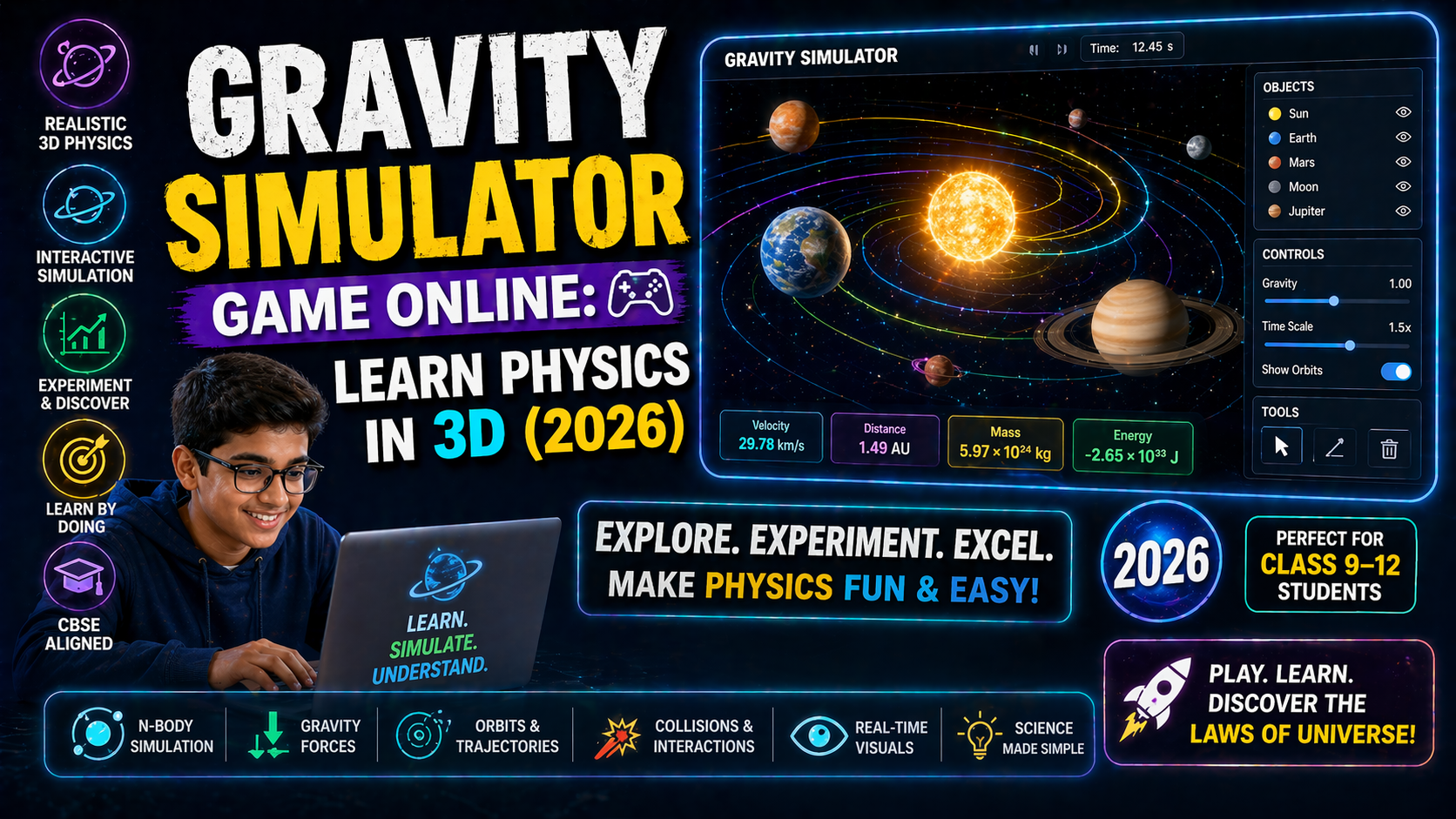
Simulations for CBSE are changing how students in India learn physics. Instead of memorizing formulas or watching static diagrams, you can now see forces in action, manipulate circuits, and explore waves and optics in real time. These aren’t just animations — they’re interactive virtual labs where you change variables, run experiments, and get instant AI explanations. Whether you're preparing for board exams, JEE, or NEET, these simulations align with the CBSE curriculum and NEP 2020, making complex concepts intuitive and engaging.
Imagine learning about Ohm’s Law by adjusting resistor values and watching current change instantly. Or exploring wave interference by tweaking frequency and amplitude to see how crests and troughs collide. With AI-powered simulations, every experiment comes with step-by-step guidance, error correction, and even quiz questions to test your understanding. And the best part? You don’t need a physical lab — just a browser and curiosity.
Why This Matters for CBSE Students and Teachers
In India’s evolving education landscape, the National Education Policy (NEP) 2020 emphasizes experiential learning and digital integration. Traditional physics labs are limited by time, space, and resources. But with virtual labs and simulations for CBSE, every student can conduct experiments safely, repeat them as needed, and visualize abstract concepts like never before. Teachers can use these tools to demonstrate difficult topics, assign interactive homework, and track student progress automatically.
For students preparing for Class 10, 11, or 12 board exams, these simulations are a game-changer. They cover key CBSE topics like Newton’s Laws, Electrostatics, Optics, and Fluid Dynamics — all mapped to the NCERT syllabus. And with AI explanations after every experiment, you’re not just seeing results — you’re understanding why they happen.
Waves and Optics Simulations: See Light and Sound Come Alive
One of the most challenging topics in CBSE physics is waves and optics. How do light rays bend? Why do colors appear? How does interference create patterns? These questions become crystal clear with interactive simulations. You can adjust the wavelength, frequency, and amplitude of a wave and watch how it reflects, refracts, or interferes with another wave.
What You Can Do in a Waves and Optics Simulation
- Refraction and Lenses: Drag a light ray through a convex or concave lens and see how it converges or diverges. Change the focal length and observe the image formation — real, virtual, inverted, or magnified.
- Interference Patterns: Simulate double-slit experiments. Adjust the slit separation and wavelength to see how the interference pattern changes. Perfect for understanding Young’s Double Slit Experiment.
- Polarization: Rotate a polarizing filter and watch how light intensity changes. Visualize why sunglasses reduce glare.
- Doppler Effect: Move a sound source and hear the pitch change. See the wavefronts compress or expand in real time.
These simulations are not just visual — they’re auditory too. Hear the Doppler shift as a siren passes by, or feel the resonance of a vibrating string. It’s physics you can see, hear, and touch — even if you’re not in a lab.
How It Helps in CBSE Exams
In CBSE Class 12 Physics, wave optics is a high-weightage topic. Simulations help you master ray diagrams, lens formulas, and interference patterns with confidence. You’ll be able to:
- Predict image positions using the lens formula: 1/f = 1/v – 1/u
- Explain why the sky is blue using Rayleigh scattering simulations
- Solve numerical problems on diffraction gratings with real-time feedback
Teachers can use these simulations to create interactive lessons where students predict outcomes before running the experiment, fostering critical thinking and inquiry-based learning.
Electrostatics Simulation: Charge, Fields, and Forces in 3D
Electrostatics is another tough nut to crack — invisible forces, field lines, and potential differences. But with a 3D electrostatics simulation, you can place charges, draw electric field lines, and measure forces between them. It’s like having a virtual Van de Graaff generator on your screen.
Key Features of an Electrostatics Simulation
- Charge Placement: Add positive or negative charges and watch the electric field lines form around them. See how field lines behave near conductors and insulators.
- Coulomb’s Law in Action: Drag two charges and see the force between them change. The simulation calculates the force using F = kq1q2/r² and displays it in real time.
- Equipotential Surfaces: Draw lines of equal potential and see how they relate to electric field lines. Perfect for understanding electric potential and potential difference.
- Capacitor Charging: Simulate a parallel plate capacitor. Adjust the plate separation and dielectric material to see how capacitance changes.
These simulations are ideal for CBSE Class 12 Physics, where electrostatics is a core topic. You’ll be able to visualize concepts like electric flux, Gauss’s Law, and capacitance — all mapped to the NCERT syllabus and NEP 2020 guidelines.
Why Visual Learning Beats Textbooks
Many students struggle with electrostatics because they can’t “see” the invisible. But with a simulation, you can:
- Zoom into a region and see the direction and magnitude of the electric field
- Observe how a charge moves in an electric field — like a tiny electron in a CRT
- Test different charge configurations and predict field patterns
This hands-on approach builds intuition and reduces exam anxiety. You’ll walk into your board exams knowing exactly what to expect.
Ohm’s Law Resistor Simulation: Build and Test Circuits Instantly
Ohm’s Law is the foundation of electronics: V = IR. But understanding it isn’t just about plugging numbers into a formula. It’s about seeing how current changes when you vary voltage or resistance. With an Ohm’s Law resistor simulation, you can build a circuit in seconds, adjust the resistor value, and watch the current flow change in real time.
What You Can Do in a Resistor Simulation
- Adjust Voltage and Resistance: Increase the voltage and watch the current rise. Increase the resistance and see the current drop. The simulation updates the values instantly.
- Series and Parallel Circuits: Build a circuit with multiple resistors. See how total resistance changes in series (R_total = R1 + R2) and parallel (1/R_total = 1/R1 + 1/R2).
- Power Dissipation: Measure how much power is dissipated in a resistor using P = I²R. See why resistors get hot.
- Kirchhoff’s Laws: Simulate a complex circuit and apply Kirchhoff’s Voltage and Current Laws to find unknown currents and voltages.
These simulations are perfect for CBSE Class 10 Science and Class 12 Physics. They align with the NCERT curriculum and help students prepare for practical exams and competitive tests like JEE and NEET.
Real-World Applications
Understanding Ohm’s Law isn’t just for exams. It’s the basis for designing circuits in phones, laptops, and even electric vehicles. With a simulation, you can:
- Design a voltage divider to power an LED
- Troubleshoot a circuit by measuring current and voltage drops
- Predict how changing a resistor affects brightness in a bulb
It’s like having a virtual breadboard where you can experiment without burning components.
Fluid Pressure and Buoyancy Simulation: Float, Sink, or Swim
Fluid pressure and buoyancy are central to understanding why ships float and why balloons rise. But how do you visualize pressure at different depths or the buoyant force on an object? With a fluid pressure and buoyancy simulation, you can submerge objects in water, change their density, and watch them sink or float. You can even see the pressure gradient in a fluid column.
Key Experiments You Can Run
- Pressure vs Depth: Place a pressure sensor at different depths in a fluid and watch the pressure increase linearly with depth. See how it depends on fluid density.
- Buoyant Force: Submerge a block in water and see the buoyant force push it upward. Adjust the block’s volume and density to see how the force changes.
- Archimedes’ Principle: Measure the weight of an object in air and water. The difference is the buoyant force — exactly equal to the weight of the displaced fluid.
- Floating Conditions: Change the density of an object and see when it floats or sinks. Understand why a steel ship floats but a steel block sinks.
These simulations are ideal for CBSE Class 9 Science and Class 10 Physics. They help students grasp concepts like Pascal’s Law, Bernoulli’s Principle, and Archimedes’ Principle — all mapped to the NCERT syllabus.
Why It’s Better Than a Real Lab
In a real lab, measuring pressure at different depths is tricky. But in a simulation, you can:
- Instantly change fluid type (water, oil, mercury)
- See pressure values in real time
- Repeat experiments with different shapes and sizes
- Get AI feedback on your observations
It’s safe, repeatable, and accessible — perfect for students in remote areas or schools with limited lab resources.
What If You Changed This? 3 Interactive Scenarios to Try
Now it’s your turn. Don’t just watch — experiment. Here are three “what-if” scenarios to try in your simulations:
1. What if you double the resistance in a circuit?
In your Ohm’s Law resistor simulation, set the voltage to 10V and the resistance to 5Ω. Note the current. Now double the resistance to 10Ω. What happens to the current? According to Ohm’s Law, I = V/R, so the current should halve. But does the simulation confirm this? Try it and see.
This isn’t just a thought experiment — it’s how real circuits behave. Understanding this helps you design safe circuits and avoid overloading components.
2. What if you increase the wavelength of light in a double-slit experiment?
In your waves and optics simulation, set up a double-slit experiment with a screen. Use red light (long wavelength) and blue light (short wavelength). What do you observe on the screen? The fringe width increases with wavelength. Now increase the wavelength further — what happens to the pattern?
This is how scientists study the wave nature of light. It’s also the principle behind spectroscopy and holography.
3. What if you place a charged particle in a non-uniform electric field?
In your electrostatics simulation, place a positive charge near a negatively charged plate. Watch how it accelerates toward the plate. Now move the charge to a region with a weaker field. What changes? The force decreases, and the acceleration slows down.
This is how cathode ray tubes and particle accelerators work. It’s also the basis for inkjet printers and photocopiers.
These scenarios aren’t just fun — they’re the kind of questions you’ll encounter in JEE Main, NEET, and CBSE board exams. The more you experiment, the more confident you’ll become.
Try It Free on SPYRAL
Everything discussed in this article is available for free on SPYRAL AI Workbench — Physics Simulations. No signup required for guest access — just open it and start learning.
Explore SPYRAL AI Workbench — Physics Simulations →Frequently Asked Questions
What are simulations for CBSE and how do they help in 2026?
Simulations for CBSE are interactive virtual labs that let students conduct physics experiments online. They bring concepts like waves, optics, electrostatics, and Ohm’s Law to life with real-time visuals and AI explanations. In 2026, these tools are essential for NEP 2020-aligned learning, helping students prepare for board exams, JEE, and NEET with hands-on practice.
Are there free virtual labs for NEP 2020 that work for CBSE students?
Yes! Platforms like SPYRAL AI Workbench offer free virtual labs for NEP 2020 that are fully mapped to the CBSE syllabus. These labs include AI-powered explanations, quiz questions, and progress tracking — all without any cost.
Can I run a waves and optics simulation for CBSE Class 12 online?
Absolutely. You can run a waves and optics simulation directly in your browser on platforms like SPYRAL. These simulations let you adjust wavelength, frequency, and lens types to see refraction, interference, and polarization in real time — perfect for mastering CBSE Class 12 Physics.
How does an electrostatics simulation help me understand CBSE Class 12 Physics?
An electrostatics simulation lets you place charges, draw electric field lines, and measure forces between them. It visualizes concepts like Coulomb’s Law, electric flux, and Gauss’s Law — all core topics in CBSE Class 12 Physics. With real-time feedback and AI explanations, you’ll understand why field lines behave the way they do.
Is there an Ohm’s Law resistor simulation for CBSE Class 10 students?
Yes! You can find free Ohm’s Law resistor simulations online that let you build circuits, adjust voltage and resistance, and see current change instantly. These simulations are perfect for CBSE Class 10 Science and help students prepare for practical exams and board tests.
Where can I find a fluid pressure and buoyancy simulation for CBSE Class 9?
You can run a fluid pressure and buoyancy simulation on platforms like SPYRAL AI Workbench. These simulations let you submerge objects, change fluid density, and observe buoyant forces — all mapped to the CBSE Class 9 Science syllabus. It’s a safe, interactive way to learn Archimedes’ Principle and Pascal’s Law.
Do CBSE physics simulations include AI explanations after each experiment?
Yes! The best simulations for CBSE include AI-powered explanations after every experiment. These explanations break down the science, correct mistakes, and provide quiz questions to test your understanding. It’s like having a personal tutor guiding you through each lab.
Are these simulations aligned with the NCERT syllabus for CBSE?
Yes. High-quality CBSE physics simulations are mapped to the NCERT syllabus for Classes 9–12. They cover all key topics, including waves, optics, electrostatics, Ohm’s Law, and fluid dynamics — ensuring you’re learning exactly what’s required for exams.
Can teachers use these simulations to track student progress?
Yes! Platforms like SPYRAL offer a teacher dashboard where educators can assign simulations, track student progress, and generate quizzes. This makes it easy to integrate virtual labs for NEP 2020 into daily teaching and homework.
Do I need to install anything to run these CBSE physics simulations?
No installation is needed. All simulations for CBSE run in your web browser — no downloads, no plugins. Just open the link, start experimenting, and learn in real time.
Are there simulations for CBSE that work on mobile devices?
Yes! Most modern physics simulations for CBSE are designed to work on both desktop and mobile devices. You can run experiments on your phone or tablet — perfect for learning on the go.
How do these simulations compare to PhET or OLabs for CBSE students?
While PhET and OLabs are great, AI-powered simulations for CBSE go further by offering real-time AI explanations, curriculum mapping, and teacher dashboards. They’re designed specifically for Indian students, with content aligned to CBSE and NEP 2020 — making them a better fit for exam preparation.
Can I use these simulations to prepare for JEE or NEET in 2026?
Absolutely. The simulations for CBSE cover advanced topics like wave optics, electrostatics, and fluid dynamics — all relevant for JEE and NEET. With AI explanations and quiz questions, they’re a powerful tool for competitive exam prep.
Ready to See Physics in Action?
If you’ve ever felt frustrated by static textbook diagrams or limited lab access, simulations for CBSE are your solution. They bring physics to life, align with your syllabus, and prepare you for exams with confidence. Whether you're a student in Delhi, Mumbai, or a remote village, you now have access to a world-class virtual lab — for free.
Start with a topic you’re struggling with: waves and optics, electrostatics, Ohm’s Law, or fluid pressure. Run the simulation, tweak the variables, and watch science unfold before your eyes. And with AI by your side, you’ll never feel stuck.
Physics isn’t just about formulas — it’s about seeing, feeling, and understanding. With the right tools, you can master it all.
So go ahead — simulate it.