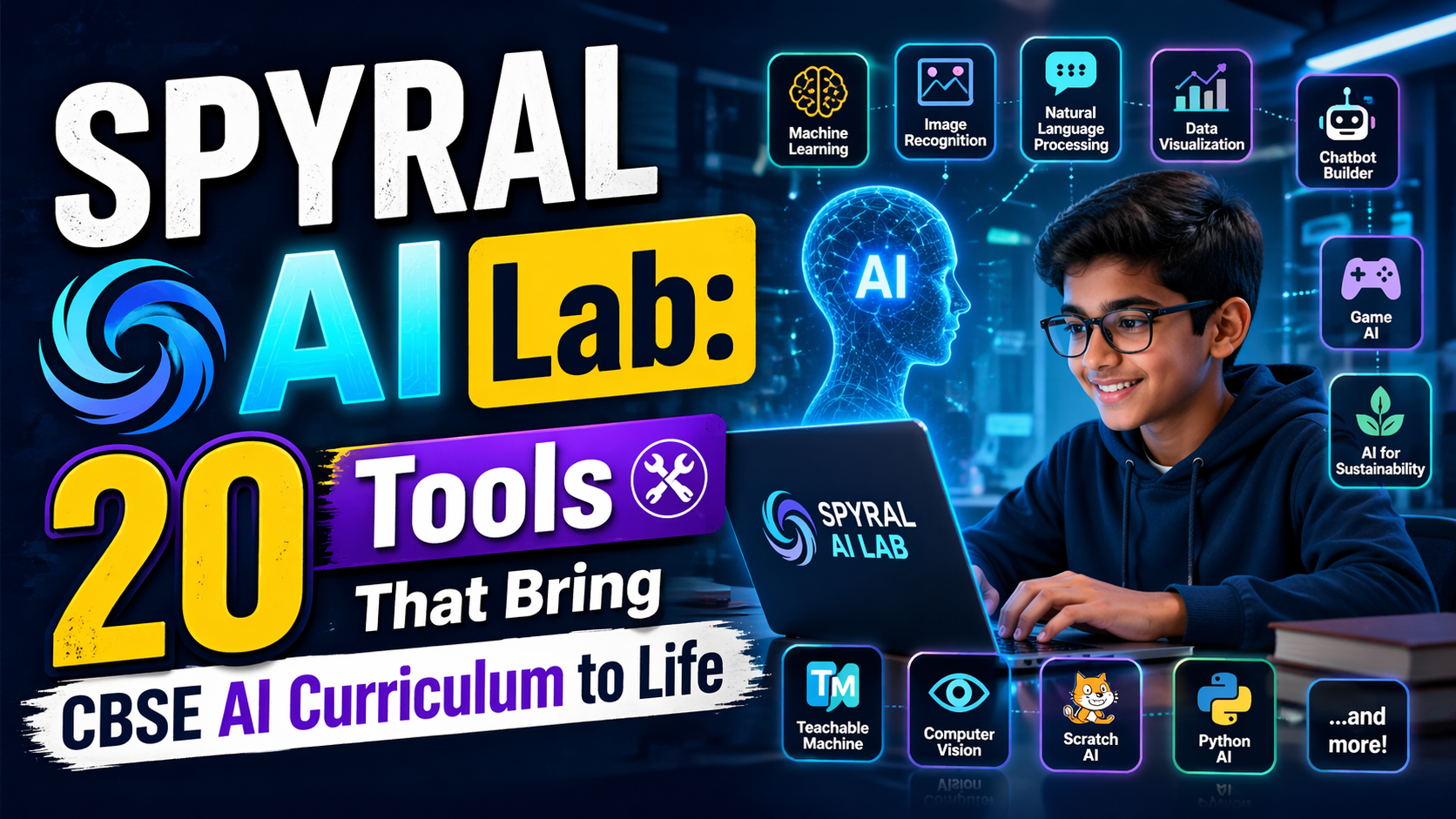
If you're a Class 10 student in India following the CBSE AI curriculum in 2026, you’re not just learning about artificial intelligence — you’re experiencing it. Forget static textbooks and one-way videos. The new AI curriculum is interactive, visual, and hands-on, thanks to AI-powered simulations and coding environments that let you build, test, and see AI in action.
That frustration you feel when reading about neural networks or decision trees without really understanding them? It ends here. With platforms like anAIza School by SPYRAL, every AI concept in your Class 10 syllabus becomes a living experiment. You don’t just read — you simulate, tweak, and discover. And the best part? You can do it all online, for free, without needing advanced hardware.
Why This Matters: AI Isn’t Just a Subject — It’s a Way of Thinking
In 2026, AI isn’t just another chapter in your science book. It’s a core life skill — like learning to read or do math. The CBSE AI curriculum for Class 10 is designed to prepare students for a world where AI touches everything from healthcare to entertainment. But traditional teaching often leaves students confused: How does a machine learn? What’s the difference between supervised and unsupervised learning?
That’s where interactive AI simulations come in. Instead of memorizing definitions, you see the algorithm in action. You adjust parameters, run experiments, and watch how changing one variable affects the whole system. It’s like having a mini AI lab on your laptop — and it’s transforming how students in India learn AI.
According to the Ministry of Education, Government of India, integrating AI into school curricula aligns with the goals of NEP 2020: fostering creativity, critical thinking, and computational literacy. And with AI expected to contribute $967 billion to India’s economy by 2035 (PIB, 2025), early exposure isn’t just smart — it’s essential.
What’s New in the CBSE AI Curriculum for Class 10 (2026)?
The 2026 CBSE AI syllabus for Class 10 is built around four core themes:
- Introduction to AI: What is AI? Types of AI, real-world applications
- AI Project Cycle: Problem identification, data collection, model training, evaluation
- AI Ethics and Safety: Bias, privacy, responsible AI use
- Hands-on AI Tools: Using AI platforms to build simple models
But here’s the game-changer: every concept is paired with an interactive simulation. You don’t just learn about decision trees — you build one. You don’t just read about chatbots — you train a simple one. And you do it all in a browser, with AI explanations guiding you at every step.
This approach isn’t just for students. Teachers in India are using these tools to make AI lessons engaging, inclusive, and curriculum-aligned. Whether you're in Delhi, Mumbai, or a small town in Kerala, AI labs are now accessible — no lab coats or microscopes required.
How Interactive Simulations Make AI Click
Imagine learning about neural networks without ever seeing how neurons connect. Or understanding supervised learning without training a model yourself. That’s where traditional teaching falls short.
With AI-powered simulations, you get to:
- Visualize AI models in real time — see how weights change in a neural net or how data splits in a decision tree.
- Experiment safely — try different algorithms, tweak hyperparameters, and see results instantly.
- Get AI explanations — after every simulation, the platform explains what happened and why, in simple language.
- Build projects — from chatbots to recommendation systems — using drag-and-drop or code.
This isn’t just edutainment. It’s active learning, proven to improve retention and understanding. Research from the National Center for Biotechnology Information (NCBI) shows that students using interactive simulations score up to 30% higher on conceptual tests than those using traditional methods.
AI Ethics: The Missing Piece in Most AI Courses
One of the most important additions to the 2026 CBSE AI curriculum is a strong focus on AI ethics. Students aren’t just taught to build AI — they’re taught to build it responsibly.
Through interactive scenarios, students explore:
- How bias can creep into AI models (e.g., facial recognition failing on darker skin tones)
- Why privacy matters when training AI on personal data
- How to ensure transparency in AI decision-making
These aren’t abstract concepts. They’re brought to life with simulations where students can introduce bias into a model and see the real-world impact — then fix it. It’s ethics made tangible, not theoretical.
Teacher-Friendly AI Tools: No PhD Required
Teachers in India often struggle to teach AI due to lack of resources or training. But with platforms like anAIza School’s Teacher Dashboard, anyone can teach AI effectively.
Features include:
- Curriculum mapping to CBSE, ICSE, and state boards
- Pre-built lesson plans with simulations and quizzes
- Progress tracking for each student
- AI-generated quizzes based on student performance
Teachers can assign simulations, monitor results, and even generate custom worksheets — all in one place. No extra software, no steep learning curve. Just open a browser and start teaching.
AI Lab for Schools in India: What Does It Look Like in 2026?
An AI lab in 2026 isn’t a room full of robots and screens. It’s a digital ecosystem where students and teachers collaborate in real time. Here’s what it includes:
1. Interactive AI Simulations (No Installation Needed)
Students access simulations directly from their browsers. No downloads. No logins (for guest access). Just click and explore.
For example, in the Neural Network Visualizer, students can:
- Draw their own neural network architecture
- Adjust learning rates and epochs
- See how the network learns to classify handwritten digits
- Get an AI-generated explanation of each step
This turns abstract math into something you can see and feel — exactly what the CBSE AI curriculum aims for.
2. No-Code AI Builders for Beginners
Not every student wants to write code. That’s why platforms now offer no-code AI builders where students can:
- Train a simple chatbot using drag-and-drop
- Build a recommendation system for movies or books
- Create a sentiment analyzer for social media posts
These tools use pre-trained models and visual interfaces, making AI accessible to all — even those with no coding background.
3. Coding Classes for Kids India Online: Learn Python with AI
For students ready to dive deeper, coding classes for kids in India online now include AI-focused Python labs. Students learn to:
- Write a basic chatbot using Python and AI libraries
- Train a decision tree on real datasets
- Use APIs to integrate AI into their own projects
These aren’t dry coding drills. They’re project-based, tied to real-world problems like predicting exam scores or analyzing weather data.
4. Data Science for School Students India: From Data to Insights
Data science isn’t just for college students anymore. In Class 10, students learn to:
- Collect and clean small datasets
- Use AI tools to visualize trends
- Build simple predictive models
For example, students can analyze CBSE exam data to predict trends or use weather data to forecast temperatures. It’s math made meaningful — and it’s part of the 2026 AI curriculum.
5. AI Ethics Simulator: Learn Responsible AI by Doing
One of the most powerful tools in the AI lab is the AI Ethics Simulator. Students are given scenarios like:
- A school wants to use AI to predict student performance. What biases could affect the results?
- A company uses AI to screen job applicants. How can we make it fair?
Students run simulations, tweak parameters, and see the impact of their choices. They’re not just learning ethics — they’re practicing responsible AI.
Best AI Learning Platform for Class 9 to 12: What to Look For
Not all AI learning platforms are created equal. When choosing one for your Class 10 AI curriculum, look for these features:
✅ Curriculum-Aligned Content
The platform should map directly to the CBSE AI syllabus 2026, including AI ethics, project cycles, and hands-on labs. Avoid generic “AI for kids” tools — look for ones designed for Indian schools.
✅ Interactive Simulations Over Videos
Videos are passive. Simulations are active. The best platforms let you change variables and see results in real time. For example, in a decision tree simulator, you should be able to adjust the splitting criteria and watch the tree rebuild instantly.
✅ AI Explanations After Every Simulation
After you run a simulation, the platform should explain what happened and why, in simple language. This turns every experiment into a mini-lesson.
✅ Teacher Tools and Progress Tracking
Teachers need to assign simulations, track student progress, and generate reports. A good platform includes a teacher dashboard with these features.
✅ Free or Low-Cost Access
AI education shouldn’t be a luxury. Look for platforms that offer free guest access or low-cost school licenses. anAIza School, for example, offers free interactive simulations with no signup required for basic access.
✅ Support for Multiple Languages
In India, students learn in Hindi, English, Tamil, Telugu, and more. A good AI platform should support localized content and interfaces to make learning accessible to all.
Try This Simulation Free
Open the interactive simulation on anAIza School — no download, no signup needed.
Open Simulation →Change the variables yourself — see what happens in real time.