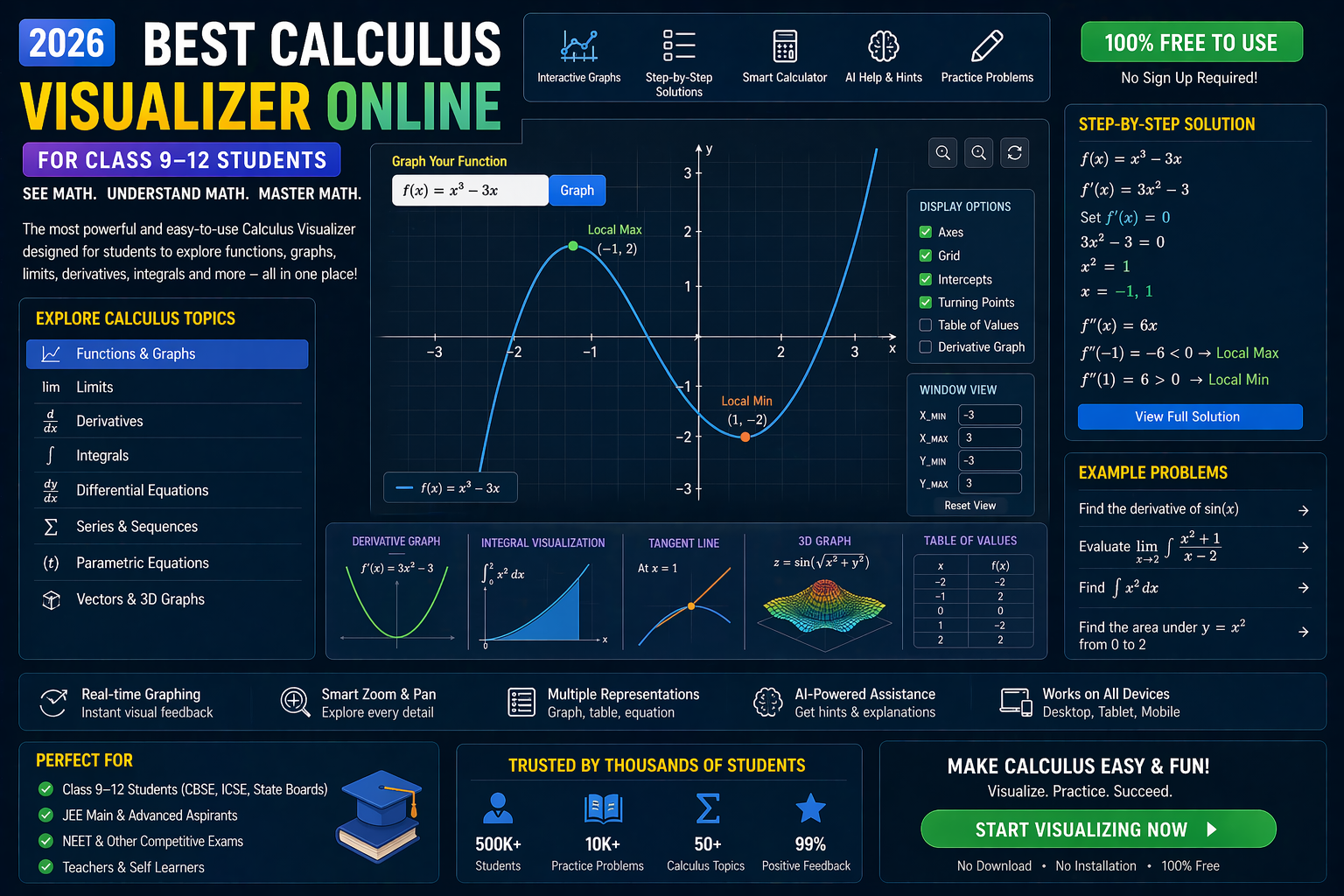
You just opened your Class 10 CBSE math textbook, stared at a page full of functions, limits, and derivatives, and thought: ‘How am I supposed to understand this?’ You’re not alone. Calculus feels abstract because it’s about change — and textbooks freeze that change in static diagrams. But in 2026, you can see calculus move. You can drag a point on a curve and watch the slope of the tangent change. You can adjust a slider and see the area under a curve grow. That’s what AI-powered simulations do — they turn confusing symbols into living, breathing math.
Why This Matters: Calculus Isn’t Just for Exams
Calculus isn’t just a chapter in your NCERT book — it’s the language of change. It helps us model how fast a virus spreads, how a rocket accelerates, or how a population grows. In Class 10 CBSE, you’re laying the foundation for JEE, NEET, and real-world problem-solving. But to master it, you need to feel it — not just memorize formulas. AI simulations let you experiment: What happens if the rate doubles? What if the curve flips? You’ll discover calculus by doing, not just reading.
What You’ll Actually Learn in Class 10 CBSE Calculus (2026)
According to the latest NCERT and CBSE curriculum, Class 10 introduces the basics of calculus through intuitive ideas:
- Introduction to Calculus: Understanding change — how one quantity varies with another.
- Limits (Intuitive Idea): What happens as a variable approaches a value — like a car slowing down to a stop.
- Derivatives (Rate of Change): How fast something is changing — like the speed of a falling object.
- Applications: Using calculus to find maxima/minima — like maximizing area with a fixed perimeter.
But here’s the catch: these concepts are often taught with graphs on paper. You can’t see the limit approaching, or feel the derivative changing. That’s where interactive simulations change everything.
See Limits Come Alive
Imagine a curve approaching a point. On paper, it’s a dotted line. In a simulation, you can zoom in, move a point closer and closer, and watch the function values get nearer to a target. You’re not just told the limit exists — you see it happen. This is how calculus becomes intuitive.
Watch Derivatives in Motion
Derivatives represent the slope of a curve at any point. In a textbook, you see a static tangent line. In an AI simulation, you can:
- Drag a point along a parabola.
- See the tangent line tilt and rotate in real time.
- Read the slope value instantly — positive, negative, zero.
You’ll understand why a curve increases or decreases just by watching the slope. No more guessing.
Discover Areas Under Curves (Integrals)
Integrals let you find the area under a curve — like the total distance traveled by a car whose speed changes over time. In a simulation, you can:
- Draw a curve (e.g., a velocity-time graph).
- Use a slider to increase the number of rectangles under the curve.
- Watch the sum of areas get closer to the true area — the integral.
You’ll see why more rectangles give a better approximation. This is the essence of integration — made visual.
SIM EMBED SECTION
Try This Simulation Free
Open the interactive simulation on anAIza School — no download, no signup needed.
Open Simulation →Change the variables yourself — see what happens in real time.