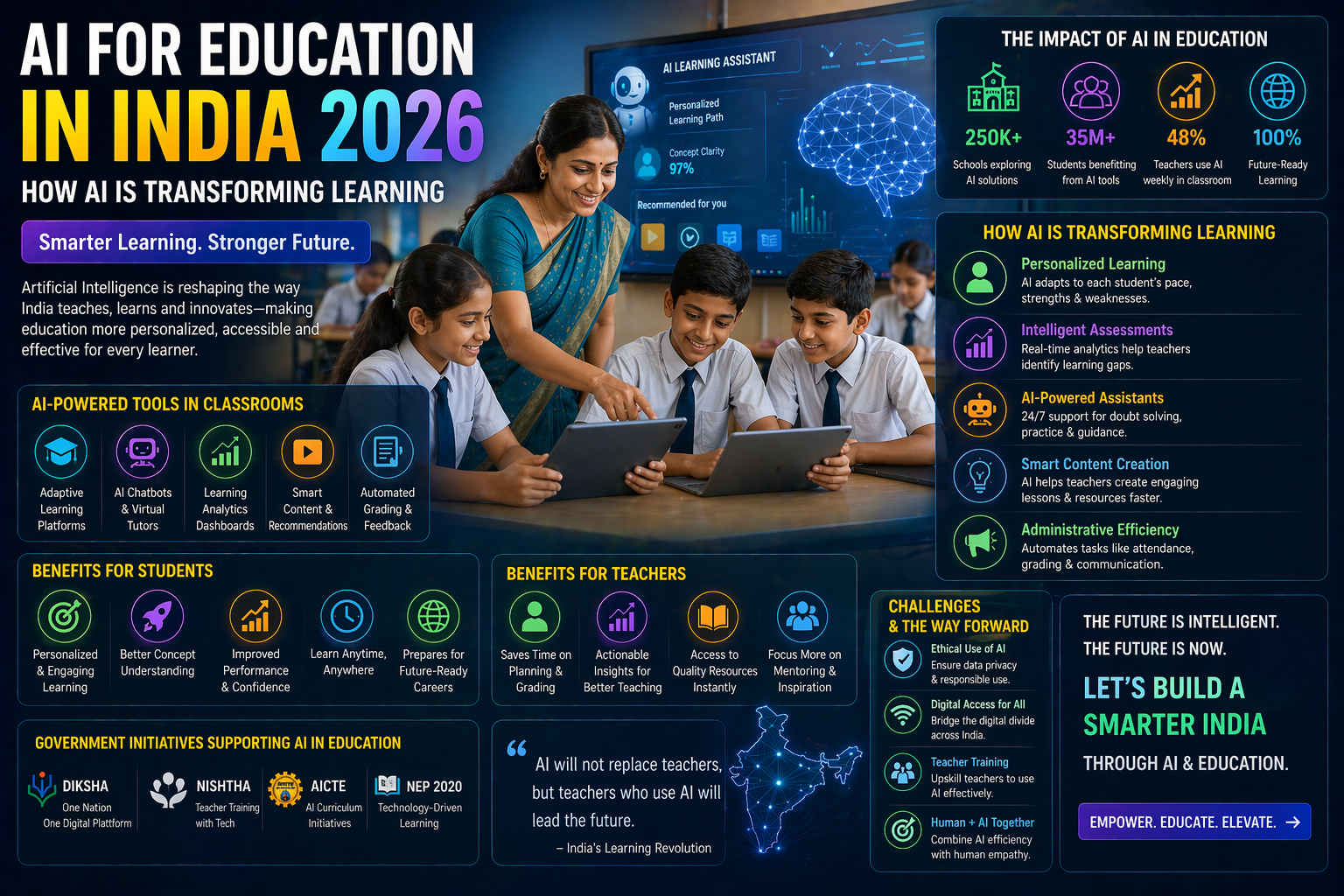
Artificial Intelligence (AI) is no longer a futuristic concept—it’s a present-day reality reshaping education in India. By 2026, AI labs in schools are becoming as essential as science labs, empowering students with critical thinking, problem-solving, and future-ready skills. Whether you're a school administrator, teacher, or parent, setting up an AI lab for your school can unlock new learning opportunities and prepare students for the digital age.
In this guide, we’ll walk you through the AI lab setup for schools in India in 2026, covering everything from hardware and software requirements to curriculum alignment and free tools. Let’s dive in.
Why Schools in India Need an AI Lab in 2026
The National Education Policy (NEP) 2020 emphasizes experiential learning, multidisciplinary education, and the integration of technology in classrooms. AI labs align perfectly with these goals by:
- Enhancing STEM Learning: AI labs make abstract concepts tangible through hands-on projects in robotics, machine learning, and data science.
- Future-Proofing Students: By 2026, AI skills will be in high demand across industries. Early exposure gives students a competitive edge.
- Supporting CBSE Curriculum: CBSE has introduced Artificial Intelligence as a subject for Class 9 and offers it as an elective in higher grades. An AI lab ensures seamless integration with the syllabus.
- Encouraging Creativity: AI labs foster innovation, allowing students to build projects like chatbots, smart assistants, and automated systems.
According to a 2025 report by the Ministry of Education, schools with dedicated AI labs saw a 30% improvement in student engagement and a 25% increase in STEM-related career aspirations.
Key Components of an AI Lab Setup for Schools
Setting up an AI lab doesn’t require a massive budget or advanced infrastructure. Here’s a breakdown of the essential components:
1. Hardware Requirements
An AI lab can start small and scale up. Here’s a basic hardware setup for 2026:
- Computers/Laptops: At least 1 computer per 2 students (minimum 8GB RAM, 512GB SSD, and a dedicated GPU for AI/ML tasks).
- Microcontrollers & Development Boards:
- Raspberry Pi 5: Affordable and versatile for IoT and AI projects.
- Arduino Uno/Nano: Ideal for robotics and automation.
- ESP32: For wireless projects and edge AI applications.
- Sensors & Actuators: Temperature, humidity, motion sensors, and servo motors for hands-on projects.
- Robotics Kits: LEGO Mindstorms, Makeblock, or DIY robotics kits for building AI-powered robots.
- 3D Printer: Optional but useful for prototyping AI-driven models and custom parts.
- VR/AR Headsets: For immersive AI learning experiences (e.g., virtual labs, AI simulations).
2. Software & Platforms
AI labs thrive on the right software. Here are the top tools for 2026:
- AI Education Platforms:
- SPYRAL AI Workbench: A free, no-signup-required platform for AI/ML projects, aligned with CBSE AI curriculum.
- Google’s Teachable Machine: For quick AI model training (image, sound, pose recognition).
- Scratch with AI Extensions: For younger students to learn AI concepts visually.
- Programming Tools:
- Python: The most popular language for AI/ML (Jupyter Notebooks, Google Colab).
- Scikit-learn, TensorFlow, PyTorch: Libraries for machine learning projects.
- Blockly-based Tools: For beginners (e.g., MIT App Inventor for AI app development).
- Simulation Software:
- Tinkercad Circuits: For virtual circuit design and AI-powered simulations.
- Unity ML-Agents: For game-based AI learning.
3. Curriculum & Lesson Plans
An AI lab is only as effective as its curriculum. Here’s how to align it with Indian education standards:
- CBSE AI Syllabus (Class 9-12):
- Class 9: Introduction to AI, ethics, and simple AI projects.
- Class 10: Python basics, data handling, and AI applications.
- Class 11-12: Machine learning, neural networks, and AI project development.
- NEP 2020-Aligned Projects:
- AI for Social Good (e.g., waste management, healthcare diagnostics).
- Smart Agriculture (e.g., AI-powered soil monitoring).
- AI in Daily Life (e.g., chatbots for school assistance).
- Project-Based Learning: Encourage students to work on real-world problems like traffic management, pollution control, or personalized learning tools.
For ready-to-use lesson plans, check out SPYRAL’s NEP-aligned resources.
Step-by-Step Guide to Setting Up an AI Lab in Your School
Follow these steps to create a functional AI lab in your school by 2026:
Step 1: Assess Your Needs & Budget
Start with a pilot lab for 10-20 students and scale up. Budget considerations:
- Low Budget (₹50,000 - ₹1,00,000): Raspberry Pi kits, basic sensors, free software (Python, Teachable Machine).
- Mid Budget (₹1,00,000 - ₹3,00,000): Add laptops, robotics kits, and VR headsets.
- High Budget (₹3,00,000+): Dedicated AI workstations, 3D printers, and advanced AI platforms.
Step 2: Choose a Location
Select a well-ventilated, spacious room with:
- Ample power outlets and charging stations.
- Whiteboard/projector for demonstrations.
- Storage for equipment and student projects.
Step 3: Install Hardware & Software
Set up computers, development boards, and install necessary software. Ensure all systems are updated and secured with antivirus software.
Step 4: Train Teachers
Teachers don’t need to be AI experts, but they should understand:
- Basic AI concepts (machine learning, neural networks).
- How to use AI tools (Python, Teachable Machine, SPYRAL Workbench).
- Project-based learning strategies.
SPYRAL offers free teacher training modules to help educators get started. Explore here.
Step 5: Develop a Curriculum
Start with introductory AI projects and gradually move to advanced topics. Use a mix of:
- Online courses (Coursera, edX, NPTEL).
- School-specific projects (e.g., AI-powered attendance system).
- Competitions (e.g., hackathons, robotics challenges).
Step 6: Monitor & Improve
Track student progress and gather feedback. Adjust the curriculum and resources based on what works best.
Free AI Lab Tools for Schools in India (2026)
You don’t need a big budget to start an AI lab. Here are free tools and platforms to get you started:
- SPYRAL AI Workbench: Free AI/ML projects for students, no signup required. Perfect for CBSE AI classes.
- Google’s AI Experiments: Fun, interactive AI projects for kids.
- Scratch 3.0 with AI Blocks: Teach AI concepts through block-based coding.
- Kaggle for Students: Access free datasets and AI competitions.
- Tinkercad Circuits: Simulate AI-powered circuits and robotics projects.
For a complete list of free tools, visit SPYRAL’s Free Tools Hub.
Try It Free on SPYRAL
Everything discussed in this article is available for free on SPYRAL AI Workbench. No signup required for guest access — just open it and start learning.
Explore SPYRAL AI Workbench →Challenges & Solutions for AI Lab Setup in Schools
While setting up an AI lab is exciting, schools may face challenges. Here’s how to overcome them:
Challenge 1: Lack of Technical Expertise
Solution: Start with beginner-friendly tools like Scratch or SPYRAL AI Workbench. Use online tutorials and teacher training programs. Collaborate with local colleges or tech companies for mentorship.
Challenge 2: High Cost of Equipment
Solution: Begin with low-cost options like Raspberry Pi and open-source software. Apply for government grants (e.g., Atal Innovation Mission, NITI Aayog) or corporate CSR funds.
Challenge 3: Keeping Students Engaged
Solution: Focus on project-based learning. Let students work on problems they care about (e.g., school sustainability, local community issues). Organize hackathons and exhibitions to showcase their work.
Challenge 4: Maintenance & Upgrades
Solution: Assign a dedicated teacher or student club to manage the lab. Use cloud-based tools to reduce hardware dependency. Plan a yearly budget for upgrades and new equipment.
Success Stories: AI Labs in Indian Schools (2026)
Many schools across India have already transformed their classrooms with AI labs. Here are a few inspiring examples:
1. Kendriya Vidyalaya, Delhi
KV Delhi integrated an AI lab in 2024 and saw a 40% increase in student participation in STEM activities. Students developed projects like an AI-powered plant health monitor and a chatbot for school queries. The lab is now a model for other KVs in the region.
2. DAV Public School, Chennai
DAV Chennai’s AI lab, set up in 2025, focuses on social impact projects. Students created an AI model to predict water scarcity in their locality and won a national innovation award. The school now offers AI as an elective for Classes 11-12.
3. Government School, Jaipur
A government school in Jaipur, with support from a CSR initiative, set up a low-cost AI lab using Raspberry Pi and free software. Students from rural backgrounds are now building AI projects and aspiring for tech careers.
Future of AI Labs in Indian Schools
The AI lab landscape in Indian schools is evolving rapidly. Here’s what to expect by 2026 and beyond:
1. AI-Powered Personalized Learning
AI labs will move beyond robotics to personalized learning platforms that adapt to each student’s pace and style. Tools like SPYRAL’s AI Workbench will offer real-time feedback and customized project suggestions.
2. Integration with NEP 2020
The NEP 2020 emphasizes multidisciplinary learning. AI labs will bridge subjects like mathematics, science, and social studies through project-based activities (e.g., AI in climate change, AI in history).
3. Expansion to Tier 2 & Tier 3 Cities
With the rise of affordable AI tools and government initiatives, AI labs will become common in schools beyond metro cities. Initiatives like DIKSHA AI and Atal Tinkering Labs are already making this possible.
4. AI Competitions & Olympiads
National-level AI competitions (e.g., India AI Olympiad) will encourage more schools to invest in AI labs. These platforms provide students with exposure to real-world AI challenges.
FAQs About AI Lab Setup for Schools
1. What is the minimum budget required to set up an AI lab in a school in 2026?
A basic AI lab for 10-20 students can start with a budget of ₹50,000 - ₹1,00,000. This includes Raspberry Pi kits, basic sensors, and free software. Mid-range labs (₹1,00,000 - ₹3,00,000) can add laptops, robotics kits, and VR headsets.
2. Do teachers need to be AI experts to run an AI lab?
No! Teachers only need a basic understanding of AI concepts and tools. Platforms like SPYRAL AI Workbench are designed for beginners. Free teacher training programs are also available online.
3. How can an AI lab align with the CBSE AI syllabus for Class 9?
CBSE’s AI syllabus for Class 9 covers introduction to AI, ethics, and simple projects. An AI lab can support this through:
- Hands-on projects using Scratch or Python.
- Ethics discussions on AI bias, privacy, and job displacement.
- Use of free tools like Google’s Teachable Machine for quick AI model training.
For a step-by-step guide, refer to SPYRAL’s CBSE AI Resources.
4. Are there government schemes to fund AI labs in schools?
Yes! Schools can apply for grants under:
- Atal Innovation Mission (AIM): Up to ₹10 lakh for setting up Atal Tinkering Labs (ATLs).
- Samagra Shiksha Abhiyan: Funding for digital infrastructure in government schools.
- CSR Initiatives: Companies like TCS, Infosys, and Google offer grants for AI education.
5. How can students without coding experience benefit from an AI lab?
AI labs are designed for all skill levels. Beginners can start with:
- Block-based coding: Scratch with AI extensions or MIT App Inventor.
- No-code AI tools: Google’s Teachable Machine or SPYRAL’s drag-and-drop AI projects.
- Robotics kits: LEGO Mindstorms or Makeblock for hands-on learning without deep coding.
These tools make AI accessible to every student, regardless of their technical background.
Setting up an AI lab in your school is a game-changer for students, teachers, and the community. By 2026, AI literacy will be as fundamental as reading and writing. Start small, leverage free tools, and watch your students innovate, create, and prepare for the future.
Ready to take the first step? Explore SPYRAL AI Workbench for free AI projects and resources tailored for Indian schools.