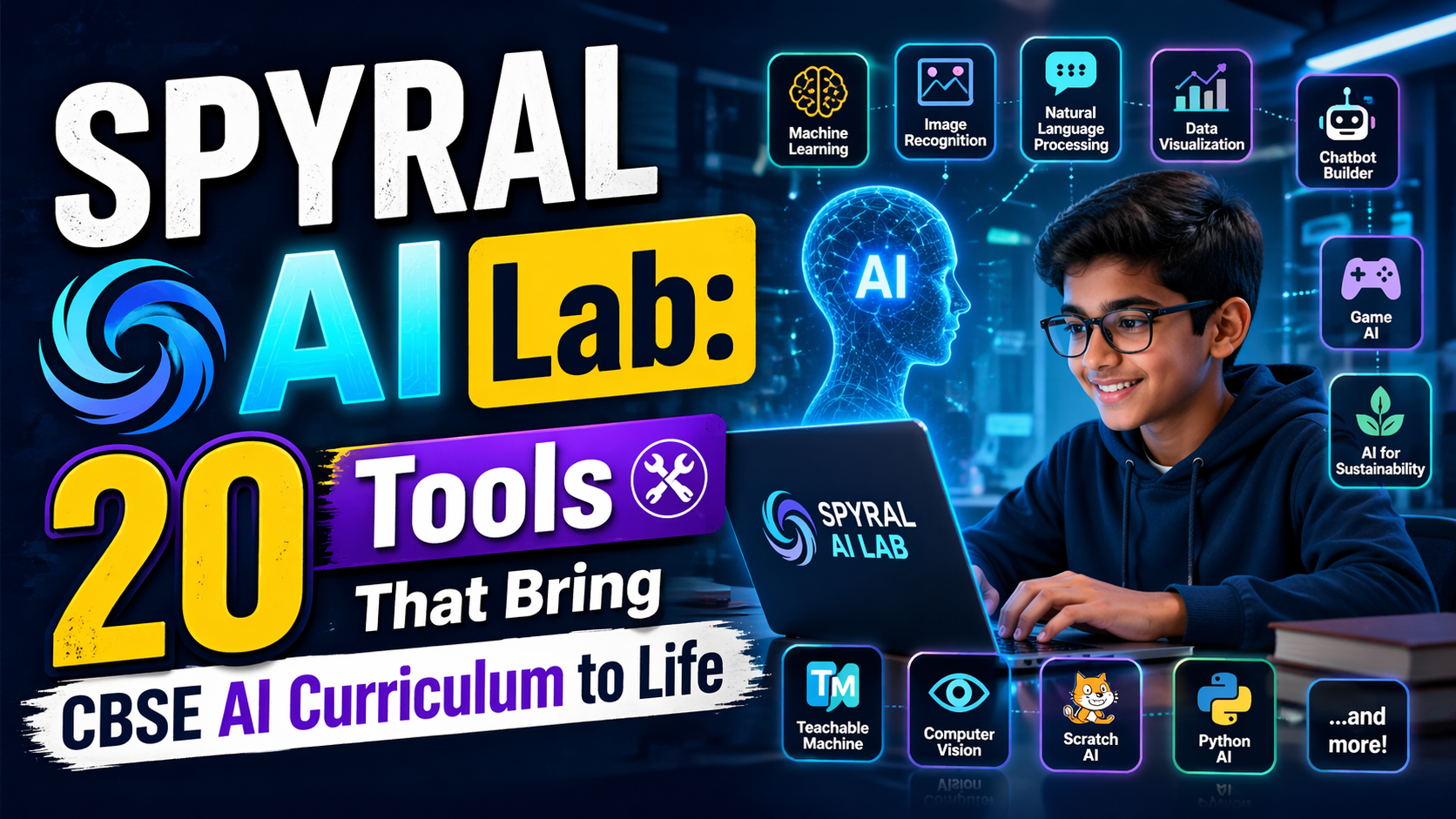
If your child is in Class 6, 7, or 8 in India and you’ve ever felt frustrated watching them struggle with abstract science or math concepts, you’re not alone. Many students find it hard to visualize forces, reactions, or equations — until they see them in action. That’s where AI-powered interactive simulations come in. In 2026, platforms like anAIza School by SPYRAL are transforming how students in India learn science and math — making every concept feel real, explorable, and fun.
Imagine your child adjusting the angle of a projectile and watching the path curve in real time, or tweaking the resistance in a circuit and seeing the current change instantly. These aren’t just animations — they’re AI-powered interactive labs that respond to student input, explain concepts in simple language, and adapt to different learning paces. Whether it’s CBSE, ICSE, or state boards, AI simulations are now aligning with the NCERT syllabus and NEP 2020’s emphasis on experiential learning. And the best part? Many of these tools are free, require no signup, and work on any device.
Why AI Simulations Are a Game-Changer for Indian Students in Grades 6–8
In India’s fast-evolving education landscape, AI is no longer just a buzzword — it’s a learning companion. The Ministry of Education has highlighted the need for digital-first classrooms, especially post-pandemic. But here’s the catch: traditional teaching often relies on static images or videos that don’t let students experiment. AI simulations change that by turning passive learning into active discovery.
For example, in Class 8 Science, students learn about friction. A textbook might explain it with a diagram, but an AI simulation lets them drag a block across different surfaces, change the weight, and see how friction changes in real time. They don’t just read about it — they feel it. This kind of hands-on learning is proven to improve retention and curiosity, especially in STEM subjects.
Moreover, AI-powered platforms now offer personalized feedback. If a student gets a concept wrong, the AI doesn’t just say “incorrect” — it explains the mistake in simple terms and offers a new simulation to try. This is especially helpful for students preparing for Olympiads or competitive exams like NTSE, where conceptual clarity is key.
And let’s not forget the cost factor. Many schools in India, especially in rural or semi-urban areas, lack well-equipped labs. AI simulations act as virtual labs — accessible anytime, anywhere, and at zero cost. This democratizes quality education, aligning perfectly with NEP 2020’s vision of inclusive and equitable learning.
How AI Makes Science and Math Feel Real — Not Just Theoretical
1\. Visualizing the Invisible: Forces, Energy, and Reactions
Science is full of invisible forces — gravity, magnetism, electric fields. How do you explain these to a 12-year-old? With AI simulations, you don’t have to. Students can:
- Drop objects in a gravity simulator and watch acceleration change based on mass and height.
- Build circuits using a drag-and-drop interface and see current flow in real time.
- Mix chemicals in a virtual lab and observe reactions like color change or gas formation.
These aren’t just pretty animations — they’re interactive models that respond to student input. For instance, in a magnetism simulation, students can move a magnet near a wire and see how it generates electricity, directly connecting theory to real-world applications like generators or motors.
Platforms like anAIza School’s Workbench include AI explanations after every simulation. So if a student is unsure why the current increased when they added more batteries, the AI breaks it down in simple language — no jargon, no confusion.
2\. Math That Moves: From Abstract to Interactive
Math in middle school can feel abstract — fractions, decimals, geometry. AI simulations turn these into visual, interactive experiences. For example:
- Fraction explorer: Drag slices of a pizza to see how 1/2 compares to 2/3.
- Geometry playground: Rotate 3D shapes to understand volume and surface area.
- Algebra visualizer: Adjust sliders to see how changing the slope affects a line on a graph.
These tools are especially helpful for students who struggle with traditional teaching methods. Visual learners, kinesthetic learners, and even auditory learners (who benefit from AI explanations) all find a way to connect with the material.
What’s more, many AI platforms now include curriculum mapping — they align simulations with CBSE, ICSE, and even international standards like Common Core or IB. So whether your child is preparing for a school exam or a competitive test, the simulations are relevant and up-to-date.
3\. Coding Meets Creativity: AI and Machine Learning for Kids
AI isn’t just for science — it’s also a gateway to coding. Platforms like anAIza School offer a machine learning playground for kids, where students can:
- Train simple AI models to recognize handwritten digits.
- Use drag-and-drop blocks to build logic circuits.
- Experiment with neural networks in a no-code environment.
This early exposure to AI and coding prepares students for the future. According to a 2026 report, over 60% of Indian tech jobs will require some level of AI or coding skills. Starting early with platforms designed for kids makes the transition smoother and more enjoyable.
And the best part? These tools are designed to be fun. Imagine a student building a virtual robot that sorts colored blocks using AI — they’re not just coding; they’re playing and learning at the same time.
4\. AI Tutors That Adapt to Your Child’s Learning Style
Every child learns differently. Some are visual learners, others learn by doing. AI-powered platforms use adaptive learning to tailor the experience to each student. For example:
- If a student struggles with a concept, the AI offers additional simulations or simpler examples.
- If a student excels, the AI challenges them with advanced scenarios or quizzes.
- The AI tracks progress and suggests areas for improvement, just like a personal tutor.
This personalized approach is a game-changer for students who feel left behind in traditional classrooms. It also reduces the pressure on parents to find extra tuition — the AI acts as a 24/7 tutor, available whenever the student needs it.
Try This Simulation Free
Open the interactive simulation on anAIza School — no download, no signup needed.
Open Simulation →Change the variables yourself — see what happens in real time.