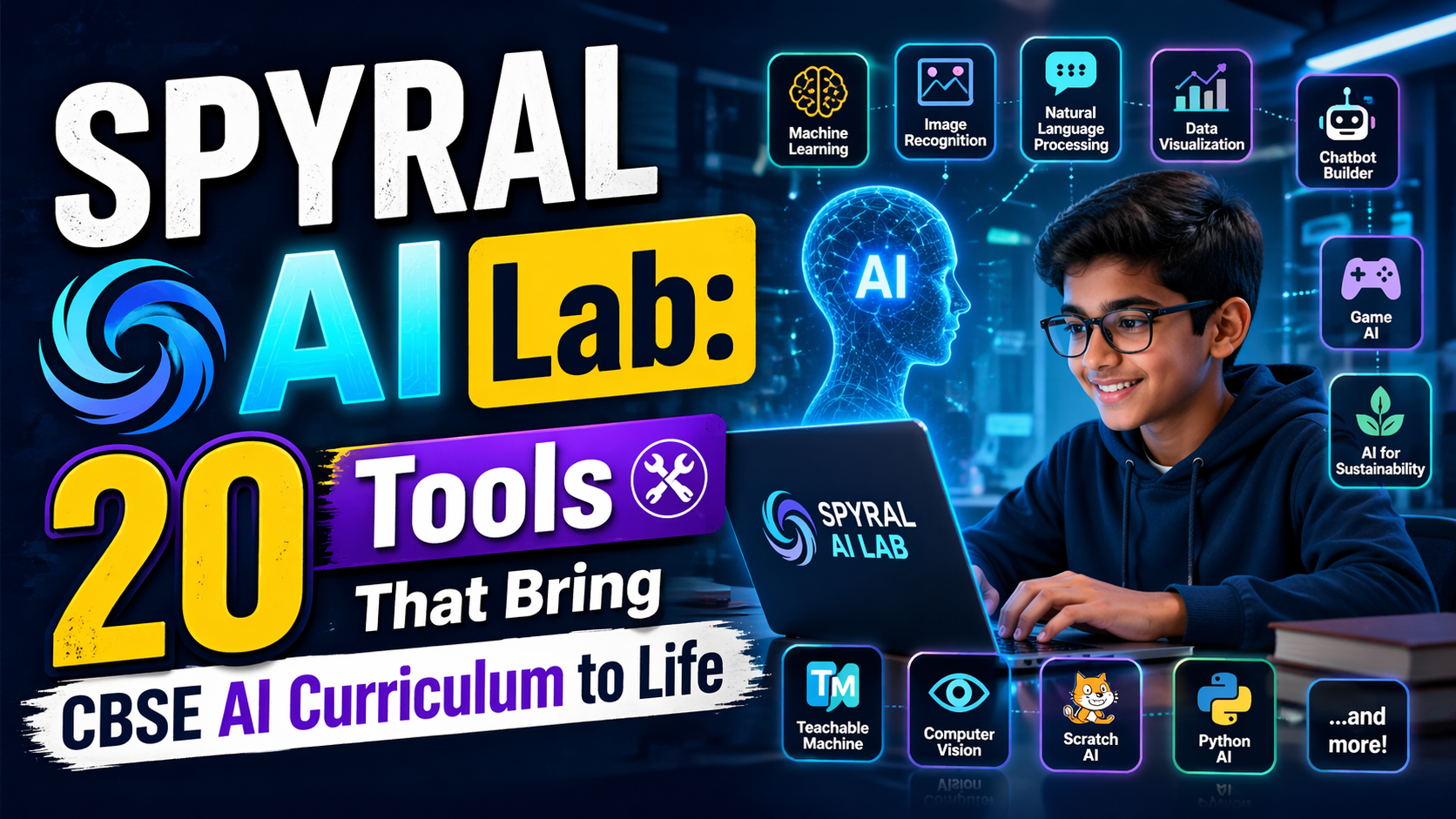
If you’re a student or teacher in India searching for a virtual lab for class 6 to 12 that actually works, you’ve likely tried OLabs — but found it limited in interactivity, explanations, and real-time feedback. In 2026, there’s a smarter, more engaging alternative: anAIza School by SPYRAL. This AI-powered platform delivers interactive science and math simulations that feel real, respond instantly, and adapt to your learning pace — making it the best OLabs alternative in India for CBSE, ICSE, and international curricula.
Whether you're exploring physics simulation for class 10 CBSE, dissecting a virtual frog in biology, or visualizing calculus concepts in real time, anAIza School turns passive learning into active discovery. No more static diagrams or pre-recorded videos — just hands-on, AI-guided experiments where you change variables, see results, and get instant explanations. Ready to feel science and math come alive? Let’s explore why this is the future of education in India.
Why This Matters: The Limits of OLabs and the Need for a Better Alternative
OLabs, developed by the Central Board of Secondary Education (CBSE) and Amrita Vishwa Vidyapeetham, was a groundbreaking initiative when launched. It provided digital access to lab experiments for students in remote areas, especially during the COVID-19 pandemic. But by 2026, many educators and students have outgrown its static, video-based format. Here’s what’s missing:
- No real interactivity: OLabs often presents experiments as pre-recorded videos or step-by-step PDFs — you watch, but you don’t do.
- No AI guidance: You complete the lab and move on. There’s no AI tutor to explain why a result happened or how to troubleshoot errors.
- Limited curriculum alignment: While OLabs covers core experiments, it doesn’t adapt to individual learning needs or offer interactive simulation for CBSE students across grades 6–12.
- No instant feedback: Students can’t experiment with “what if” scenarios — like changing the angle in a projectile motion or altering the focal length in a lens — and see the impact in real time.
This is where anAIza School steps in. Built as a modern virtual science lab India needs, it combines the accessibility of OLabs with the power of AI, interactivity, and real-time learning. It’s not just an alternative — it’s the next evolution of virtual labs in Indian education.
And with the National Education Policy (NEP) 2020 emphasizing experiential learning and digital integration, platforms like anAIza School are no longer optional — they’re essential.
What Makes anAIza School the Best OLabs Alternative in India in 2026?
1. AI-Powered Explanations After Every Simulation
Imagine completing a physics experiment on Ohm’s Law in a virtual physics lab class 12 India curriculum. In OLabs, you’d see the final graph and maybe a short note. But in anAIza School, after you run the simulation:
- The AI analyzes your inputs and results.
- It explains why the current increased when voltage rose — using Ohm’s Law and electron flow.
- It highlights common mistakes (e.g., incorrect resistor values).
- It suggests related experiments to deepen understanding.
This turns every lab into a personalized tutoring session. The AI doesn’t just grade — it teaches. That’s the power of an AI-powered virtual lab India offers.
2. Real-Time, Interactive Simulations You Control
OLabs simulations are often passive. You press play and watch. But in anAIza School’s interactive simulation for CBSE students:
- You adjust variables — like mass in a pendulum, resistance in a circuit, or pH in a titration.
- The simulation responds instantly. The pendulum swings faster. The bulb glows brighter. The graph updates in real time.
- You can pause, rewind, and repeat — just like a real lab.
This level of control is what makes it ideal for physics simulation for class 10 CBSE and higher grades. Students aren’t just observers — they’re scientists.
3. Curriculum-Aligned for CBSE, ICSE, and International Boards
Whether you're following the NCERT syllabus, ICSE curriculum, or preparing for JEE/NEET, anAIza School maps simulations to your board’s requirements. You’ll find:
- Physics: Mechanics, thermodynamics, optics, electromagnetism
- Chemistry: Titration, electrolysis, atomic structure, reaction kinetics
- Biology: Cell biology, photosynthesis, genetics, human anatomy
- Math: Calculus, geometry, vectors, statistics
Each simulation includes AI-generated notes, step-by-step guides, and quiz questions aligned with your exam pattern. It’s a virtual lab for class 6 to 12 that grows with you.
4. Teacher Dashboard with Progress Tracking and Quiz Generation
Teachers aren’t left behind. The teacher dashboard lets educators:
- Assign simulations based on topic or grade.
- Track student progress in real time.
- Generate quizzes automatically from simulation data.
- Export reports for parent-teacher meetings.
This makes anAIza School not just a virtual science lab India uses — it’s a complete classroom tool. No more manual grading or disconnected labs. Everything is integrated, data-driven, and aligned with NEP 2020’s vision of personalized learning.
5. “What-If” Inventor Mode: The Future of STEM Learning
This is where anAIza School outshines all competitors — including OLabs. In the Inventor Mode, students can:
- Modify parameters beyond the standard experiment.
- Design their own circuits, ecosystems, or projectile paths.
- See how changing gravity, friction, or mass affects outcomes.
- Save and share their custom simulations.
It’s not just a lab — it’s a sandbox for future engineers, physicists, and innovators. This feature alone makes it the top OLabs alternative in India for students aiming for STEM careers.
Virtual Physics Lab Class 12 India: See Forces, Waves & Energy in Action
One of the most powerful features of anAIza School is its virtual physics lab class 12 India simulations. These go far beyond textbook diagrams. Let’s take Newton’s Second Law as an example:
- You select a mass (e.g., 2 kg) and apply a force (e.g., 10 N).
- The AI calculates acceleration: a = F/m = 5 m/s².
- You run the simulation — the block moves across the screen.
- You add friction — the block slows down. You increase the force — it speeds up again.
- The AI explains: “Friction opposes motion. Net force = applied force – frictional force.”
This isn’t just visualization — it’s embodied cognition. You feel the physics. And with JEE/NEET around the corner, this kind of deep understanding is priceless.
Other key physics simulations include:
- Wave Interference: See light and sound waves collide, create patterns, and learn about superposition.
- Photoelectric Effect: Adjust frequency and intensity of light to see how electrons are emitted — and why Einstein’s explanation matters.
- Circuit Builder: Design series and parallel circuits, measure current and voltage, and troubleshoot open circuits.
- Projectile Motion: Launch a ball at different angles and speeds. Watch the trajectory change. Calculate range and maximum height.
Each simulation includes a sim-embed-block where you can try it yourself:
What If You Changed This? 3 Real Experiments You Can Re-run in Seconds
One of the biggest frustrations with traditional labs — even OLabs — is the lack of experimentation. You follow the steps, get the result, and that’s it. But in anAIza School, you’re encouraged to break the rules. Here are three “what-if” scenarios that turn passive learning into active discovery:
1. What If You Double the Mass in a Pendulum? (Physics → Simple Harmonic Motion)
In a standard pendulum lab, you measure the period for a 100g bob. But what happens if you double the mass to 200g?
In OLabs: You’d see the same period — but you wouldn’t understand why.
In anAIza School:
- You change the mass slider from 100g to 200g.
- The simulation runs — the pendulum swings slower.
- The AI explains: “Period depends on length and gravity, not mass. But increased mass increases inertia, making it feel slower.”
- You try a 500g bob — now it swings even slower. You see the relationship.
This is how deep learning happens.
2. What If You Add Salt to Pure Water in Electrolysis? (Chemistry → Conductivity)
In a standard electrolysis simulation, you split water into hydrogen and oxygen. But what if you add salt?
In OLabs: You’d see bubbles form faster — but no explanation of ions.
In anAIza School:
- You add NaCl to the water.
- The current increases dramatically.
- The AI shows a 3D model of Na⁺ and Cl⁻ ions moving toward electrodes.
- It explains: “Salt increases ion concentration, boosting conductivity.”
- You try adding sugar instead — no change. Why? Sugar doesn’t dissociate.
Now you understand electrolytes — not just memorize them.
3. What If You Remove CO₂ from Photosynthesis? (Biology → Plant Physiology)
In a standard photosynthesis lab, you see oxygen bubbles form. But what if CO₂ is absent?
In OLabs: You’d see no bubbles — but no deeper insight.
In anAIza School:
- You set CO₂ levels to zero.
- The plant stops producing oxygen.
- The AI overlays a chemical equation: 6CO₂ + 6H₂O → C₆H₁₂O₆ + 6O₂
- It highlights: “CO₂ is a reactant. Without it, photosynthesis halts.”
- You add CO₂ back — bubbles return. You see the cause and effect.
This is how interactive learning builds intuition.
Try It Free on SPYRAL
Everything discussed in this article is available for free on anAIza School — Free Interactive Simulations. No signup required for guest access — just open it and start learning.
Explore anAIza School — Free Interactive Simulations →Frequently Asked Questions
Is anAIza School really a free alternative to OLabs in India?
Yes! anAIza School offers a free tier with full access to interactive simulations, AI explanations, and basic teacher tools. No hidden fees, no forced upgrades. It’s designed to support Indian students and schools under NEP 2020 guidelines.
Can I use anAIza School for virtual lab for class 6 to 12?
Absolutely. The platform covers physics, chemistry, biology, and math simulations for grades 6 through 12, aligned with CBSE, ICSE, and international curricula like IB and AP.
How is anAIza School better than OLabs for physics simulation for class 10 CBSE?
OLabs shows pre-recorded experiments. anAIza School lets you run the experiment, change variables, and get AI explanations in real time. You’re not just watching — you’re doing science.
Does anAIza School provide AI explanations after every simulation?
Yes! After each simulation, the AI analyzes your inputs and results, then provides a step-by-step explanation, common mistakes, and related concepts — just like a personal tutor.
Is there a virtual science lab India that works on mobile?
Yes! anAIza School is fully responsive and works on phones, tablets, and desktops. No downloads needed — just open your browser and start experimenting.
Yes. Teachers can assign simulations, track student progress, generate quizzes, and export reports from the teacher dashboard.
Can students design their own experiments in anAIza School?
Yes! The “Inventor Mode” lets students modify parameters, create custom setups, and save their simulations — ideal for science fairs and project-based learning.
Is anAIza School aligned with NEP 2020?
Yes. It supports experiential learning, interdisciplinary projects, and personalized pathways — all key goals of NEP 2020. It’s designed to complement classroom teaching, not replace it.
Do I need to install anything to use anAIza School?
No. It runs in your browser. Just visit tryspyral.com/school and start simulating.
Can I use anAIza School for JEE/NEET preparation?
Yes. The physics and chemistry simulations cover advanced topics like projectile motion, lens formulas, and electrochemistry — all crucial for competitive exams.
Is anAIza School available in Hindi and other Indian languages?
Currently, the interface and AI explanations are in English. However, the platform supports multilingual content, and Hindi and other language support is in development for 2026.
How does anAIza School compare to PhET simulations?
PhET offers great simulations, but lacks AI explanations, curriculum mapping, and “what-if” inventiveness. anAIza School goes further by adding AI tutoring, teacher tools, and real-time feedback — making it a true interactive simulation for CBSE students.
Can schools integrate anAIza School with their LMS like Google Classroom?
Yes. anAIza School supports single sign-on (SSO) and can be embedded in most LMS platforms. Teachers can share simulation links directly with students.
From OLabs to AI Labs: The Future of Science Education in India
OLabs was a revolutionary step in democratizing lab access for Indian students. But in 2026, education demands more than access — it demands engagement, personalization, and understanding. That’s what anAIza School delivers.
Whether you're a student preparing for board exams, a teacher looking for better tools, or a parent wanting to supplement learning at home, this platform offers a virtual lab for class 6 to 12 that actually works. It’s not just an alternative to OLabs — it’s the next step forward.
And with AI-powered explanations, real-time interactivity, and a growing library of simulations, it’s the closest thing to a real lab you can get — without the Bunsen burner.
Ready to experience the future of science and math learning? Start your first simulation today — no signup required.